


























Views
Downloads

Printable Fish Life Cycle Worksheet | Grade 6 Science
Paste this activity's link or code into your existing LMS (Google Classroom, Canvas, Teams, Schoology, Moodle, etc.).
Students can open and work on the activity right away, with no student login required.
You'll still be able to track student progress and results from your teacher account.
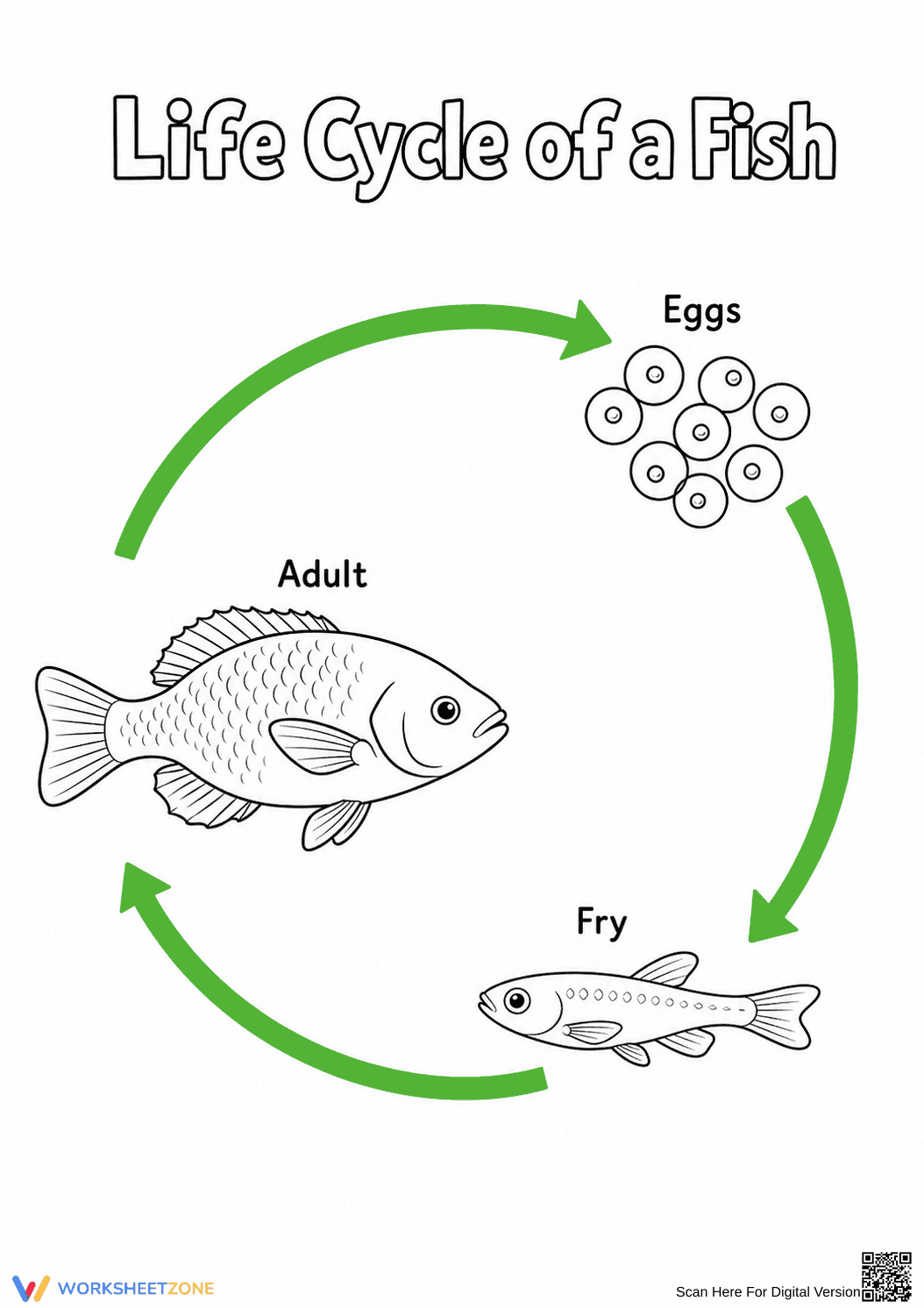
This Grade 6 science worksheet introduces students to the biological growth stages of aquatic life by illustrating the fish life cycle. Students will examine the progression from eggs to fry to adult fish, reinforcing their understanding of organism development and reproduction through a clear, visual model.
At a Glance
- Grade: 6 · Subject: Science
- Standard:
MS-LS1-5— Understand organism growth and development stages- Skill Focus: Identifying life cycle stages
- Format: 1 page · 1 visual task · No answer key required · PDF
- Best For: Visual learning and science centers
- Time: 10–15 minutes
This single-page resource features a clear, circular diagram depicting the three primary stages of a fish's life: eggs, fry, and adult. Bold, easy-to-read labels accompany detailed, colorable illustrations of each developmental phase. Green directional arrows guide students through the continuous biological sequence, making the progression easy to follow without requiring complex instructions or additional reading materials.
- Print (1 minute): Simply print the PDF. No special formatting or color ink is required, as the black-and-white design is optimized for standard classroom printers.
- Distribute (1 minute): Hand out the diagrams to students along with colored pencils or markers.
- Review (3 minutes): Briefly discuss the transition from egg to fry to adult, allowing students to color the stages as they learn. Total teacher prep time is under two minutes, making this an excellent emergency sub plan or quick transition activity.
Aligned to MS-LS1-5: Construct a scientific explanation based on evidence for how environmental and genetic factors influence the growth of organisms. While this standard encompasses broader growth factors, understanding the baseline developmental stages (egg, fry, adult) is a necessary prerequisite for discussing how external factors impact that growth. Both standard codes can be copied directly into lesson plans, IEP goals, or district curriculum mapping tools.
Use this diagram as an introductory visual aid before a larger unit on aquatic ecosystems or animal reproduction. It works perfectly as a "do-now" activity where students color the stages while the teacher takes attendance. As a formative assessment observation tip, ask students to verbally explain what happens between the "fry" and "adult" stages to check their understanding of biological growth and maturation. Expected completion time is 10 to 15 minutes.
This resource is designed for middle school science students needing a simplified, visual introduction to life cycles, and is particularly highly effective for English Language Learners (ELLs) or students with IEPs who benefit from reduced text and strong visual supports. Pair this diagram with a direct instruction lesson on aquatic habitats or a short documentary clip showing fish hatching to bridge the gap between the static model and real-world biology.
Integrating visual models into science instruction significantly enhances student comprehension of cyclical biological processes. According to EdReports 2024, utilizing clear diagrams helps students map complex scientific phenomena, directly supporting standards like MS-LS1-5 where learners must understand organism growth and development stages. By providing a structured, visual representation of the fish life cycle, educators can reduce cognitive load and allow students to focus on the sequence of biological maturation rather than decoding dense scientific text. When middle school learners engage with straightforward illustrations, they build a stronger foundational vocabulary and conceptual framework before moving on to more advanced ecological topics. This approach ensures that all students, regardless of their reading proficiency or background knowledge, can successfully access the core curriculum. Furthermore, incorporating these visual aids into daily routines fosters a more inclusive classroom environment, ultimately leading to higher retention rates and deeper engagement with the fascinating world of aquatic biology and animal reproduction.


