


























Views
Downloads

Essential Character Traits Worksheet | Grade 3 Aligned
Paste this activity's link or code into your existing LMS (Google Classroom, Canvas, Teams, Schoology, Moodle, etc.).
Students can open and work on the activity right away, with no student login required.
You'll still be able to track student progress and results from your teacher account.
This character traits worksheet helps Grade 3 students connect personality observations to specific narrative proof. By providing a structured graphic organizer, the resource ensures that learners move beyond simple descriptions and engage in the rigorous process of citing textual evidence. It is a functional tool for deepening literary comprehension and improving analytical writing across various fiction genres.
At a Glance
- Grade: 3 · Subject: English Language Arts
- Standard:
CCSS.ELA-LITERACY.RL.3.1— Ask and answer questions about a text while referring explicitly to text evidence- Skill Focus: Character Trait Identification and Evidence Citation
- Format: 1 page · 3 tasks · Answer key not included · PDF
- Best For: Literacy centers and independent reading response
- Time: 15–20 minutes
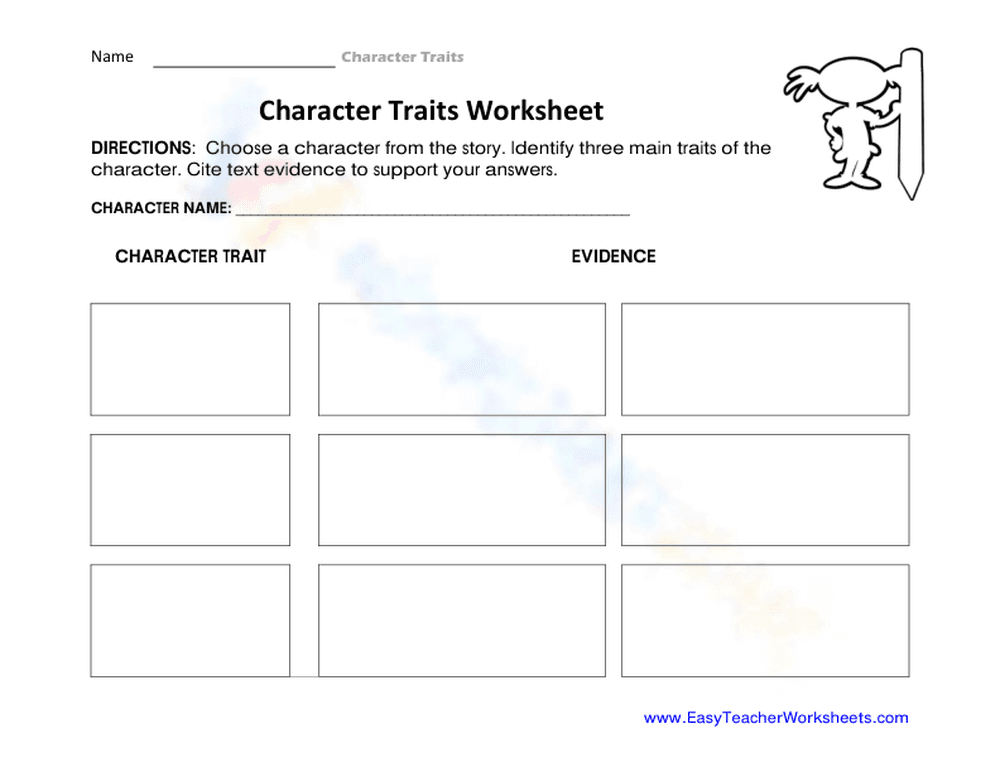
Inside this single-page PDF, you will find a clean, professional graphic organizer designed for maximum student focus. The worksheet features three primary entry rows, each containing a dedicated box for a character trait and a corresponding large box for the text evidence. This layout ensures students have ample space to transcribe quotes or summarize specific scenes from their reading materials.
The zero-prep workflow for this resource is designed for busy educators who need high-impact materials without the overhead of complex setup. First, print the single-page document (30 seconds). Second, distribute the worksheets during your independent reading block or literacy centers (1 minute). Third, review student responses as a quick exit ticket or formative assessment (1 minute). The total teacher preparation time remains under two minutes.
This resource is primarily aligned to CCSS.ELA-LITERACY.RL.3.1, which requires students to ask and answer questions to demonstrate understanding of a text, referring explicitly to the text as the basis for the answers. It also supports RL.3.3 by asking students to describe characters in a story. This standard code can be copied directly into lesson plans, IEP goals, or district curriculum mapping tools.
Use this worksheet as an independent practice activity following a whole-class read-aloud or during a guided reading group. As a formative assessment tip, observe whether students are selecting internal traits (like "brave") versus external traits (like "tall"). Expect most students to complete the three traits and evidence pairings within a 15–20 minute instructional window, making it an ideal supplemental activity.
This worksheet is ideal for Grade 2, Grade 3, and Grade 4 students working on evidence-based reading responses. It is particularly effective for learners who need visual scaffolds to organize their thoughts before drafting longer paragraphs. Pair this resource with any short story, picture book, or chapter from a middle-grade novel to provide consistent, focused practice on character analysis.
The character trait analysis framework provided in this worksheet aligns with the instructional shifts identified by EdReports (2024), emphasizing the necessity of grounded textual evidence in elementary literacy. By requiring students to link abstract traits to specific textual citations, the resource reinforces the cognitive connections between character development and objective comprehension. Research suggests that structured graphic organizers, like this single-page layout, reduce the cognitive load associated with complex literary analysis, allowing Grade 3 learners to focus on the evaluative task of justifying their observations. According to the EdReports 2024 analysis, high-quality instructional materials must bridge the gap between simple identification and evidence-based reasoning. This worksheet fulfills that requirement by providing a clear, scaffolded path for students to document three distinct traits alongside their supporting evidence. This methodology supports long-term retention of RL.3.1 skills by standardizing the citation process across different literary genres and narrative structures.


