


























Views
Plays



Printable J Sound Phonics Worksheet | Grade 2
Paste this activity's link or code into your existing LMS (Google Classroom, Canvas, Teams, Schoology, Moodle, etc.).
Students can open and work on the activity right away, with no student login required.
You'll still be able to track student progress and results from your teacher account.
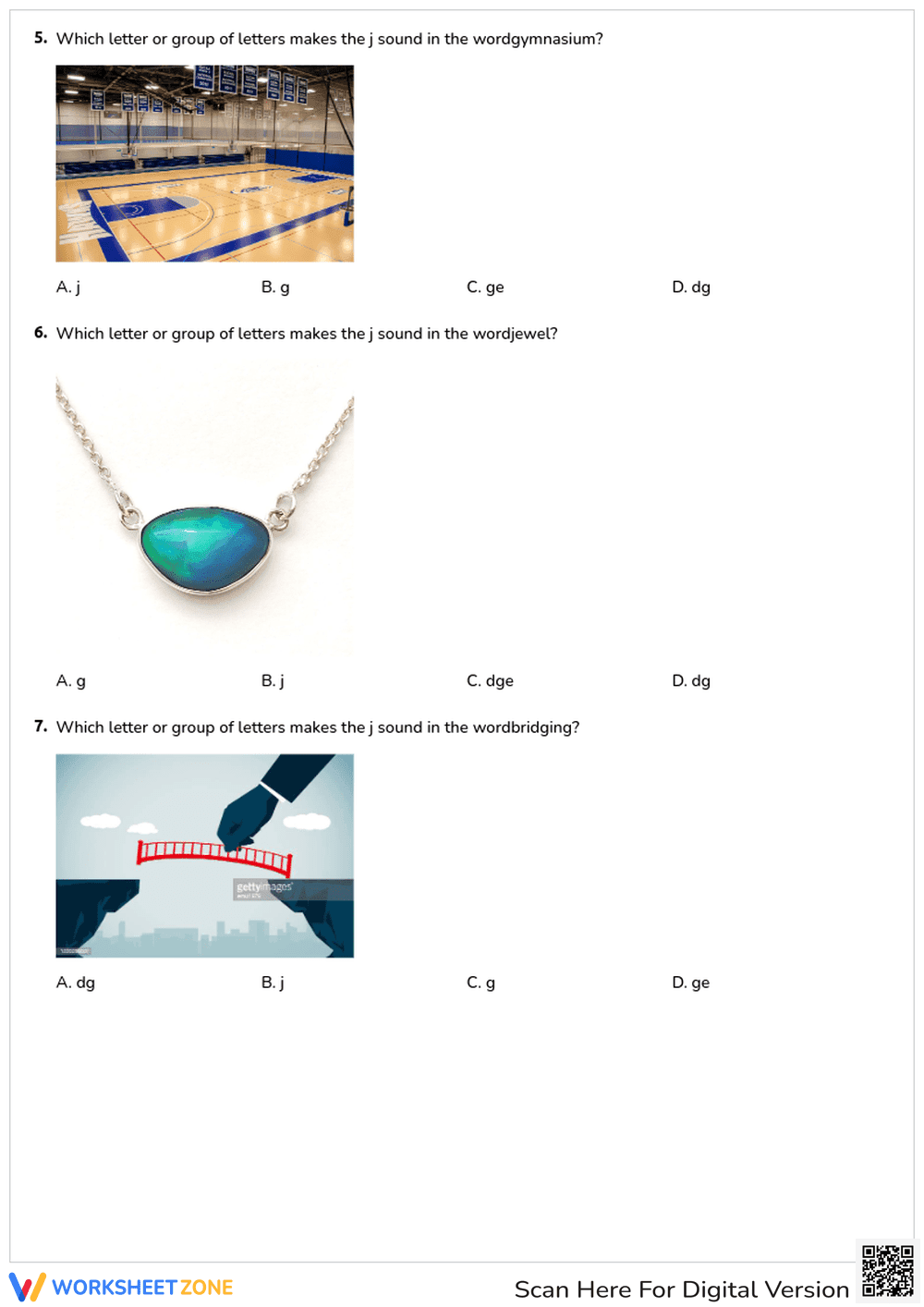
This phonics worksheet helps early readers master spelling patterns for the /j/ sound. By identifying whether words use j, g, ge, or dge, students strengthen their decoding and spelling accuracy. This resource provides targeted practice to build confidence in recognizing inconsistent but common sound-spelling correspondences.
At a Glance
- Grade: 2 · Subject: English
- Standard:
CCSS.ELA-LITERACY.L.2.2.D— Generalize learned spelling patterns when writing words.- Skill Focus: Spelling the /j/ sound (j, g, ge, dge)
- Format: 3 pages · 10 problems · Answer key included · PDF
- Best For: Independent phonics practice
- Time: 10–15 minutes
This printable resource features a 10-question multiple-choice quiz across three pages. Each question features a high-quality image and a target word, prompting students to select the correct letter or letter combination that produces the /j/ sound in that specific word. The clear, uncluttered layout minimizes distractions, while the included answer key ensures quick and accurate grading for teachers.
This worksheet guides students through a focused skill progression:
- Guided practice: The first few questions feature highly familiar words (like jellyfish) to build initial confidence with the standard j spelling.
- Supported practice: Students transition to words using the soft g (like gymnasium and giraffe), requiring them to apply phonics rules regarding vowels that follow the target sound.
- Independent practice: The final questions challenge learners with complex endings like ge and dge (as in fringe and dodge), solidifying their mastery of the concept.
This structured approach perfectly supports a gradual-release or I Do, We Do, You Do instructional model.
This resource is strictly aligned to CCSS.ELA-LITERACY.L.2.2.D: "Generalize learned spelling patterns when writing words (e.g., cage -> badge; boy -> boil)." It also supports foundational reading skills by reinforcing decoding strategies for complex consonant sounds. Both standard codes can be copied directly into lesson plans, IEP goals, or district curriculum mapping tools.
Teachers can deploy this worksheet during morning work to review a recent phonics lesson on soft consonants and digraphs. Alternatively, it serves as an excellent formative assessment at the end of a spelling unit. As students complete the 10 problems, teachers should observe whether they struggle more with initial sounds (like g vs. j) or ending spelling patterns (like ge vs. dge) to guide future instruction. Most students will complete this activity in 10 to 15 minutes.
This activity is designed primarily for second-grade students, though it serves as a valuable review for third graders who need extra support with spelling patterns. For students requiring accommodations, teachers can read the words aloud to isolate the phoneme auditorily before the student selects the visual spelling. This worksheet pairs beautifully with a classroom anchor chart detailing the rules for when to use dge versus ge at the end of a word.
Mastering complex spelling patterns is a critical milestone in early literacy development. This resource targets CCSS.ELA-LITERACY.L.2.2.D, helping students generalize learned spelling patterns when writing words. According to Fisher & Frey (2014), explicit phonics instruction combined with targeted, independent practice significantly improves students' ability to decode and encode unfamiliar words. When learners understand that the /j/ sound can be represented by multiple graphemes—including j, g, ge, and dge—they develop greater orthographic mapping skills. This translates directly to improved reading fluency and spelling accuracy across all academic subject areas. By providing repeated exposure to these specific sound-spelling correspondences in a structured, multiple-choice format, educators can effectively bridge the gap between phonetic awareness and conventional spelling mastery, ensuring students build a strong foundation for future literacy success.


