


























Views
Downloads
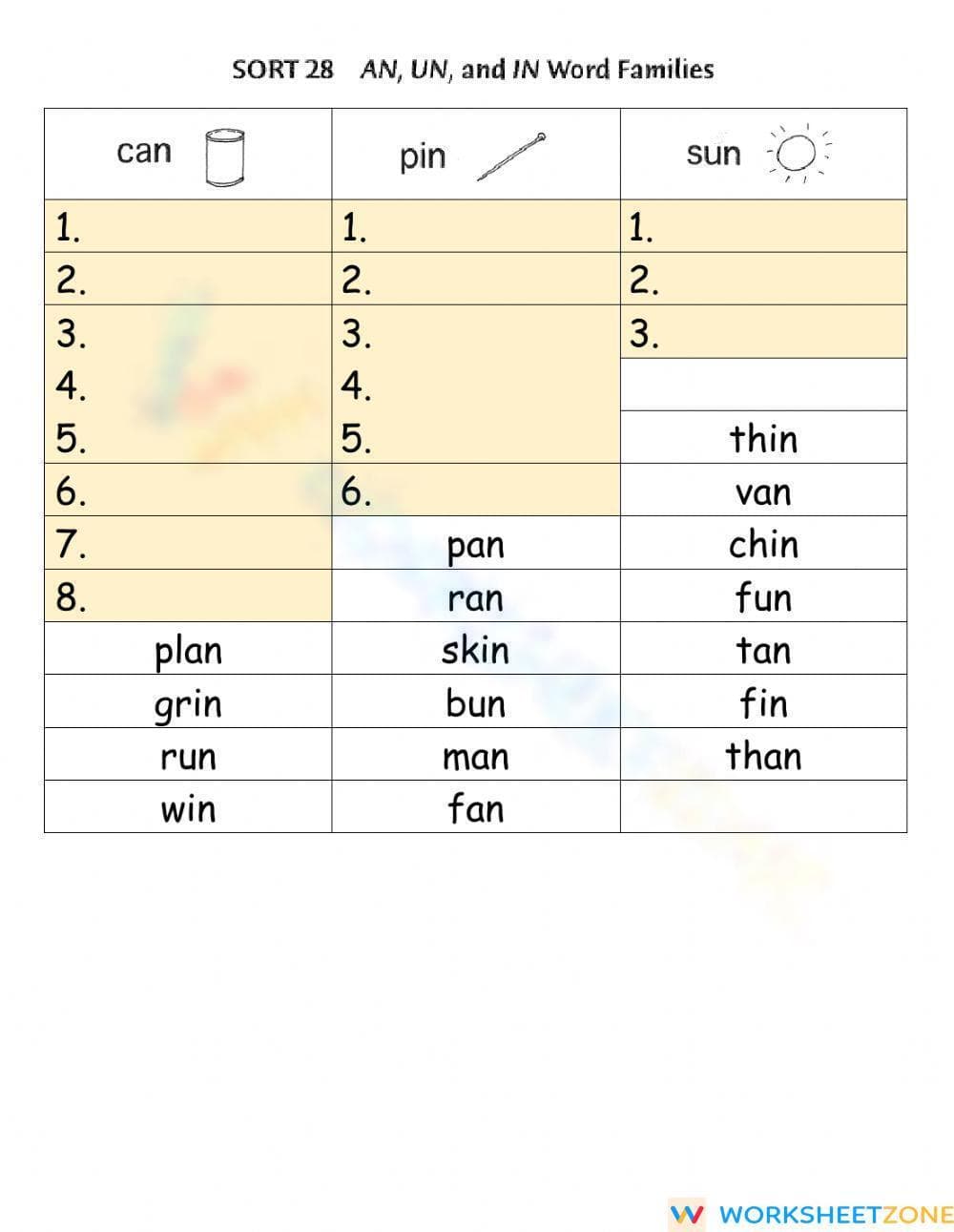

Essential Word Families Sort | Grade 1 Phonics Worksheet
Paste this activity's link or code into your existing LMS (Google Classroom, Canvas, Teams, Schoology, Moodle, etc.).
Students can open and work on the activity right away, with no student login required.
You'll still be able to track student progress and results from your teacher account.
This Grade 1 word families sort provides a structured, hands-on approach to mastering phonics by focusing on AN, UN, and IN endings. Students analyze seventeen different words, categorizing them based on their phonetic patterns to strengthen decoding and spelling accuracy. This activity is designed to transition learners from simple sound recognition to fluent word construction and literacy independence.
At a Glance
- Grade: 1 · Subject: English Language Arts
- Standard:
CCSS.ELA-LITERACY.RF.1.3— Know and apply grade-level phonics and word analysis skills in decoding words- Skill Focus: Word families and CVC decoding
- Format: 1 page · 17 words · Answer key included · PDF
- Best For: Independent phonics practice and small groups
- Time: 10–15 minutes
This single-page resource features a clean, three-column sorting grid based on common phonetic anchors: "can," "pin," and "sun." It includes seventeen target words such as "grin," "skin," and "than," providing a mix of simple CVC and slightly more complex blended starts. The layout is optimized for high-contrast printing, ensuring every letter and illustrative icon is clear for young learners beginning their reading journey.
Implementing this word families sort requires minimal effort from the teacher. First, print the single-page document (30 seconds). Second, distribute the worksheet as a writing exercise or a cut-and-paste activity (30 seconds). Third, review the completed sorts using the included answer key to identify students needing additional phonemic support (1 minute). Total prep time is under two minutes, making it an ideal candidate for sub plans or morning work.
The worksheet is strictly aligned to CCSS.ELA-LITERACY.RF.1.3, which requires students to know and apply grade-level phonics and word analysis skills in decoding words. Specifically, it targets the ability to decode regularly spelled one-syllable words by identifying the common endings in the AN, UN, and IN families. This standard code can be copied directly into lesson plans, IEP goals, or district curriculum mapping tools.
Use this worksheet as a formative assessment after introducing short vowel sounds. During direct instruction, model how to identify the "rime" in "plan" versus "skin," then assign the sort for independent practice. Observe if students are segmenting individual phonemes or recognizing the word family units as a whole; this insight helps tailor subsequent small-group interventions for struggling readers.
This resource is designed for first-grade students or kindergarteners ready for advanced phonics. It serves as an excellent tool for English Language Learners who benefit from the visual anchors provided at the top of each column. Pair this worksheet with a decodable reader that features these specific word families to reinforce the connection between isolated skill practice and fluent reading in context.
Phonemic awareness and the ability to recognize word families are foundational components of early literacy as highlighted in the RAND AIRS 2024 report. By engaging with CCSS.ELA-LITERACY.RF.1.3 through structured sorting, students develop the orthographic mapping skills necessary for long-term reading success. Research from Fisher & Frey (2014) emphasizes that categorical sorting of phonetic patterns reduces cognitive load and allows young readers to focus on the relationships between sounds and symbols. This worksheet provides seventeen data points for teachers to evaluate student progress in a controlled, manageable format. The inclusion of high-frequency word family endings ensures that the practice is directly applicable to the texts students encounter daily. This resource provides a practical application of evidence-based phonics instruction for the elementary classroom.


