


























Views
Downloads

Printable Word Transformations Suffix Worksheet | Grade 4
Paste this activity's link or code into your existing LMS (Google Classroom, Canvas, Teams, Schoology, Moodle, etc.).
Students can open and work on the activity right away, with no student login required.
You'll still be able to track student progress and results from your teacher account.
Mastering word structure is a fundamental step in literacy development. This Word Transformations worksheet empowers Grade 4 students to manipulate base words using common suffixes to expand their expressive vocabulary. By applying morphological rules to real-world examples, learners transition from simple word recognition to active language generation, ensuring they can decode and utilize complex terms with confidence.
At a Glance
- Grade: 4 · Subject: English Language Arts
- Standard:
L.4.4.B— Use common affixes like suffixes as clues to determine the meanings of unknown words.- Skill Focus: Suffix Transformations (-ful, -ly, -able)
- Format: 2 pages · 13 problems · Answer key included · PDF
- Best For: Grammar reinforcement and vocabulary building
- Time: 15–20 minutes
What's Inside
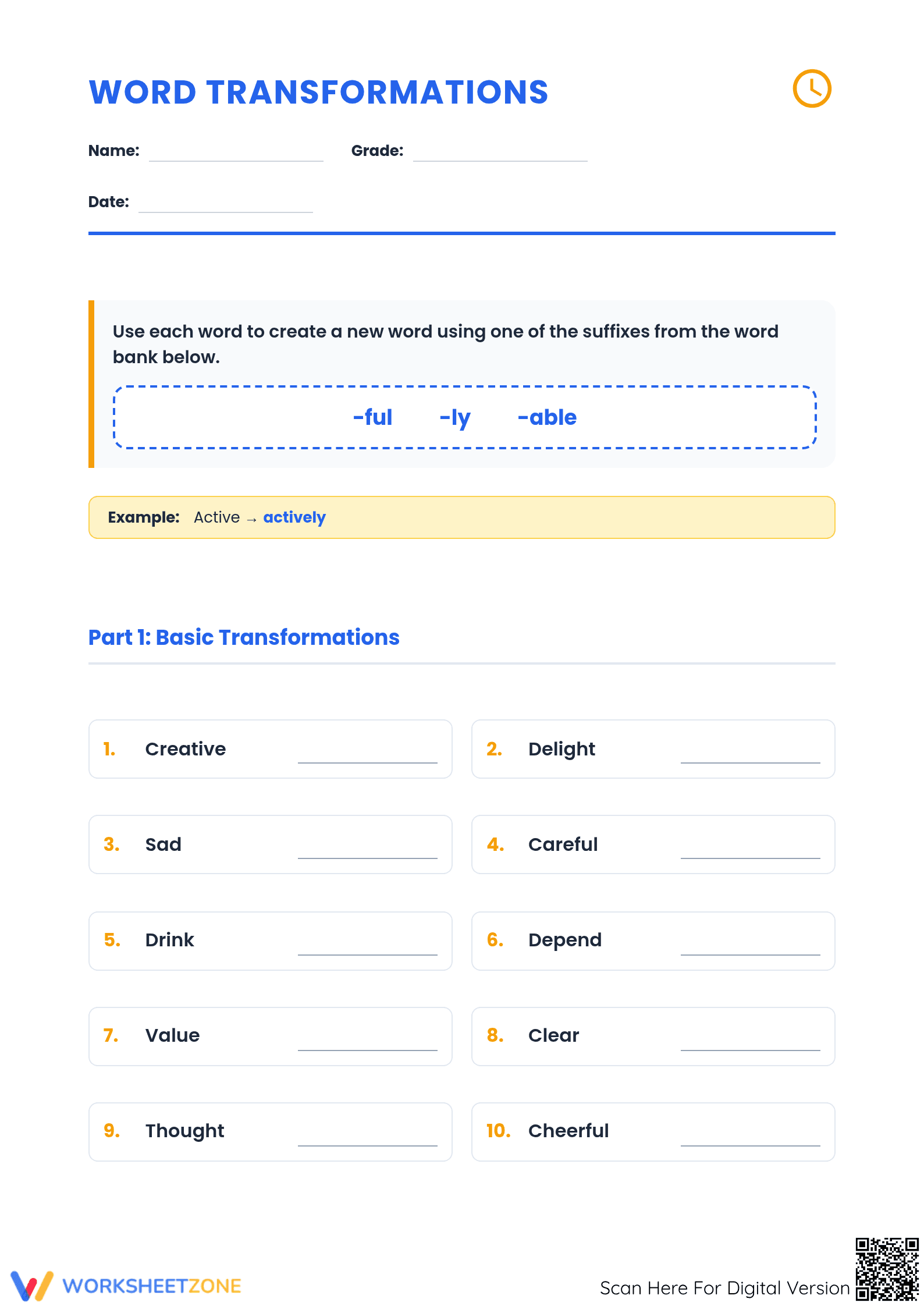
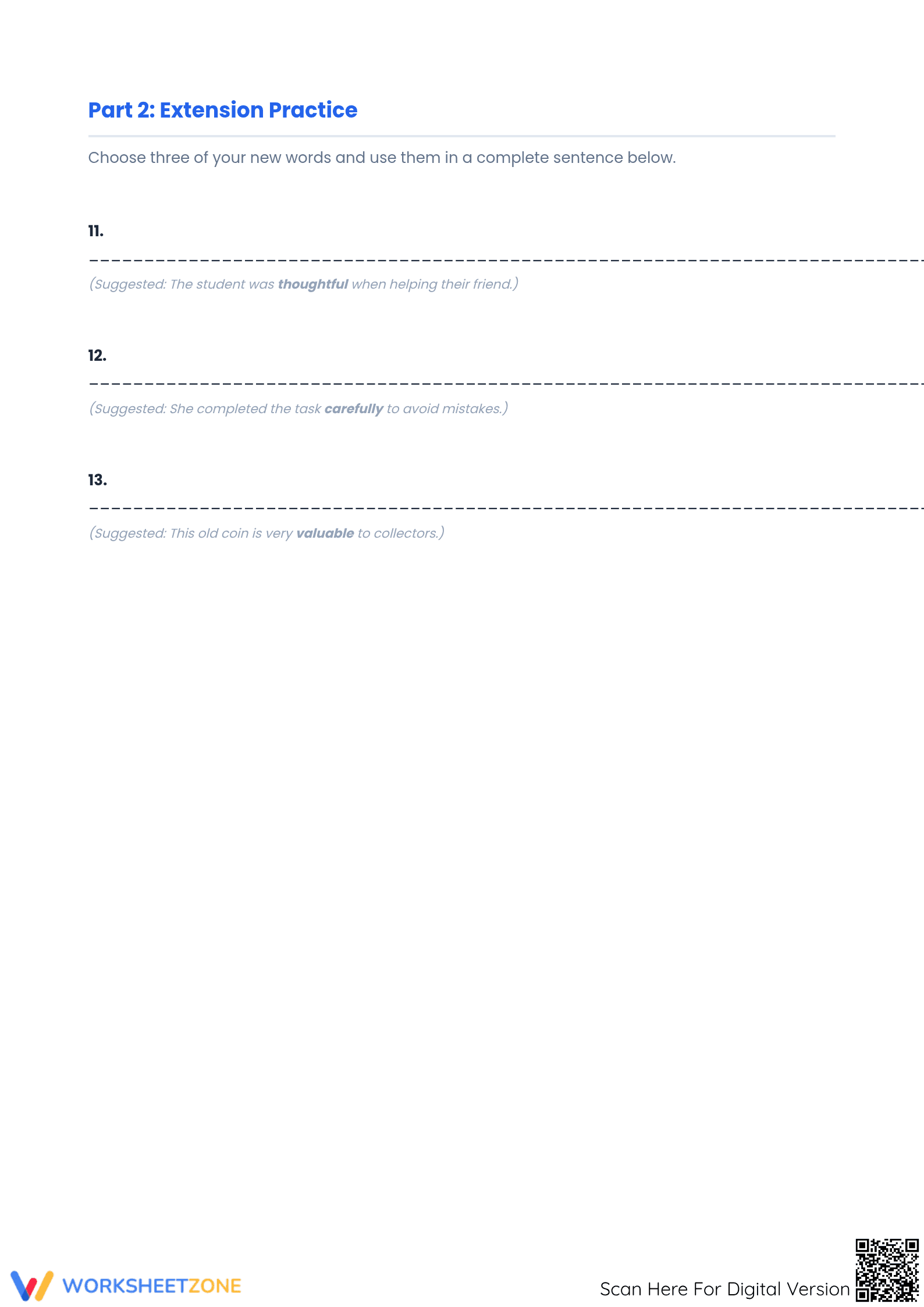
This comprehensive two-page PDF features 13 targeted tasks designed to solidify understanding of the suffixes -ful, -ly, and -able. The first page presents a word bank and ten base words for direct transformation. The second page provides an extension activity where students must select three of their newly created words to compose original, contextually accurate sentences, supported by helpful suggested models.
Skill Progression
- Guided Practice: Students begin by reviewing a clear example and a bounded word bank of three specific suffixes to reduce cognitive load during initial application.
- Supported Practice: Ten distinct base words like Creative and Value require students to identify the most appropriate suffix, practicing transformations that vary in semantic complexity.
- Independent Practice: The extension section removes the scaffold, requiring students to generate three original sentences using their transformed words to demonstrate deep conceptual mastery and practical usage.
This sequence follows the gradual release of responsibility model to ensure student success.
Standards Alignment
The activities are explicitly aligned to L.4.4.B, which requires students to use common, grade-appropriate Greek and Latin affixes and roots as clues to the meaning of a word. By transforming words like thought into thoughtful, students analyze how the addition of a suffix alters meaning and part of speech. Both standard codes can be copied directly into lesson plans, IEP goals, or district curriculum mapping tools.
How to Use It
Use this as a formative assessment after a direct instruction lesson on suffixes. Observe students during the transformations section to identify those struggling with spelling changes, such as dropping the silent e. It also serves as an excellent ready-to-use sub-plan or independent center activity, typically requiring 15 to 20 minutes for complete student engagement.
Who It's For
This resource is tailored for Grade 4 general education classrooms, but it is equally effective for ESL learners and students receiving Tier 2 vocabulary support. It pairs naturally with any mentor text focusing on descriptive writing, providing the linguistic tools necessary for students to enhance their narratives with more precise and sophisticated adverbs and adjectives.
Morphological awareness is a critical predictor of reading comprehension and vocabulary growth in the upper elementary years. Research from RAND AIRS 2024 highlights that explicit instruction in affixes, such as the transformations practiced here, significantly improves a student's ability to infer the meaning of unfamiliar multi-syllabic words encountered in complex texts. This worksheet targets the L.4.4.B standard by requiring students to actively manipulate word endings, a process that internalizes the relationship between base words and their derived forms. By moving from isolated word manipulation to sentence-level production, the activity aligns with best practices for vocabulary acquisition that emphasize usage over rote memorization. Providing students with structured opportunities to apply suffixes like -ful and -ly ensures they develop the linguistic flexibility required for the increased literacy demands of middle school and beyond. This approach supports long-term academic success across all core subjects.


