


























Views
Downloads
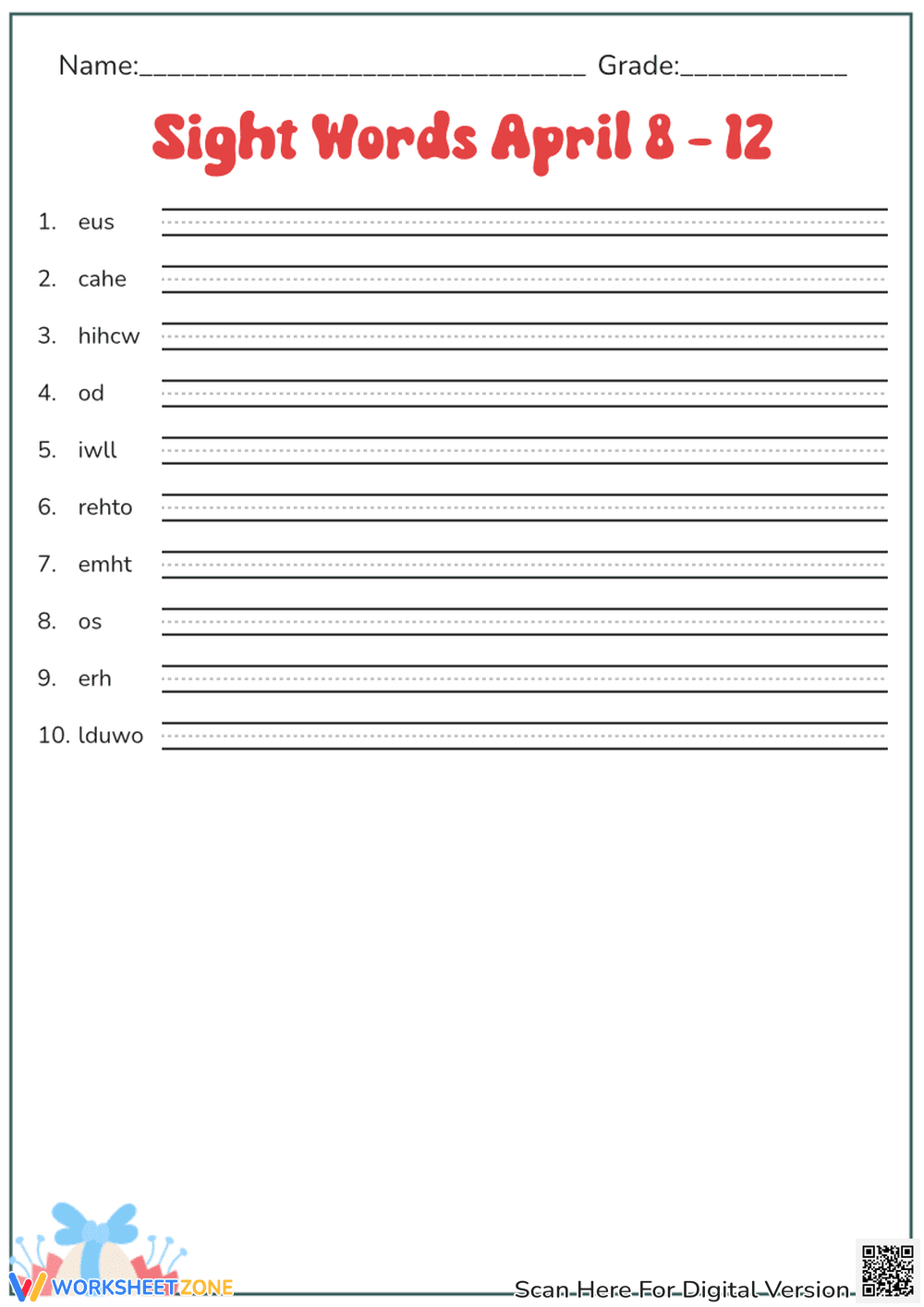

Grade 1 Sight Words — Printable No-Prep Worksheet
Paste this activity's link or code into your existing LMS (Google Classroom, Canvas, Teams, Schoology, Moodle, etc.).
Students can open and work on the activity right away, with no student login required.
You'll still be able to track student progress and results from your teacher account.
This Grade 1 sight words worksheet gives students targeted practice with high-frequency vocabulary. By unscrambling ten common words, early readers reinforce their spelling skills and improve word recognition. The straightforward format allows young learners to build confidence while mastering essential foundational reading components.
At a Glance
- Grade: 1 · Subject: ELA
- Standard:
CCSS.ELA-LITERACY.L.1.2.D— Spell frequently occurring irregular words- Skill Focus: Sight words and spelling
- Format: 1 page · 10 problems · Answer key included · PDF
- Best For: Morning work or independent practice
- Time: 10–15 minutes
Inside this resource, educators will find a single-page word scramble activity featuring ten high-frequency sight words. Each problem presents a scrambled word alongside primary handwriting lines, encouraging proper letter formation as students write the correct spelling. The layout is clean and distraction-free, making it highly accessible for first graders. A complete answer key is provided to ensure quick and accurate grading for teachers or substitute instructors.
This resource offers an efficient zero-prep workflow:
- Print (1 minute): Simply download the PDF and print the required number of copies. The black-and-white design is printer-friendly.
- Distribute (1 minute): Hand out the worksheets during morning routines or literacy centers. The instructions are self-evident, requiring minimal teacher setup.
- Review (3 minutes): Use the included answer key to quickly check student work or project it on a smartboard for whole-class self-correction.
Total teacher preparation time is under two minutes, making this an ideal, reliable option for emergency sub plans or unexpected schedule changes.
This activity is strictly aligned to CCSS.ELA-LITERACY.L.1.2.D, requiring students to use conventional spelling for words with common spelling patterns and for frequently occurring irregular words. It also supports foundational reading skills by reinforcing automatic word recognition. Both standard codes can be copied directly into lesson plans, IEP goals, or district curriculum mapping tools.
Teachers can utilize this worksheet as a focused morning work assignment to settle students at the start of the day. Alternatively, it serves as an excellent independent activity during small-group literacy centers. As a formative assessment tip, observe students while they work to see if they are relying on phonetic decoding or if they recognize the scrambled sight words automatically. Expected completion time ranges from ten to fifteen minutes, depending on the student's reading level.
This worksheet is primarily designed for first-grade students developing their foundational reading and spelling skills. It is also highly effective for kindergarten students needing an advanced challenge or second graders requiring targeted intervention with high-frequency words. For differentiation, teachers can provide a word bank on the board for students who need extra support. This activity pairs perfectly with a direct instruction phonics lesson or a classroom sight word anchor chart.
Mastering high-frequency vocabulary is a critical milestone in early literacy development. This resource directly targets CCSS.ELA-LITERACY.L.1.2.D, helping students spell frequently occurring irregular words with accuracy. According to Fisher & Frey (2014), providing students with structured, repetitive exposure to sight words significantly increases reading fluency and comprehension rates in primary grades. When young learners manipulate letters through activities like word scrambles, they actively engage their orthographic mapping skills, moving beyond rote memorization to deeper structural understanding. This targeted practice ensures that foundational spelling patterns are committed to long-term memory, reducing cognitive load during independent reading tasks. By integrating this evidence-based approach into daily routines, educators can effectively support early readers in achieving essential literacy benchmarks and building a strong foundation for future academic success.


