


























Views
Downloads
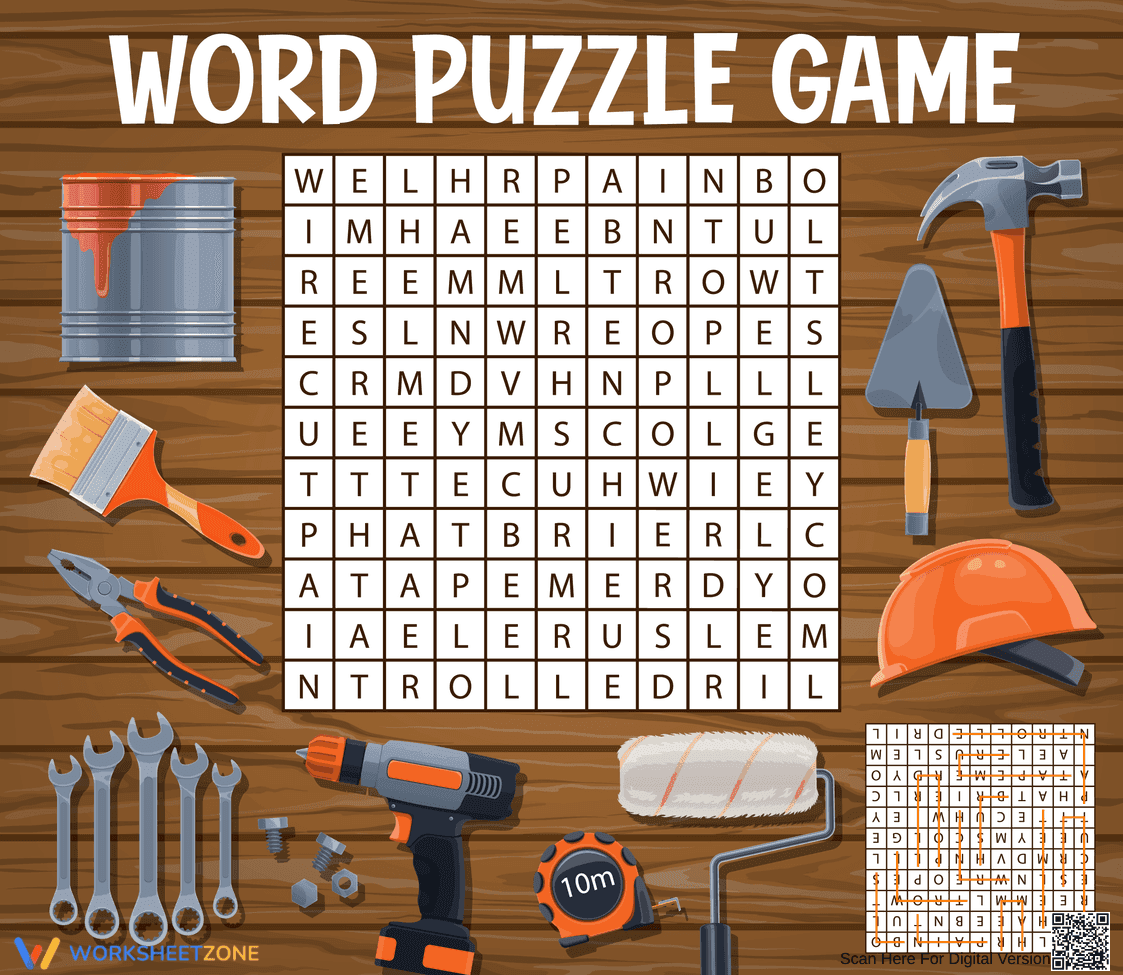

Printable Tools Word Search | Grade 2 ELA
Paste this activity's link or code into your existing LMS (Google Classroom, Canvas, Teams, Schoology, Moodle, etc.).
Students can open and work on the activity right away, with no student login required.
You'll still be able to track student progress and results from your teacher account.
This engaging tools-themed word search worksheet helps students build essential vocabulary and spelling skills through focused visual scanning. By locating hidden words related to construction and hardware, young learners reinforce letter-sound correspondence and consonant clusters while completing a fun, self-directed activity.
At a Glance
- Grade: 2 · Subject: ELA
- Standard:
CCSS.ELA-LITERACY.RF.2.3— Apply phonics and word analysis skills- Skill Focus: Vocabulary and Spelling
- Format: 1 page · 1 puzzle · Answer key included · PDF
- Best For: Early finishers and morning work
- Time: 10–15 minutes
This single-page resource features a vibrant, 11x11 letter grid surrounded by high-quality illustrations of common tools like hammers, wrenches, and paintbrushes. Students use the visual cues to identify and circle the corresponding vocabulary words hidden within the puzzle. A convenient, inverted answer key is provided in the bottom corner of the page, allowing for immediate self-checking or quick teacher review without needing a separate document.
Zero-Prep Workflow
- Print (1 minute): Simply download the PDF and print the required number of copies. Graphics print well in grayscale.
- Distribute (1 minute): Hand out the worksheets as students enter the room or transition between subjects. No additional materials or complex instructions are required.
- Review (1 minute): Use the built-in answer key to quickly verify completion or allow students to self-correct their work.
With a total teacher prep time of under two minutes, this activity is an ideal addition to any emergency sub plan or independent work folder.
Standards Alignment
This worksheet aligns with CCSS.ELA-LITERACY.RF.2.3, requiring students to know and apply grade-level phonics and word analysis skills in decoding words. As they scan for specific letter sequences, they practice recognizing common spelling patterns and consonant blends. Both standard codes can be copied directly into lesson plans, IEP goals, or district curriculum mapping tools.
How to Use It
Use this word search as morning work to settle students, or keep it for early finishers during literacy blocks. Before independent practice, you might briefly review the names of the tools pictured to ensure vocabulary comprehension. As a formative assessment tip, observe how students scan the grid; those who look for the first two letters of a word demonstrate stronger phonemic awareness than those scanning letter-by-letter. Expect students to complete the puzzle in 10 to 15 minutes.
Who It's For
This resource is designed for primary grade students, particularly those in first through third grade who are expanding their everyday vocabulary. It serves as an excellent differentiation tool for visual learners who benefit from picture cues alongside text. Pair this worksheet with a read-aloud about community helpers or a hands-on building activity to reinforce the thematic vocabulary in a broader context.
Integrating thematic word puzzles into early literacy instruction provides a low-stakes environment for students to practice critical decoding strategies. Aligned with CCSS.ELA-LITERACY.RF.2.3, this activity requires learners to apply phonics and word analysis skills as they identify target vocabulary within a distracting field of letters. According to Fisher & Frey (2014), providing students with structured, independent tasks that reinforce prior knowledge is essential for building automaticity in word recognition. Word searches encourage systematic scanning and pattern recognition, which are foundational for fluent reading and accurate spelling. By combining visual cues with letter grids, educators can support diverse learning profiles while maintaining rigorous engagement with grade-level phonics standards. This targeted practice solidifies orthographic mapping, ensuring students quickly retrieve spelling patterns during writing tasks.


