


























Views
Downloads

Essential Compound Words Worksheet | Grade 2 Printable
Paste this activity's link or code into your existing LMS (Google Classroom, Canvas, Teams, Schoology, Moodle, etc.).
Students can open and work on the activity right away, with no student login required.
You'll still be able to track student progress and results from your teacher account.
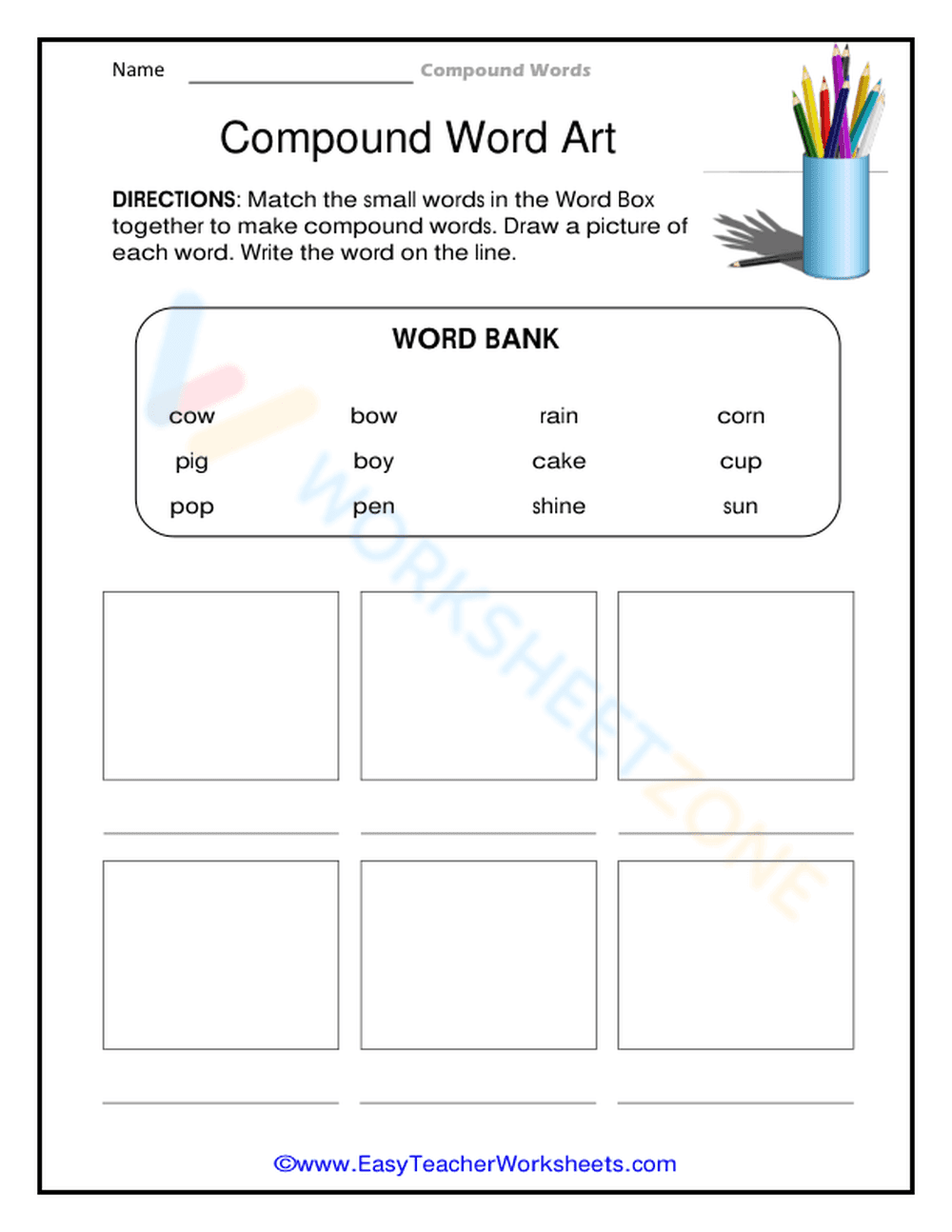
This Compound Word Art worksheet provides a creative and engaging way for students to master the concept of compound words. By combining simple base words from a provided word bank, learners visualize how new meanings are formed. This activity reinforces vocabulary acquisition and spelling accuracy through integrated drawing and writing tasks.
At a Glance
- Grade: 2 · Subject: English Language Arts
- Standard:
CCSS.ELA-LITERACY.L.2.4.D— Use individual word meanings to predict the meaning of a compound word- Skill Focus: Compound Word Formation
- Format: 1 page · 6 problems · Answer key included · PDF
- Best For: Independent centers and early finishers
- Time: 15–20 minutes
What's Inside
This single-page printable features a curated word bank containing twelve high-frequency base words such as "rain," "bow," "sun," and "shine." Students must pair these words correctly to form six distinct compound words. Below the word bank, six dedicated modules provide space for students to illustrate their newly formed words and write them on primary-ruled lines, ensuring a multisensory learning experience.
Zero-Prep Workflow
Implementing this resource is an efficient process for teacher convenience. First, print the single-page PDF in 30 seconds. Second, distribute the copies with drawing supplies like crayons. Finally, review the illustrations and spellings using the answer key. This no-prep design makes it an ideal choice for substitute plans or quick literacy rotations.
Standards Alignment
The primary focus is `CCSS.ELA-LITERACY.L.2.4.D`, which requires students to use knowledge of individual words to predict the meaning of a compound word. By combining "rain" and "bow" to create "rainbow," students demonstrate how semantic units merge to create specific new concepts. This standard code can be copied directly into lesson plans, IEP goals, or district curriculum mapping tools.
How to Use It
This worksheet is best used during the independent practice phase of a vocabulary lesson. After a direct instruction session on how compound words function, assign this task to verify student comprehension. Alternatively, use it as a formative assessment tool by observing students during the drawing phase; a student who draws a "pop-corn" accurately demonstrates a clear grasp of the combined meaning before they even write the word on the line.
Who It's For
While designed primarily for Grade 2 students, this resource is highly effective for Grade 1 enrichment or Grade 3 intervention. It is particularly beneficial for visual learners and English Language Learners who profit from the concrete connection between word parts and visual representation. This worksheet pairs naturally with a classroom anchor chart displaying common compound word examples or a reading passage focused on nature-themed vocabulary words.
Mastering compound words through visual-spatial tasks like those in the Compound Word Art worksheet is a proven strategy for early literacy development. According to research cited by Fisher & Frey (2014) regarding the gradual release of responsibility, providing students with structured scaffolds—such as the word bank and illustration prompts—facilitates the transition from guided instruction to independent mastery. This resource directly addresses CCSS.ELA-LITERACY.L.2.4.D by challenging students to synthesize individual word meanings into complex semantic units. By requiring students to draw their predictions, the worksheet reinforces the neural pathways associated with both vocabulary retention and conceptual understanding. Such multisensory approaches are essential for diverse learners who may struggle with abstract linguistic concepts in isolation. This self-contained activity serves as a reliable metric for measuring a student's ability to manipulate word parts and accurately spell common compound words within a Grade 2 curriculum framework.


