


























Views
Downloads

Essential Women in History Worksheet | Grade 5-6
Paste this activity's link or code into your existing LMS (Google Classroom, Canvas, Teams, Schoology, Moodle, etc.).
Students can open and work on the activity right away, with no student login required.
You'll still be able to track student progress and results from your teacher account.
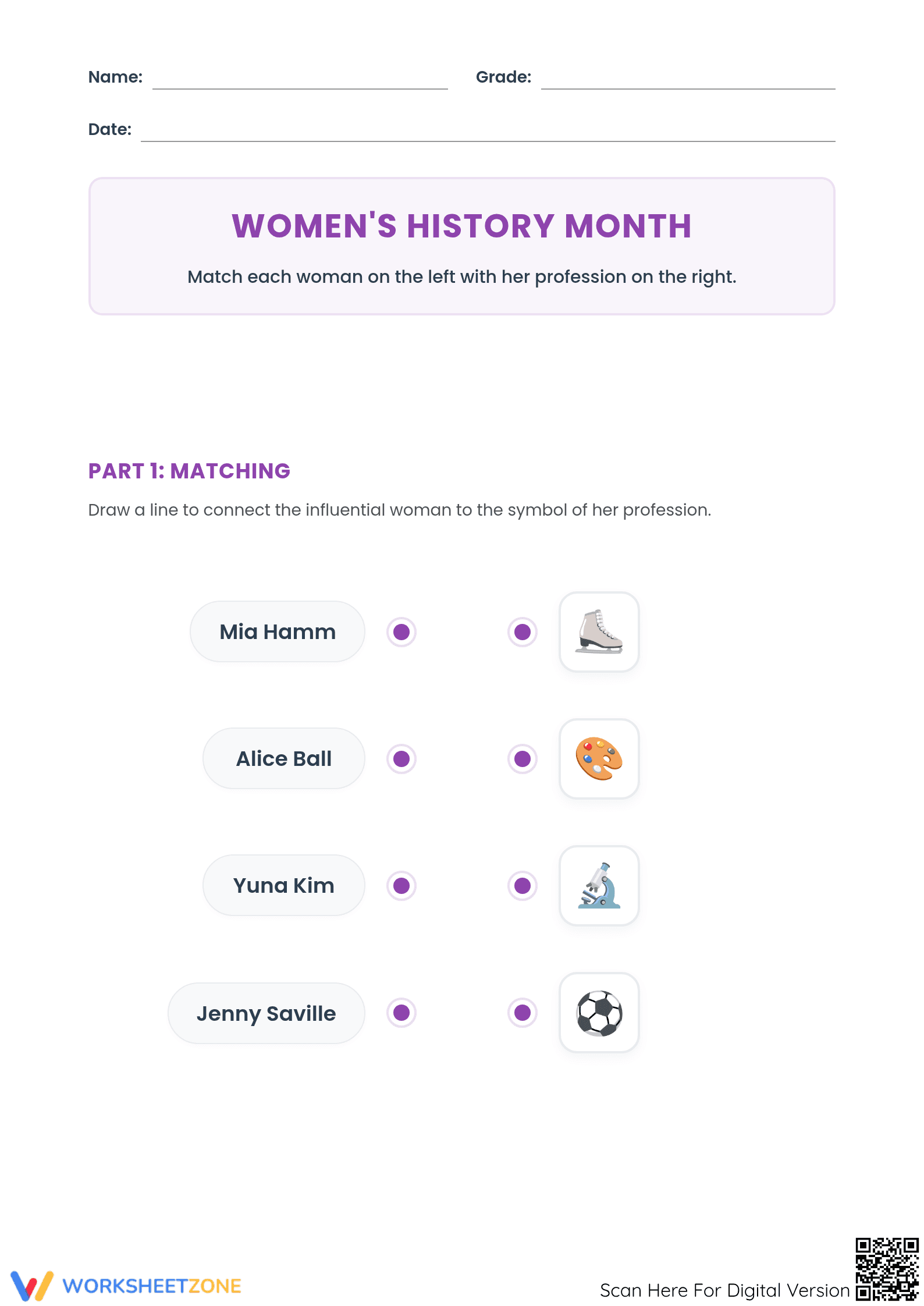
This Grade 5-6 Women's History Month worksheet helps students identify the contributions of influential women through visual matching and reflective writing. By connecting names like Alice Ball and Mia Hamm to their respective fields, learners build historical context and vocabulary. It provides a concise, engaging way to celebrate achievements while practicing informational text skills.
At a Glance
- Grade: 5-6 · Subject: ELA
- Standard:
CCSS.ELA-LITERACY.RI.5.3— Explain the relationships or interactions between two or more individuals in a text- Skill Focus: Historical figure identification & reflection
- Format: 2 pages · 5 tasks · Answer key included · PDF
- Best For: Quick Women's History Month activity
- Time: 15–20 minutes
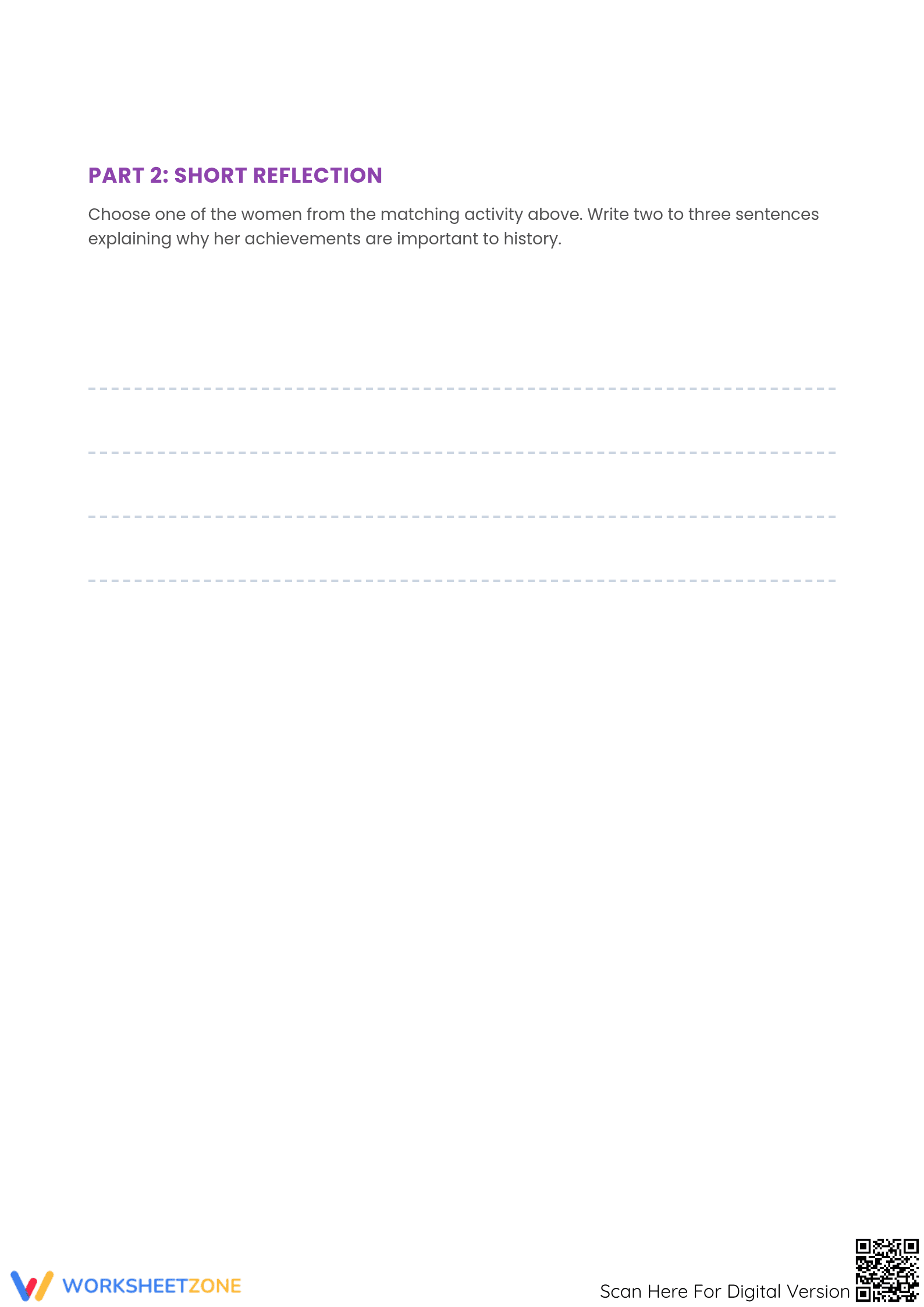
The resource consists of a two-page PDF designed for immediate use. Page one features a matching activity where students link four influential women to symbols representing their professions, such as science, art, and sports. Page two provides a structured reflection space with primary-ruled lines, prompting students to explain the historical significance of one chosen figure in two to three sentences.
Zero-Prep Workflow
- Print: Select the two-page PDF and print enough copies for your roster (30 seconds).
- Distribute: Hand out the sheets as a morning warm-up or an independent literacy center activity (1 minute).
- Review: Check the matching answers as a whole group and invite students to share their written reflections (5 minutes).
Total teacher preparation time is under 2 minutes, making it an ideal sub plan or seasonal supplement for busy classrooms.
Standards Alignment
The primary focus is `CCSS.ELA-LITERACY.RI.5.3`, which requires students to explain the relationships between individuals and their historical contributions. By matching figures to their fields and justifying their importance in writing, students demonstrate an understanding of how these individuals influenced history. Both standard codes can be copied directly into lesson plans, IEP goals, or district curriculum mapping tools.
How to Use It
Use this worksheet during the first week of March to introduce Women's History Month. It works best after a brief gallery walk or introductory video about the featured women. As a formative assessment, observe if students can correctly identify the microscope for Alice Ball, which indicates their ability to associate specific scientific achievements with historical figures. Completion typically takes 15 to 20 minutes.
Who It's For
This activity is tailored for 5th and 6th-grade students in general education or ESL settings who benefit from visual scaffolds. It pairs naturally with a biographical anchor chart or a short reading passage about the four featured women.
According to the RAND AIRS 2024 report, integrating visual-to-text matching activities significantly improves retention of historical facts among middle-grade learners. This worksheet addresses CCSS.ELA-LITERACY.RI.5.3 by requiring students to synthesize the relationship between a person and their professional legacy. By moving from a simple matching task to a written reflection, the resource follows a scaffolded approach that supports cognitive load management. Research from Fisher & Frey (2014) suggests that such brief, focused writing tasks reinforce the connection between vocabulary and conceptual understanding. This 2-page resource provides a high-utility tool for educators looking to integrate social studies content into the ELA block without extensive preparation. It ensures that students not only recognize names but also articulate the why behind historical significance, a key component of informational literacy.


