


























Views
Downloads

Women's History Word Scramble | Essential Grade 3 Worksheet
Paste this activity's link or code into your existing LMS (Google Classroom, Canvas, Teams, Schoology, Moodle, etc.).
Students can open and work on the activity right away, with no student login required.
You'll still be able to track student progress and results from your teacher account.
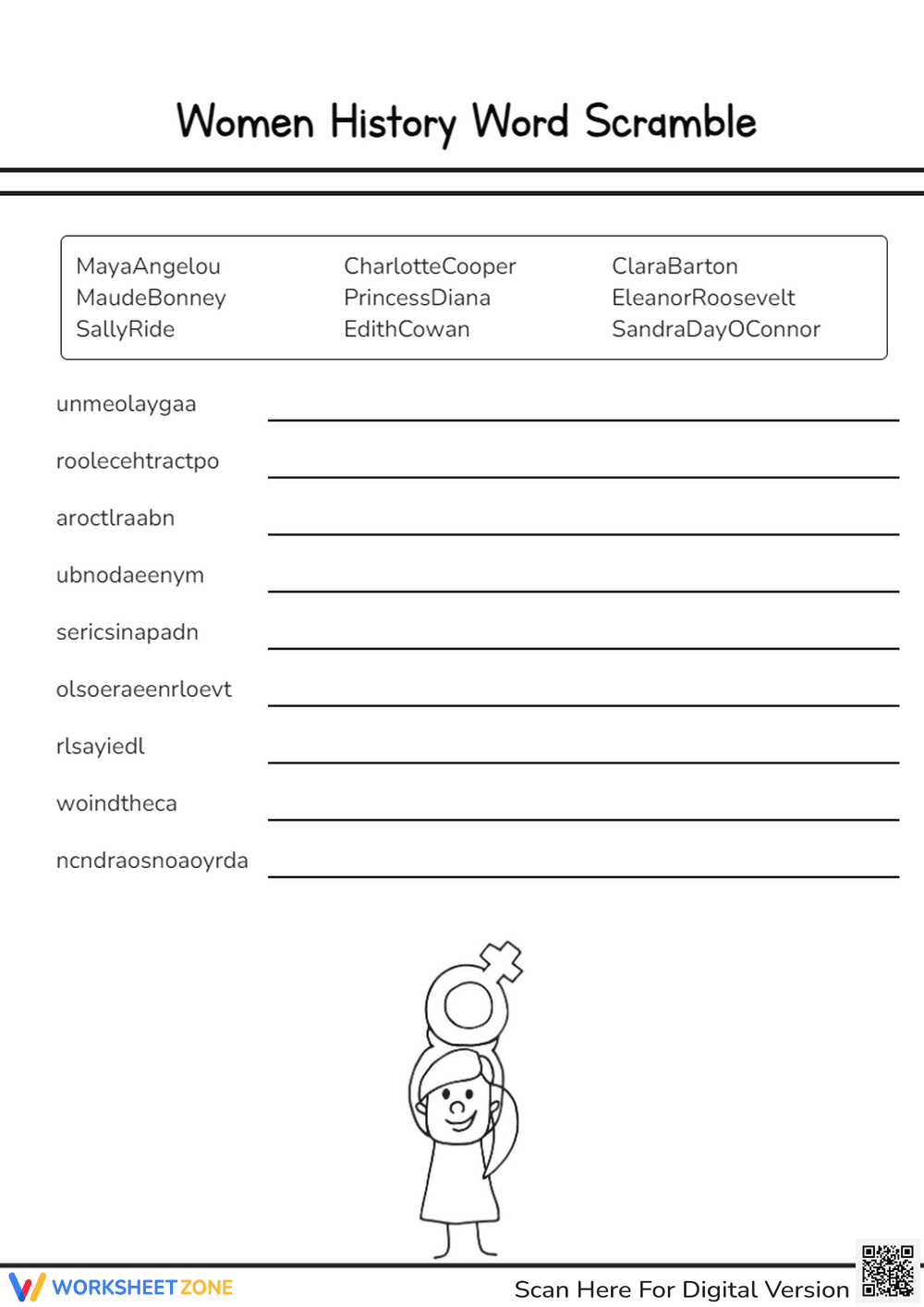
This Women's History Month word scramble worksheet helps students recognize and spell the names of influential historical figures. By unscrambling 9 key names, learners engage with social studies content while strengthening their orthographic processing and letter-pattern recognition. It is an ideal supplement for elementary history units or literacy centers during March.
At a Glance
- Grade: 3 · Subject: ELA & Social Studies
- Standard:
CCSS.ELA-LITERACY.L.3.2— Use conventional spelling patterns and recognize high-frequency words in context- Skill Focus: Historical Vocabulary & Spelling
- Format: 1 page · 9 problems · Answer key included · PDF
- Best For: Morning work or fast finishers
- Time: 10–15 minutes
This single-page PDF features a word bank containing 9 names of iconic women, including Maya Angelou and Sally Ride. Below the bank, students find scrambled versions of these names with dedicated lines for writing the correct spelling. The layout is clean and includes a thematic illustration, making it visually engaging for young learners. A full answer key is provided for quick grading.
Teachers can implement this resource in under 2 minutes. First, print the required number of copies for your class. Second, distribute the sheets as a quiet transition activity or a "bell ringer" to start the day. Third, review the names as a whole group to discuss the contributions of each woman, providing an immediate formative check on historical literacy.
The primary standard addressed is `CCSS.ELA-LITERACY.L.3.2`, which requires students to demonstrate command of the conventions of standard English capitalization, punctuation, and spelling when writing. This activity specifically targets spelling patterns and word recognition. This standard code can be copied directly into lesson plans, IEP goals, or district curriculum mapping tools.
Use this worksheet during the first week of March to introduce a Women's History Month unit. It serves as an excellent hook to pique interest in the biographies of the women listed. Alternatively, assign it as a formative assessment after a series of read-alouds to see if students can identify the figures by name. Expect completion in 10 to 15 minutes.
This resource is designed for Grade 2 through Grade 4 students, with a primary focus on Grade 3 developmental levels. It is particularly helpful for English Language Learners who benefit from the visual support of a word bank. Pair this with a set of short biographical passages or an anchor chart featuring the same historical figures.
This Grade 3 Women's History Word Scramble aligns with CCSS.ELA-LITERACY.L.3.2 by challenging students to apply spelling conventions to specific historical proper nouns. Research from Fisher & Frey (2014) emphasizes that word-level tasks, such as unscrambling and pattern recognition, are vital components of the gradual release of responsibility model, moving students from simple recognition to independent orthographic mastery. By integrating social studies content into a literacy-based task, this worksheet maximizes instructional time—a strategy supported by the RAND AIRS 2024 report on curriculum efficiency. The inclusion of a word bank provides necessary scaffolding for diverse learners, ensuring that the cognitive load remains focused on letter sequencing rather than rote memorization. This 1-page resource offers a structured way to celebrate Women's History Month while reinforcing essential ELA skills. It is a reliable tool for building both vocabulary and historical awareness in elementary classrooms.


