


























Views
Downloads

Winter Writing Practice Worksheet | Grade K-1 Printable
Paste this activity's link or code into your existing LMS (Google Classroom, Canvas, Teams, Schoology, Moodle, etc.).
Students can open and work on the activity right away, with no student login required.
You'll still be able to track student progress and results from your teacher account.
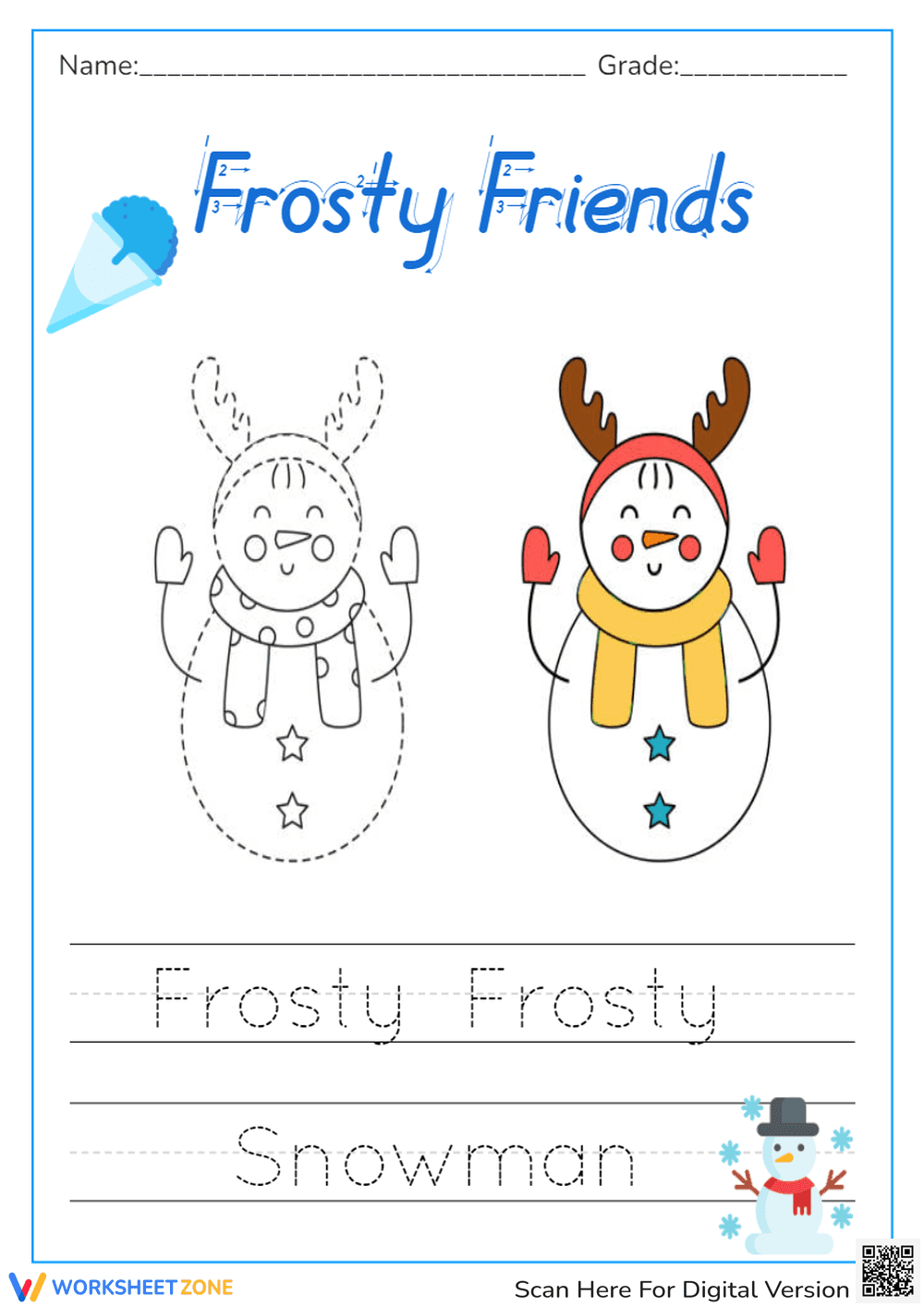
This Grade K-1 winter writing worksheet helps early learners develop fine motor control and letter formation through seasonal tracing. Students trace a snowman character and key winter vocabulary to build confidence in handwriting. It provides a structured way to practice pencil grip and stroke order during the winter months.
At a Glance
- Grade: K-1 · Subject: Handwriting
- Standard:
CCSS.ELA-LITERACY.L.K.1.A— Print many upper- and lowercase letters correctly- Skill Focus: Letter formation and fine motor tracing
- Format: 1 page · 4 tasks · No answer key included · PDF
- Best For: Morning work or seasonal centers
- Time: 10–15 minutes
What's Inside
This single-page PDF features a large snowman illustration for tracing and coloring, alongside three specific word-tracing tasks. The worksheet uses primary-ruled lines with dashed midlines to guide letter height. It includes directional arrows on the title text to model proper stroke sequence for young writers, ensuring they learn the correct mechanics of letter construction.
Zero-Prep Workflow
The workflow for this resource is designed for maximum efficiency. Teachers can print the single sheet in under 30 seconds, distribute it to students immediately, and review the fine motor progress in real-time as students color. Total teacher preparation time is less than 2 minutes, making it an ideal sub-plan or transition activity during the busy winter season.
Standards Alignment
The primary standard addressed is `CCSS.ELA-LITERACY.L.K.1.A`, which requires students to print many upper- and lowercase letters. By tracing "Frosty" and "Snowman," students practice specific letter shapes and spacing. This standard code can be copied directly into lesson plans, IEP goals, or district curriculum mapping tools to ensure compliance with literacy frameworks.
How to Use It
Use this worksheet during the instructional phase of a winter-themed unit to reinforce vocabulary. It also serves as a formative assessment tool; observe students' pencil grip and stroke direction as they trace the snowman's antlers and the letters below. Expected completion time is 10 to 15 minutes, depending on the student's coloring detail.
Who It's For
This resource is designed for Kindergarten and Grade 1 students, particularly those needing extra support with fine motor coordination. It pairs naturally with a winter-themed read-aloud or an anchor chart featuring seasonal weather words to provide context for the tracing activity. It is also suitable for occupational therapy sessions focusing on hand-eye coordination.
Handwriting instruction in early childhood is a critical predictor of later literacy success. According to Fisher & Frey (2014), the gradual release of responsibility begins with modeled tasks like tracing, which reduces cognitive load while students master the physical mechanics of writing. This worksheet aligns with CCSS.ELA-LITERACY.L.K.1.A by providing structured letter formation practice within a seasonal context. By focusing on "Frosty" and "Snowman," students engage with high-interest vocabulary while refining the fine motor skills necessary for independent writing. Research from the NAEP suggests that early fluency in letter production allows students to focus more energy on composition in later grades. This printable resource offers a low-stakes, high-engagement entry point for students to practice these essential skills. The inclusion of both image and word tracing ensures that students at various developmental stages can find success with the task.


