


























Views
Downloads

Winter Animals Vocabulary Worksheet | Grade 1 Printable
Paste this activity's link or code into your existing LMS (Google Classroom, Canvas, Teams, Schoology, Moodle, etc.).
Students can open and work on the activity right away, with no student login required.
You'll still be able to track student progress and results from your teacher account.
This two-page winter animals worksheet helps early learners build essential vocabulary and descriptive writing skills. Students practice identifying common woodland creatures and using adjectives to describe their physical traits. This engaging activity strengthens both science knowledge and foundational language arts abilities.
At a Glance
- Grade: 1 · Subject: English
- Standard:
CCSS.ELA-LITERACY.L.1.1.F— Use frequently occurring adjectives to describe nouns- Skill Focus: Animal vocabulary and descriptive writing
- Format: 2 pages · 31 problems · Answer key included · PDF
- Best For: Independent practice or morning work
- Time: 15–20 minutes
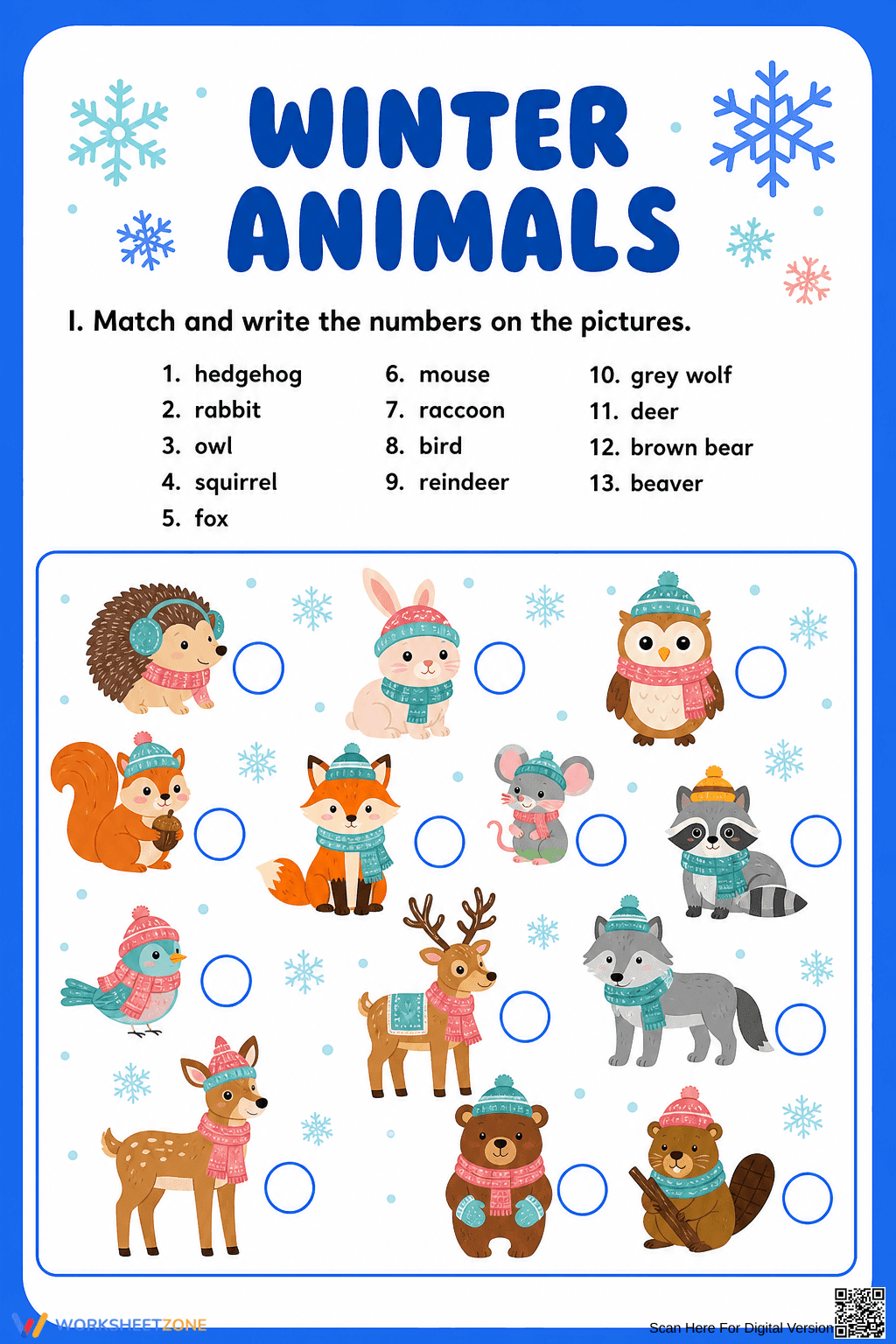
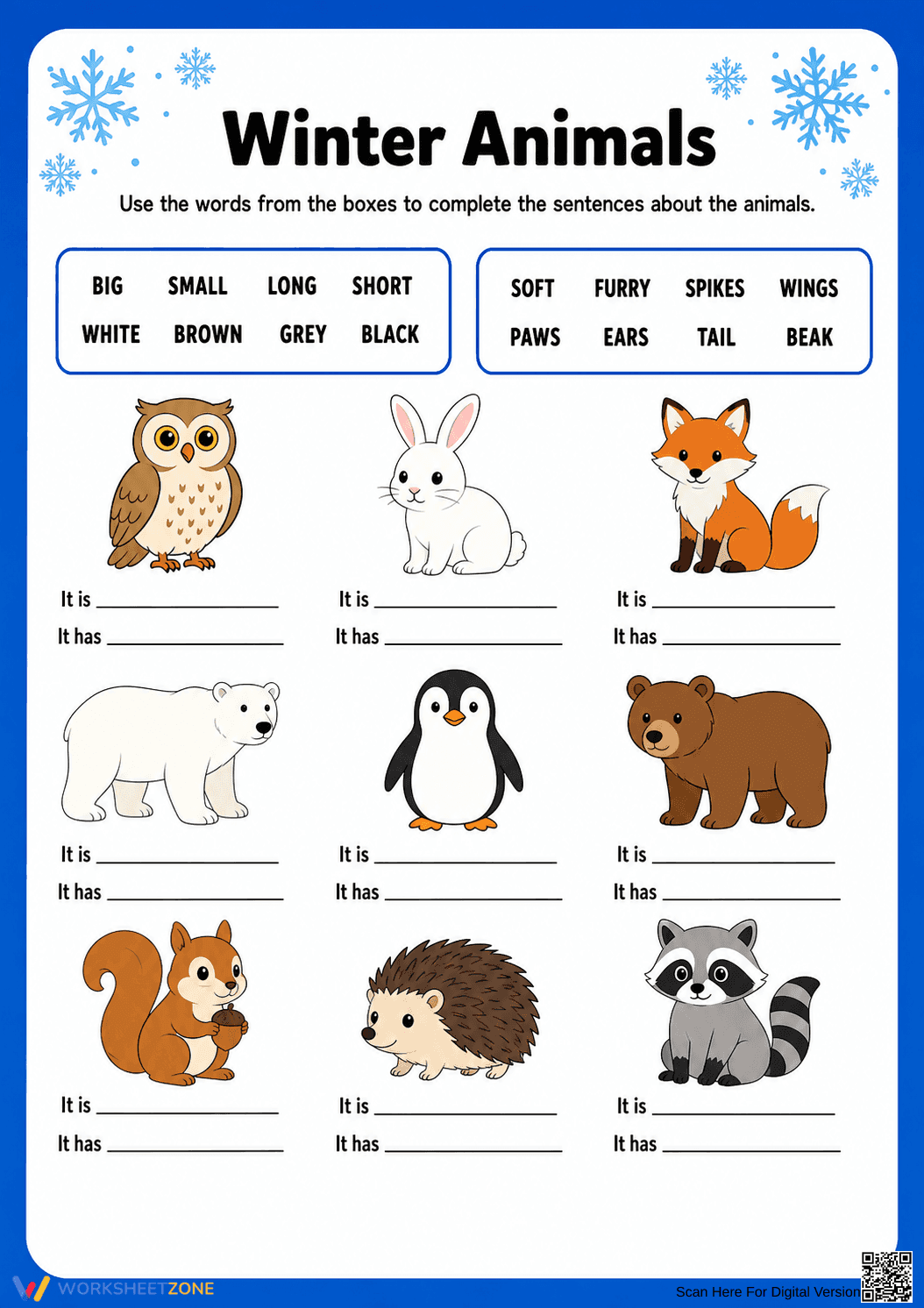
This comprehensive resource features two distinct activity pages. The first page includes a matching exercise where students connect 13 numbered animal names to their corresponding illustrations. The second page provides a structured writing task featuring a word bank of adjectives and physical traits. Students complete 18 fill-in-the-blank sentences to describe nine different animals, focusing on size, color, and body parts like wings, paws, and beaks.
Zero-Prep Workflow
- Print (1 minute): Simply download the PDF and print the two-page set. No special materials or cutting required.
- Distribute (1 minute): Hand out the worksheets along with pencils. The visual instructions and word banks make the tasks immediately clear to students.
- Review (3 minutes): Quickly go over the word bank terms as a class to ensure students understand the vocabulary before they begin independent work.
Total teacher prep time is under two minutes, making this an ideal resource for emergency sub plans or quick transitions.
Standards Alignment
Aligned to primary standard CCSS.ELA-LITERACY.L.1.1.F, this worksheet requires students to use frequently occurring adjectives to describe nouns accurately. It also supports cross-curricular science goals by having students observe and identify the physical characteristics of different animals. Both standard codes can be copied directly into lesson plans, IEP goals, or district curriculum mapping tools.
How to Use It
This worksheet is highly versatile for early elementary classrooms. Use it as an independent practice activity after a direct instruction lesson on winter habitats or animal adaptations. Alternatively, it serves as an excellent morning work assignment to settle students into the day. As a formative assessment tip, observe which students struggle to select appropriate adjectives from the word bank on the second page; this indicates a need for further vocabulary review. Expected completion time is 15 to 20 minutes.
Who It's For
This resource is designed for first-grade students, though it is also highly effective for kindergarteners needing an extra challenge or second graders requiring review. The visual supports and word banks make it particularly accessible for ESL students learning English animal vocabulary. It pairs perfectly with a read-aloud book about winter woodland creatures or a classroom anchor chart detailing animal characteristics.
Integrating cross-curricular activities that combine science concepts with language arts practice significantly enhances early childhood learning outcomes. By aligning to CCSS.ELA-LITERACY.L.1.1.F, where students use frequently occurring adjectives to describe nouns, this worksheet provides meaningful context for vocabulary acquisition. According to Fisher & Frey (2014), providing structured language frames and visual supports helps young learners internalize new vocabulary more effectively than isolated drills. This resource leverages those evidence-based strategies by pairing clear animal illustrations with targeted word banks, ensuring students can successfully articulate their observations while building essential literacy skills. When students connect descriptive words directly to visual representations of animals, they develop a deeper understanding of both the language and the biological concepts. This dual-focus approach maximizes instructional time and fosters stronger retention of foundational academic vocabulary.


