


























Views
Downloads
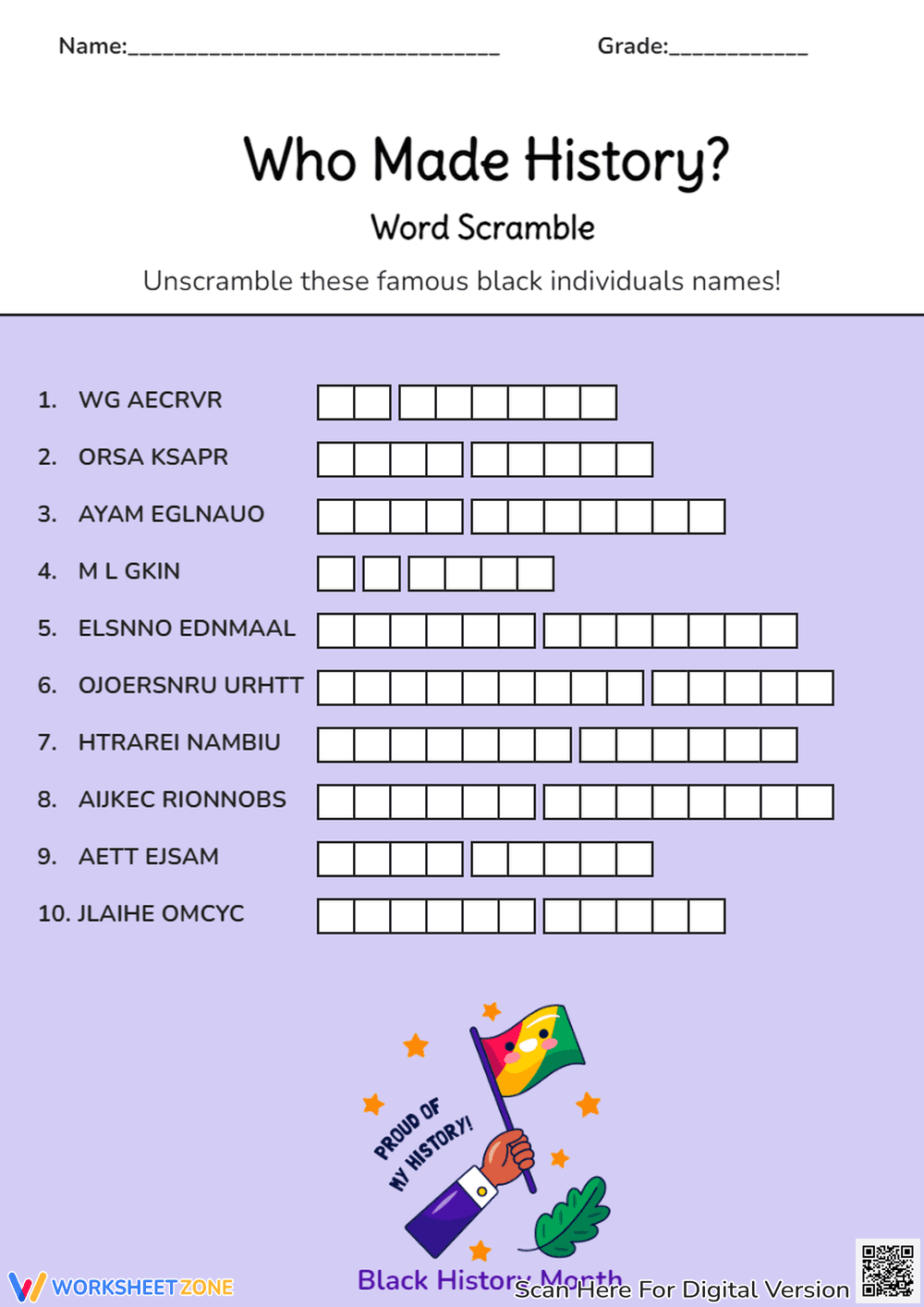

Black History Word Scramble | Essential Grade 10-11
Paste this activity's link or code into your existing LMS (Google Classroom, Canvas, Teams, Schoology, Moodle, etc.).
Students can open and work on the activity right away, with no student login required.
You'll still be able to track student progress and results from your teacher account.
This Grade 10 and 11 Black History worksheet helps students identify influential figures through a challenging word scramble format. By unscrambling names like Nelson Mandela and Sojourner Truth, learners reinforce their knowledge of global and American history while sharpening their spelling and cognitive recall skills. It serves as an engaging supplemental activity for secondary social studies.
At a Glance
- Grade: 10-11 · Subject: History & English
- Standard:
CCSS.ELA-LITERACY.L.9-10.6— Acquire and use accurately general academic and domain-specific words and phrases- Skill Focus: Historical Figure Identification
- Format: 1 page · 10 problems · Answer key included · PDF
- Best For: Bell-ringers or Black History Month
- Time: 10–15 minutes
What's Inside
The resource consists of a single-page PDF featuring 10 scrambled names of iconic Black individuals. Each entry includes a letter-box scaffold to guide students toward the correct character count. The layout is clean and visually engaging, featuring a motivational graphic at the bottom. A comprehensive answer key is provided to ensure quick and accurate grading for busy educators.
Zero-Prep Workflow
- Print: Select the single-page PDF and print enough copies for your class (30 seconds).
- Distribute: Hand out the worksheets as students enter the room for an immediate bell-ringer activity (1 minute).
- Review: Use the included answer key to project the correct names on the board for a quick whole-class check (1 minute).
Total teacher preparation time is under 3 minutes, making it an ideal sub-plan or emergency filler.
Standards Alignment
This activity aligns with CCSS.ELA-LITERACY.L.9-10.6, which requires students to acquire and use accurately general academic and domain-specific words and phrases. By correctly identifying and spelling the names of historical figures, students demonstrate mastery of specific historical terminology. Both standard codes can be copied directly into lesson plans, IEP goals, or district curriculum mapping tools.
How to Use It
Assign this worksheet as a formative assessment at the start of a unit on the Civil Rights Movement to gauge prior knowledge. Alternatively, use it as a fast-finisher task during Black History Month to keep students engaged with relevant content. Observe which names students struggle with most to identify gaps in their historical knowledge that may require further direct instruction. Completion typically takes 12 minutes.
Who It's For
This resource is designed for high school students in Grade 10 or 11 who are studying American or World History. It is particularly effective for English Language Learners who benefit from the visual scaffolding of letter boxes. Pair this activity with a short biography reading or an anchor chart featuring these ten individuals to provide additional context and support.
The use of word scrambles in secondary education serves as a retrieval practice tool that strengthens the neural pathways associated with historical memory. According to the RAND AIRS 2024 report, structured vocabulary and identification tasks in Social Studies help bridge the gap between rote memorization and conceptual understanding. By focusing on the names of significant figures like Elijah McCoy and Etta James, this worksheet supports the CCSS.ELA-LITERACY.L.9-10.6 standard by requiring students to accurately identify domain-specific proper nouns within the context of Black History. Research from Fisher & Frey (2014) suggests that these brief, focused interactions with content-specific vocabulary improve long-term retention and student confidence. This printable resource provides a low-stakes environment for students to demonstrate their knowledge, making it a valuable addition to any high school history or English curriculum seeking to diversify its instructional materials while maintaining academic rigor.


