


























Views
Downloads
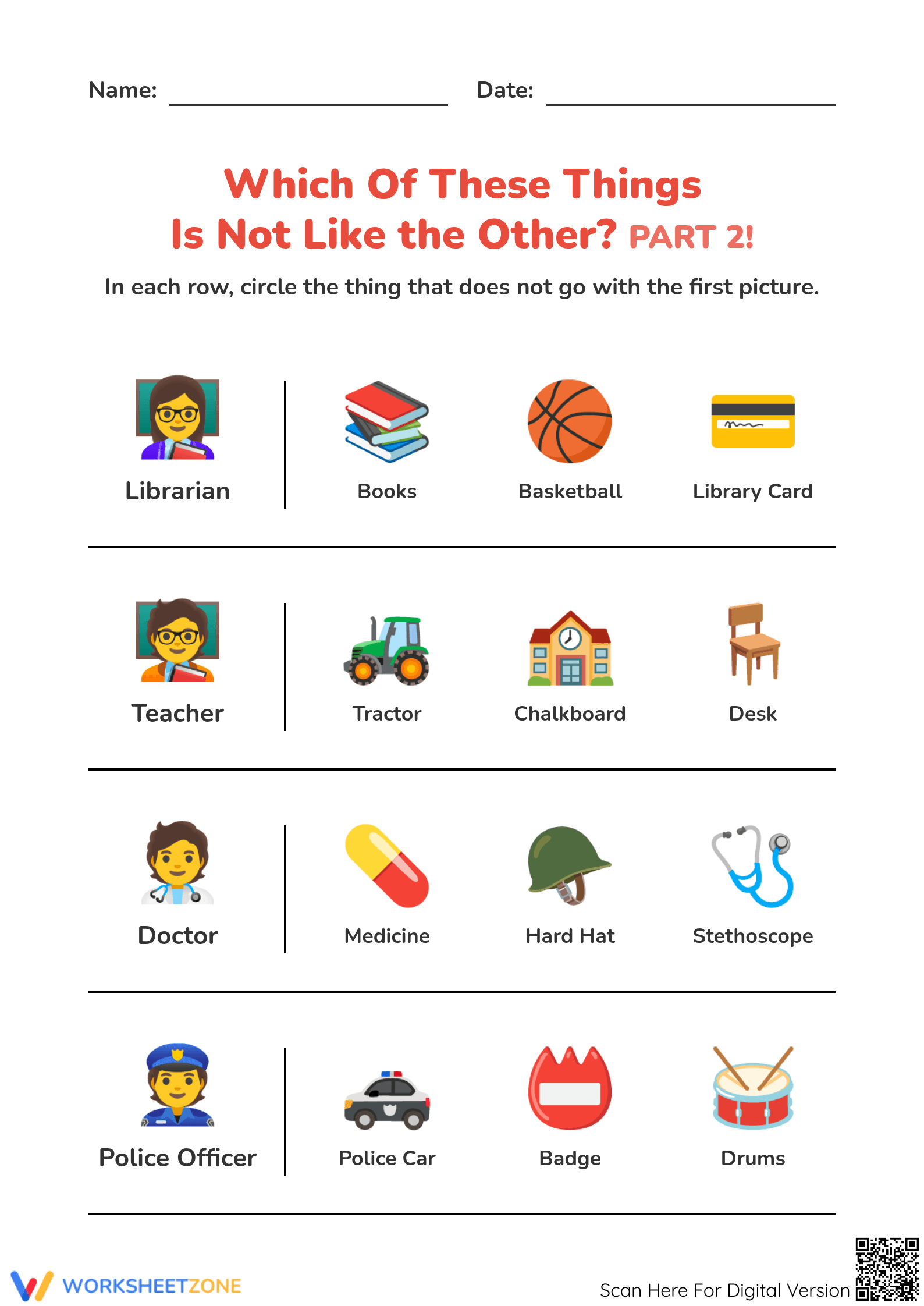

Essential Community Helpers Worksheet | Grade K Logic
Paste this activity's link or code into your existing LMS (Google Classroom, Canvas, Teams, Schoology, Moodle, etc.).
Students can open and work on the activity right away, with no student login required.
You'll still be able to track student progress and results from your teacher account.
This Kindergarten English worksheet helps young learners master categorization and logic through the lens of community helpers. By identifying which object does not belong with a specific professional, students strengthen their vocabulary and critical thinking skills. This activity provides immediate visual feedback, ensuring students understand the relationships between people, tools, and environments.
At a Glance
- Grade: Kindergarten · Subject: English
- Standard:
RF.K.3.A— Demonstrate basic knowledge of letter-sound correspondences and word relationships- Skill Focus: Categorization and Logic
- Format: 1 page · 4 problems · Answer key included · PDF
- Best For: Morning work or social studies integration
- Time: 5–10 minutes
What's Inside: This single-page PDF features four distinct rows, each highlighting a different community helper: a librarian, a teacher, a doctor, and a police officer. Each row presents three associated items and one distractor that does not fit the category. The worksheet includes clear, colorful icons and labels to support early readers, along with a dedicated answer key for quick grading.
Zero-Prep Workflow: Teachers can implement this activity in under two minutes. First, print the single-page PDF for your class (1 minute). Next, distribute the sheets and read the simple instructions aloud to ensure students understand the odd one out concept (30 seconds). Finally, review the answers as a whole group to reinforce the logic behind each correct choice (30 seconds).
Standards Alignment: The primary standard addressed is `CCSS.ELA-LITERACY.RF.K.3.A`, which focuses on foundational reading skills and word recognition. While the task is visual, the inclusion of text labels encourages students to associate spoken sounds with written words. This resource also supports L.K.5.A by requiring students to sort common objects into categories. Both standard codes can be copied directly into lesson plans, IEP goals, or district curriculum mapping tools.
How to Use It: Use this worksheet as a formative assessment during a unit on community helpers to gauge student understanding of professional roles. It also serves as an excellent transition activity between direct instruction and independent centers. Observe if students can verbally explain why the drums do not belong with the police officer to assess their reasoning skills. Completion typically takes 5 to 10 minutes.
Who It's For: This resource is designed for Kindergarten students, including English Language Learners who benefit from visual aids. It is ideal for general education classrooms, special education settings focusing on classification, and homeschooling parents. Pair this worksheet with a community helper anchor chart or a picture book about neighborhood workers for a comprehensive literacy lesson.
This educational resource focuses on the CCSS.ELA-LITERACY.RF.K.3.A standard, facilitating the development of foundational literacy and logical reasoning in Kindergarten students. By engaging in categorization tasks involving community helpers, learners practice identifying relationships between concepts, a precursor to advanced reading comprehension. Research from Fisher & Frey (2014) emphasizes the importance of visual scaffolding and odd-one-out logic in early childhood to build the cognitive frameworks necessary for vocabulary acquisition. This worksheet provides four targeted tasks that require students to discriminate between relevant and irrelevant information, reinforcing the mental schemas associated with social roles and professional tools. The inclusion of labels alongside high-quality icons ensures that students are simultaneously building phonemic awareness and word recognition. According to the RAND AIRS 2024 report, such structured, low-stakes practice is essential for developing the executive function skills required for academic success in later elementary grades.


