




























Views
Downloads

Animal Habitats Worksheet: Grade K Printable Science

Paste this activity's link or code into your existing LMS (Google Classroom, Canvas, Teams, Schoology, Moodle, etc.).
Students can open and work on the activity right away, with no student login required.
You'll still be able to track student progress and results from your teacher account.
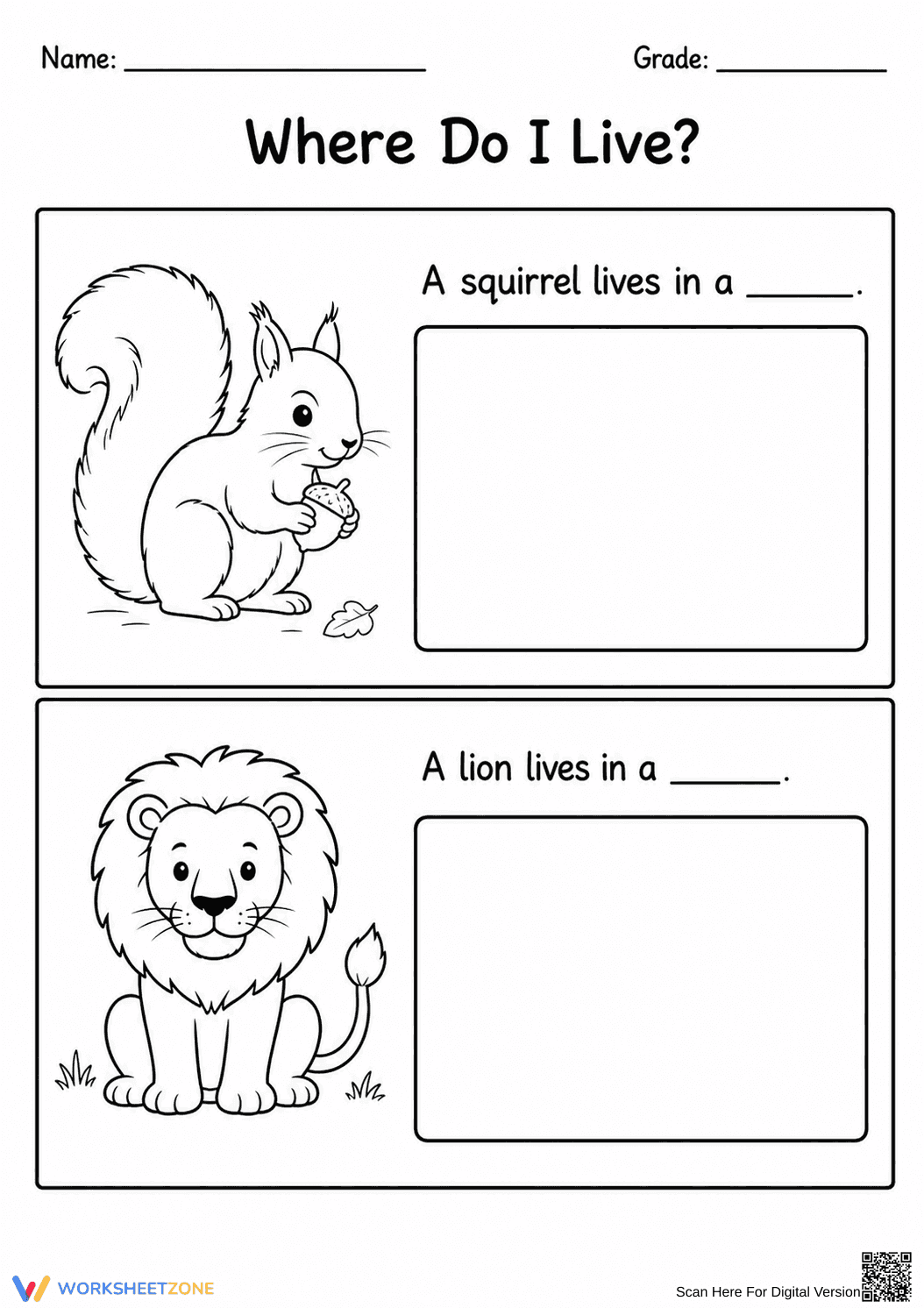
This Grade K animal habitats worksheet helps early learners identify where living things live by connecting animals to their environments. Students observe a squirrel and a lion to determine their natural homes, building foundational science vocabulary and observation skills. This resource ensures students understand the relationship between an organism's needs and its habitat.
At a Glance
- Grade: Kindergarten · Subject: Science
- Standard:
K-ESS3-1— Use a model to represent relationships between animals and where they live- Skill Focus: Identifying animal habitats
- Format: 1 page · 2 problems · Answer key included · PDF
- Best For: Early science introduction and vocabulary building
- Time: 5–10 minutes
What's Inside
Inside this single-page PDF, you will find two clear instructional panels featuring familiar animals: a squirrel and a lion. Each section includes a high-quality line-art illustration for coloring, accompanied by a simple descriptive sentence frame that identifies the animal's home. The worksheet includes a header for student names and grades, making it easy to track progress during independent science rotations.
Zero-Prep Workflow
- Print (1 minute): Generate copies of the single-page PDF for your entire class or science center.
- Distribute (1 minute): Hand out the sheets and ask students to identify the squirrel and lion illustrations.
- Review (5 minutes): Discuss the habitats as students color and complete the sentences, keeping total teacher prep time under 2 minutes.
This resource is also highly suitable for emergency sub-plans due to its self-explanatory nature and clear visual cues.
Standards Alignment
This worksheet is primarily aligned to `K-ESS3-1`: "Use a model to represent the relationship between the needs of different plants or animals (including humans) and the places they live." By using illustrations as models, students visualize the connection between an organism and its environment. Both standard codes can be copied directly into lesson plans, IEP goals, or district curriculum mapping tools.
How to Use It
Use this worksheet as a 'hook' during your introductory lesson on living things and habitats. It is also an excellent formative assessment tool to check for understanding after reading a book about animal homes. For a quick observation tip, watch if students can describe the differences between the tree trunk and the den during the coloring phase.
Who It's For
This resource is perfect for preschool and kindergarten students, particularly those developing early literacy and science vocabulary. It is also highly effective for English Language Learners who benefit from clear visual cues paired with simple sentence structures. Pair this with a local nature walk or a classroom animal anchor chart to reinforce these foundational biological concepts.
The 'Where Do I Live?' worksheet addresses the foundational need for early biological literacy by connecting animals to their survival environments, a core requirement of the NGSS K-ESS3-1 standard. Research from RAND AIRS 2024 emphasizes that providing young learners with clear visual models of animal-environment relationships significantly improves their ability to categorize living things based on observable traits. By identifying that a squirrel lives in a tree and a lion in a den, students move from simple identification to understanding the relationship between a creature's physical needs and its geographical location. This instructional approach facilitates the development of spatial reasoning and scientific vocabulary in preschool and kindergarten settings. The explicit pairing of text and imagery ensures that students are engaging with the cross-cutting concept of systems and system models as defined in contemporary US educational frameworks. This resource provides a robust starting point for mastery.


