


























Views
Downloads
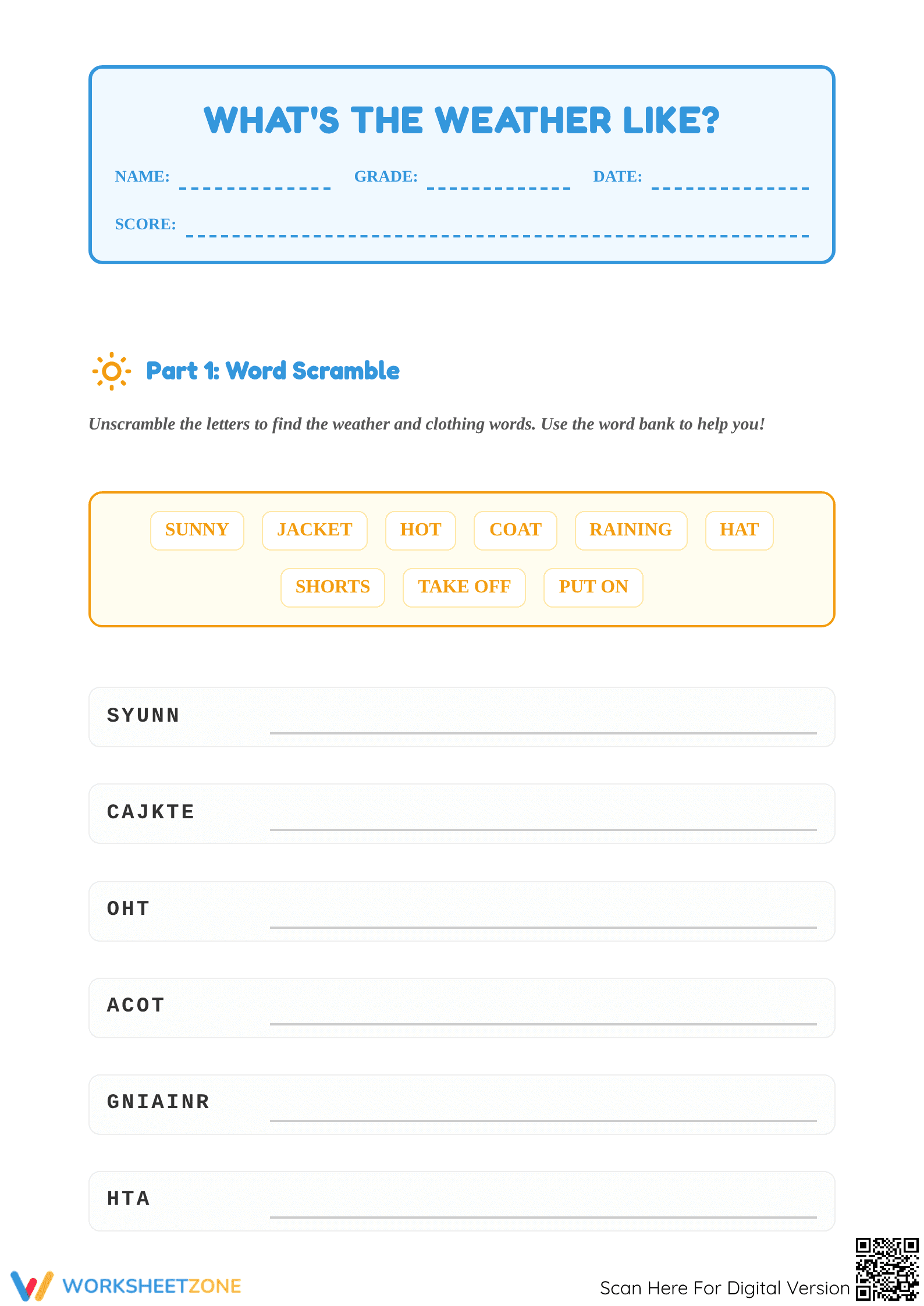


Weather Vocabulary Worksheet | Grade 2 Printable
Paste this activity's link or code into your existing LMS (Google Classroom, Canvas, Teams, Schoology, Moodle, etc.).
Students can open and work on the activity right away, with no student login required.
You'll still be able to track student progress and results from your teacher account.
This engaging Grade 2 vocabulary worksheet helps students master weather and clothing terminology while building essential spelling skills. By unscrambling words, matching conditions to appropriate attire, and illustrating current weather, young learners develop practical language abilities that connect directly to their daily lives and routines.
At a Glance
- Grade: 2 · Subject: ELA
- Standard:
CCSS.ELA-LITERACY.L.2.5.A— Identify real-life connections between words and their use- Skill Focus: Weather and clothing vocabulary
- Format: 3 pages · 14 problems · Answer key included · PDF
- Best For: Independent practice and morning work
- Time: 15–20 minutes
This three-page resource features a nine-word scramble with a helpful word bank to support spelling accuracy. The second part offers a four-question matching activity where students pair weather conditions with correct clothing items. Finally, a creative drawing and sentence-completion prompt allows students to apply their new vocabulary to the actual weather outside. A complete answer key is provided.
- Guided practice: The word scramble provides a structured word bank, allowing students to focus on spelling patterns without generating words from scratch.
- Supported practice: The matching section requires students to apply logical reasoning, connecting specific weather conditions to appropriate gear.
- Independent practice: The final drawing and writing task removes scaffolds, prompting students to observe their environment and write a complete sentence. This follows a clear gradual-release model.
Aligned to primary standard CCSS.ELA-LITERACY.L.2.5.A, this worksheet requires students to identify real-life connections between words and their use. It supports foundational spelling by having students unscramble high-frequency seasonal words. Both standard codes can be copied directly into lesson plans, IEP goals, or district curriculum mapping tools.
This resource is highly versatile for the primary classroom. Use it as an engaging morning work activity during a science unit on weather, or assign it as independent practice after a whole-group lesson on seasonal clothing. As a formative assessment tip, observe how students complete the final sentence prompt; this will quickly reveal whether they can accurately pair a weather condition with a logical clothing choice in their own writing. Expect students to complete the 14 tasks in about 15 to 20 minutes.
This worksheet is designed for second-grade students developing their practical vocabulary and spelling skills. The included word bank provides built-in differentiation for emerging readers or English Language Learners who might need extra support with spelling. It pairs perfectly with a daily calendar routine, a weather anchor chart, or a read-aloud book about the changing seasons.
Integrating thematic vocabulary into daily routines significantly enhances language acquisition for early elementary students. According to Fisher & Frey (2014), providing students with structured opportunities to apply new vocabulary in meaningful, real-world contexts deepens their semantic understanding and retention. This worksheet directly supports CCSS.ELA-LITERACY.L.2.5.A by asking students to identify real-life connections between words and their use. By linking abstract weather concepts to tangible clothing choices, learners bridge the gap between academic language and everyday life. The progression from unscrambling letters to writing a complete, context-appropriate sentence ensures that students are not just memorizing terms, but actively constructing meaning. Teachers can rely on this evidence-based approach to build robust vocabulary skills while simultaneously reinforcing spelling and logical reasoning in the primary classroom.


