


























Views
Downloads

Essential Grade 5 Bird Dichotomous Key Printable Worksheet
Paste this activity's link or code into your existing LMS (Google Classroom, Canvas, Teams, Schoology, Moodle, etc.).
Students can open and work on the activity right away, with no student login required.
You'll still be able to track student progress and results from your teacher account.
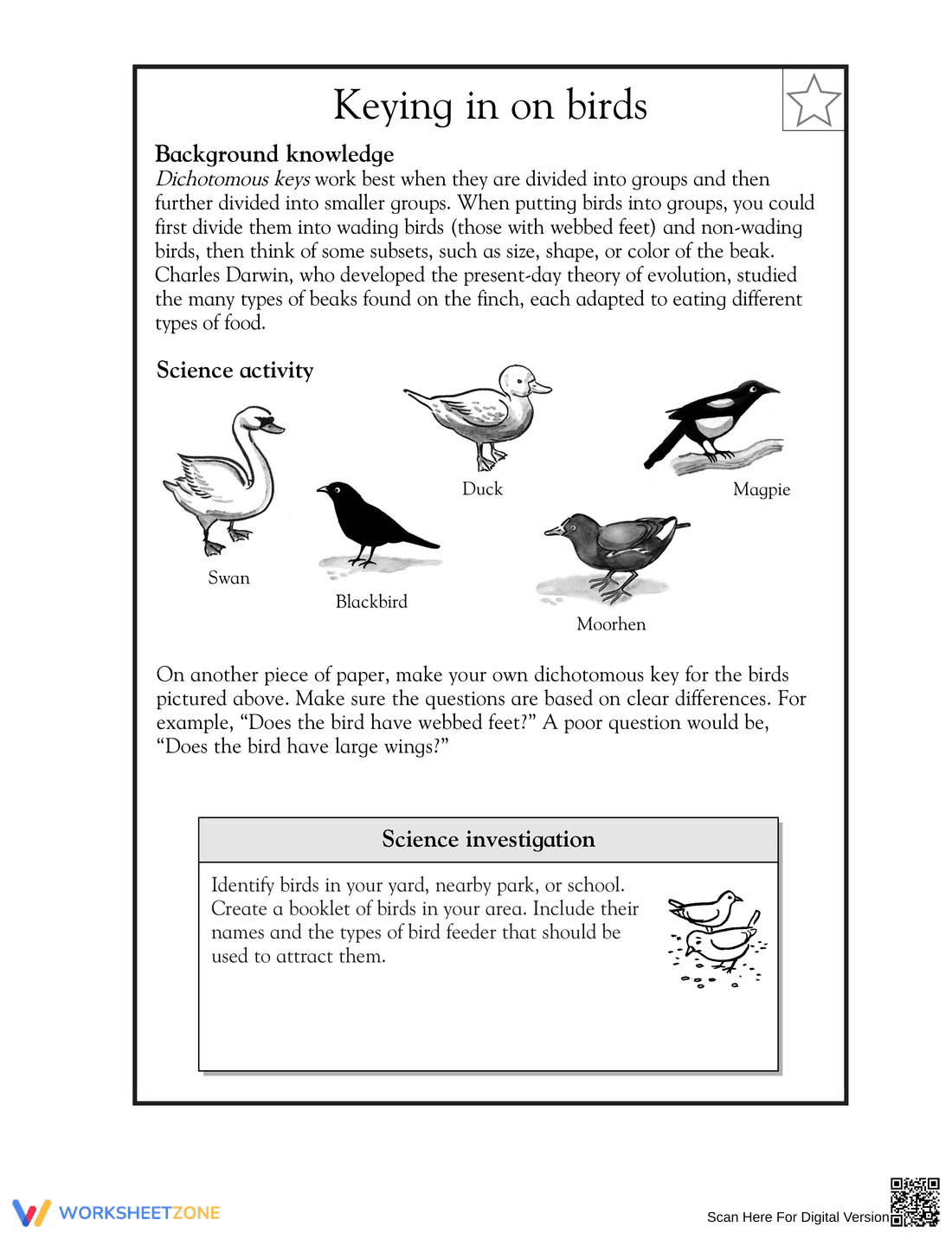
Empower your students to classify living organisms with precision using this specialized Grade 5 bird dichotomous key worksheet. Students will analyze five distinct bird species—from the webbed-footed swan to the seed-eating magpie—to construct their own branching identification system. This activity transforms abstract biological concepts into a concrete, hands-on sorting exercise for young scientists.
At a Glance
- Grade: 5 · Subject: Living Things
- Standard:
5-LS2-1— Classify organisms based on observable physical traits and structural adaptations- Skill Focus: Dichotomous Key Construction
- Format: 1 page · 2 tasks · Answer key included · PDF
- Best For: Independent science centers or sub plans
- Time: 25–35 minutes
What's Inside
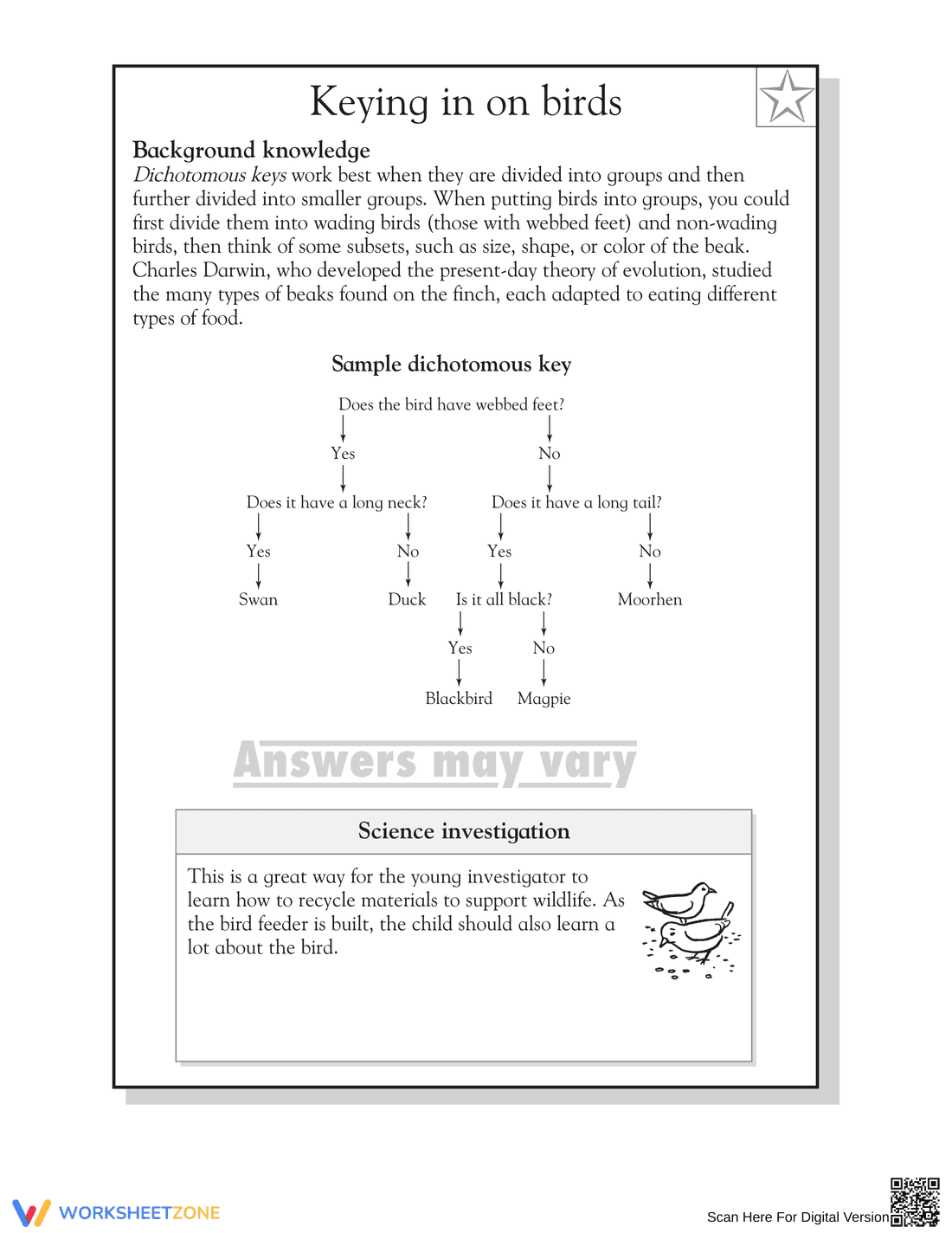
This single-page science resource features a clear introduction to dichotomous key logic and a background section on Charles Darwin's finch research. Students analyze illustrations of five birds: the swan, blackbird, duck, magpie, and moorhen. The primary task requires generating yes/no questions to separate species based on anatomical differences. A secondary investigation block prompts local bird observation, bridging theory with field-based data.
Zero-Prep Workflow
- Print (30 Seconds): Generate class sets directly from the PDF. No resizing or margin adjustments required.
- Distribute (30 Seconds): Hand out the worksheets to individual students or small lab groups to begin the classification activity immediately.
- Review (5 Minutes): Use the included answer key to verify student logic. The branching structure allows for quick visual assessment of correct classification paths.
Total teacher preparation time is under two minutes, making this an ideal choice for emergency sub plans or science lab rotations.
Standards Alignment
This worksheet is aligned to 5-LS2-1: "Develop a model to describe the movement of matter among plants, animals, decomposers, and the environment." By identifying webbed feet and beak shapes, students analyze the structural adaptations mentioned in the standard's broader ecological context. Both standard codes can be copied directly into lesson plans, IEP goals, or district curriculum mapping tools.
How to Use It
Deploy this during the 'Elaborate' phase of a 5E lesson cycle. It serves as an excellent formative assessment of student ability to distinguish anatomical features. Allow 15 minutes for key construction and 10 minutes for peer-review. The extension investigation can be assigned as homework to promote outdoor observation and real-world application of scientific skills.
Who It's For
This resource is designed for Grade 5 science students exploring life diversity. It provides scaffolding for struggling learners through visual aids while challenging advanced students with open-ended key construction. It pairs naturally with units on animal adaptations, local ecosystems, or introductory lessons on evolutionary biology and historical scientific research.
The use of dichotomous keys in Grade 5 science education serves as a fundamental bridge between basic observation and complex taxonomic reasoning. This worksheet aligns with the 5-LS2-1 standard by requiring students to identify specific structural adaptations, such as beak shape and foot webbing, to differentiate between species. According to research in ScienceDirect TpT Analysis (2024), scaffolded classification tasks significantly improve student retention of biological hierarchy concepts compared to passive reading alone. By requiring students to generate their own identifying questions, the activity encourages higher-order thinking and precise scientific communication. This resource provides a structured environment for students to apply the 5-LS2-1 standard, ensuring they can categorize organisms based on observable traits. The inclusion of a field-based science investigation further extends the learning beyond the classroom, fostering real-world application of classification skills. It is a robust tool for meeting core life science objectives through active, evidence-based inquiry.


