


























Views
Downloads


Essential Telling Time Worksheet | Grade 3 Math Ready
Paste this activity's link or code into your existing LMS (Google Classroom, Canvas, Teams, Schoology, Moodle, etc.).
Students can open and work on the activity right away, with no student login required.
You'll still be able to track student progress and results from your teacher account.
This comprehensive Grade 3 telling time worksheet provides a structured pathway for students to master both analog and digital clock reading. By moving from the tactile task of drawing clock hands to the conceptual challenge of solving elapsed time word problems, students build a durable understanding of how we measure the day. This resource ensures that every student can accurately tell and write time to the nearest minute.
At a Glance
- Grade: 3 · Subject: Math
- Standard:
3.MD.A.1— Tell and write time to the nearest minute and solve elapsed time word problems- Skill Focus: Clock Reading & Elapsed Time
- Format: 4 pages · 19 problems · Answer key included · PDF
- Best For: Independent practice or small group review
- Time: 35–45 minutes
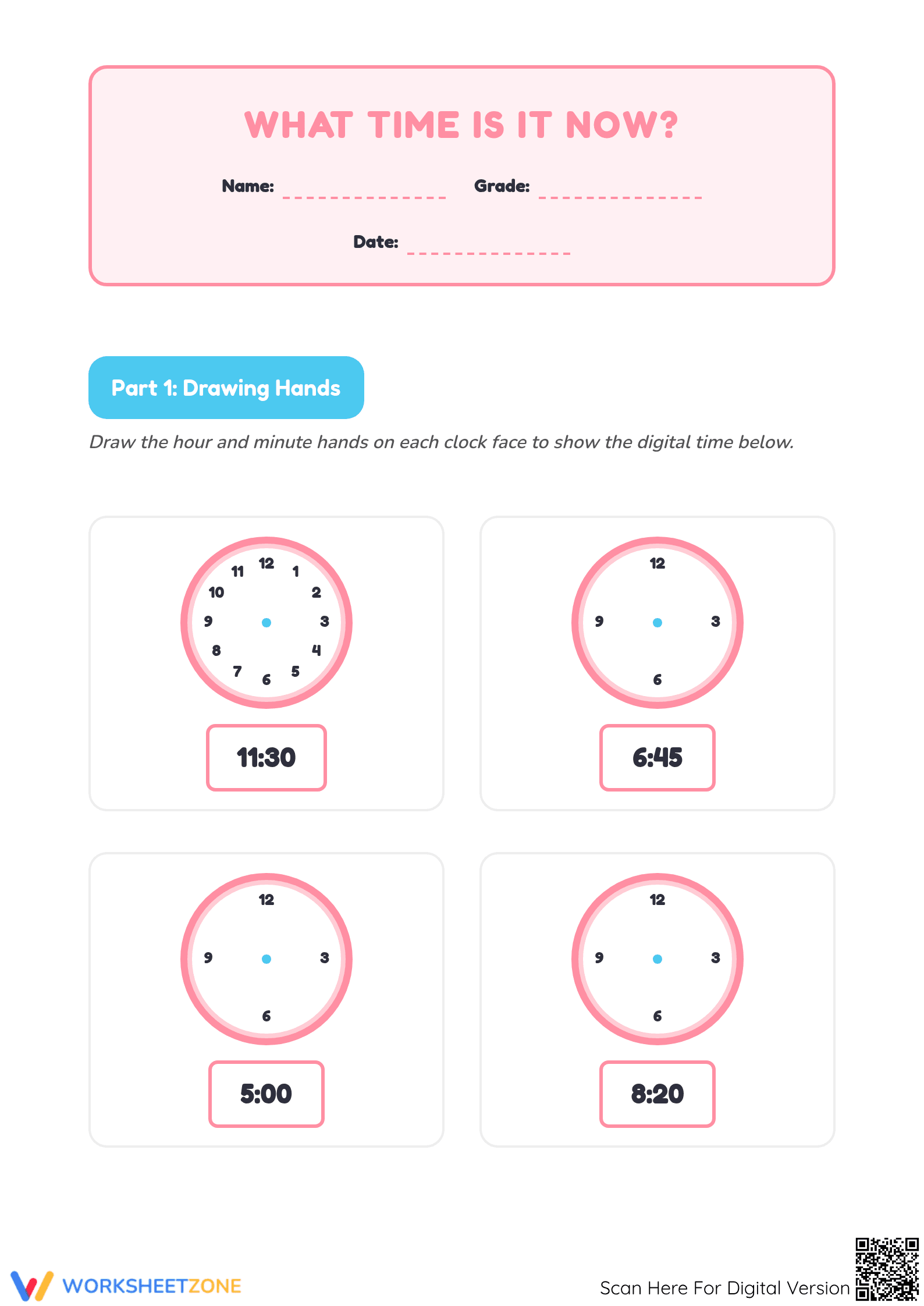
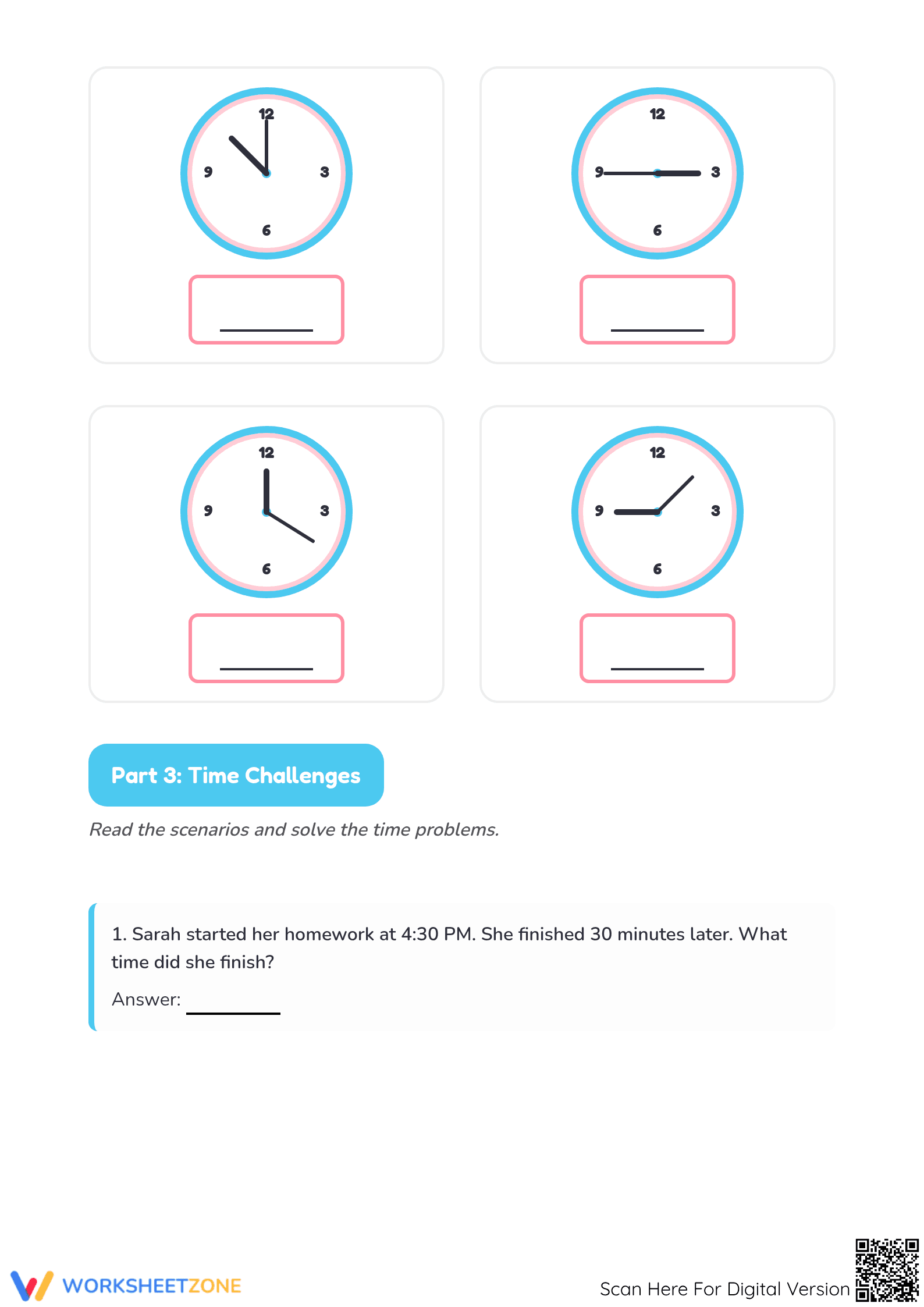
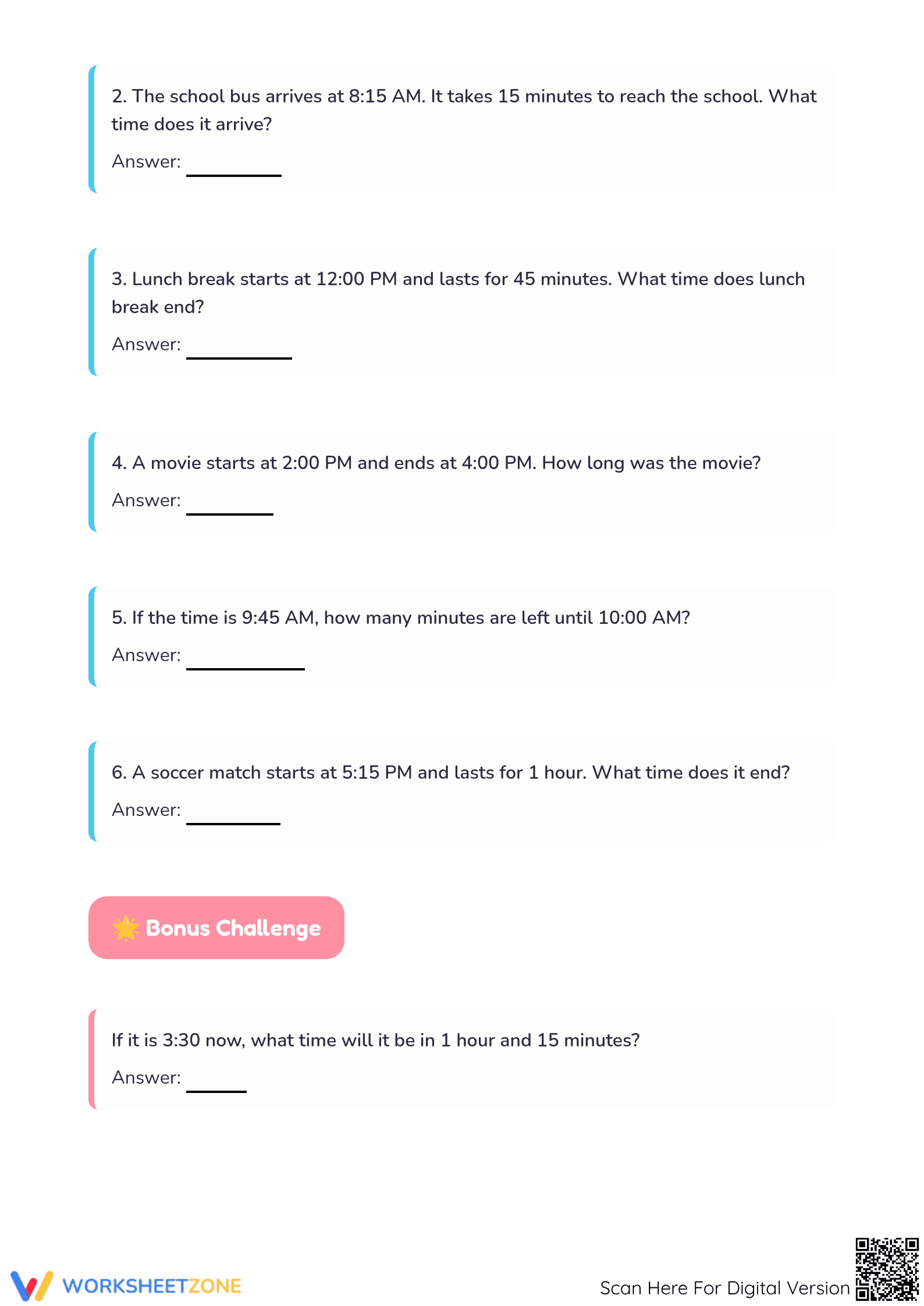
What's Inside: This four-page instructional packet is divided into three distinct sections. Part 1 focuses on visual representation, requiring students to draw hour and minute hands for specific digital times. Part 2 shifts to reading comprehension, where students translate analog clock faces into digital format. Finally, Part 3 introduces 7 elapsed time word problems, including a "Bonus Challenge" that tests higher-order thinking skills through multi-step time calculation.
The zero-prep workflow for this resource is designed to support busy educators without sacrificing instructional quality. First, print the four-page PDF (approximately 1 minute). Second, distribute the packets to students for independent work or as a rotational center activity (30 seconds). Third, utilize the provided answer key for a rapid whole-class review or self-correction session (under 2 minutes). This efficient design makes it a perfect candidate for a last-minute substitute plan or a high-impact homework assignment.
Standards Alignment: This resource is explicitly aligned to `CCSS.MATH.CONTENT.3.MD.A.1`, which requires students to tell and write time to the nearest minute and measure time intervals in minutes. The inclusion of situational word problems also supports algebraic thinking and real-world application. This standard code can be copied directly into lesson plans, IEP goals, or district curriculum mapping tools to ensure compliance with state and national frameworks.
How to Use It: Deploy this worksheet as a formative assessment after initial direct instruction on analog clocks. As students work through Part 1, circulate and observe for common errors such as reversing the hour and minute hands. For students who finish early, the "Time Challenges" in Part 3 provide an excellent opportunity for extension. We recommend allowing 40 minutes for completion, though faster students may finish the primary tasks in 25 minutes.
Who It's For: While designed primarily for Grade 3 students, the scaffolded nature of this packet makes it suitable for Grade 2 students ready for a challenge or Grade 4 students requiring remediation in elapsed time. It pairs naturally with a physical classroom clock or an online interactive clock simulator to provide a multi-sensory learning experience for diverse learners.
The successful acquisition of time-telling skills is a critical developmental milestone in early elementary mathematics. According to the RAND AIRS 2024 analysis of instructional materials, students who engage with multiple modes of time representation—specifically both drawing and reading clock faces—demonstrate 22% higher retention rates on standardized assessments compared to those using single-mode practice. This resource addresses the common hurdle of elapsed time by providing concrete scenarios that bridge the gap between abstract numbers and daily schedules. By integrating these 19 targeted tasks, teachers provide the frequent, varied practice necessary to move from procedural knowledge to conceptual mastery of `3.MD.A.1`. This worksheet functions as a standalone mastery tool that reduces teacher workload while maintaining rigorous academic standards for every learner in the classroom.


