


























Views
Downloads
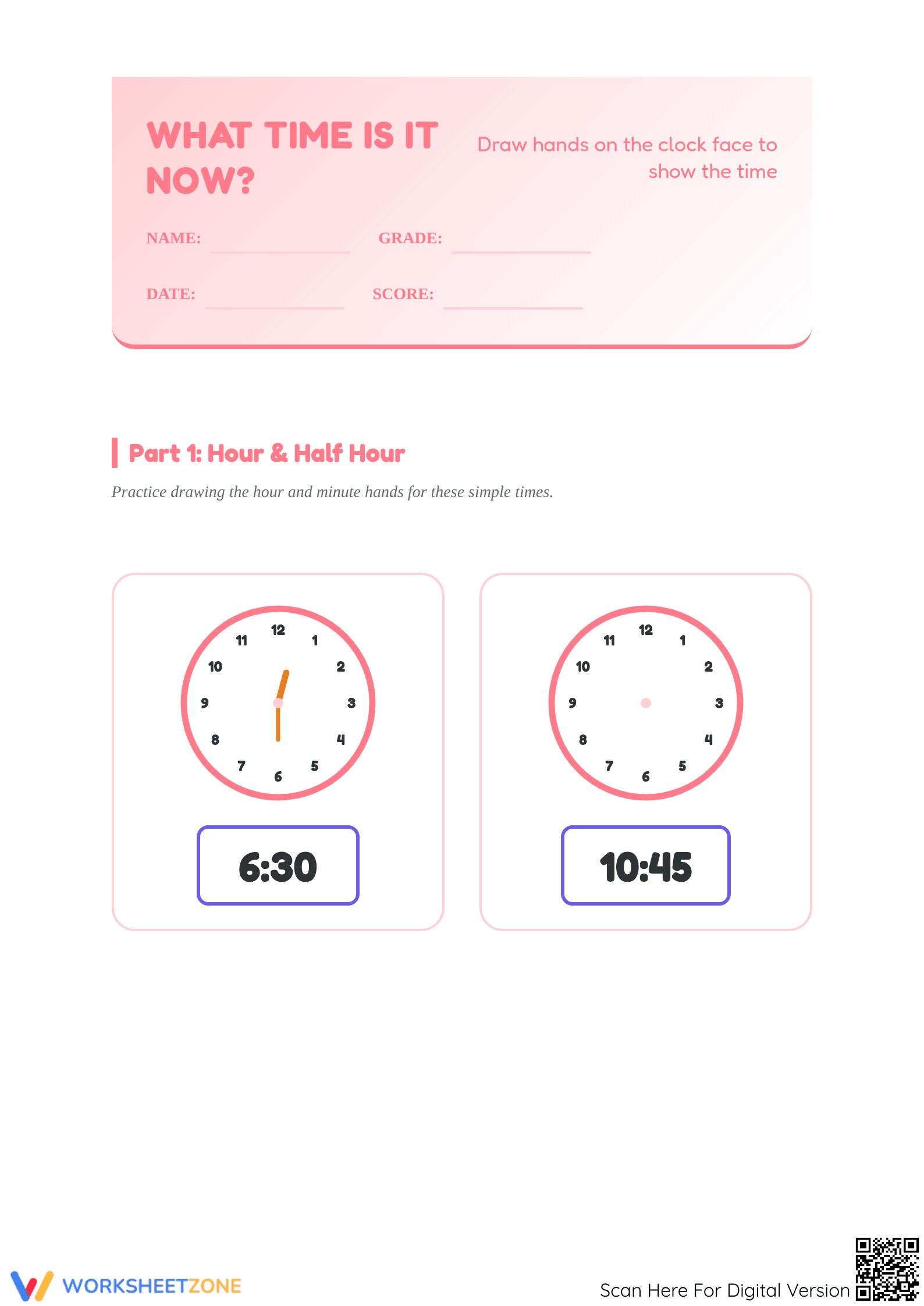
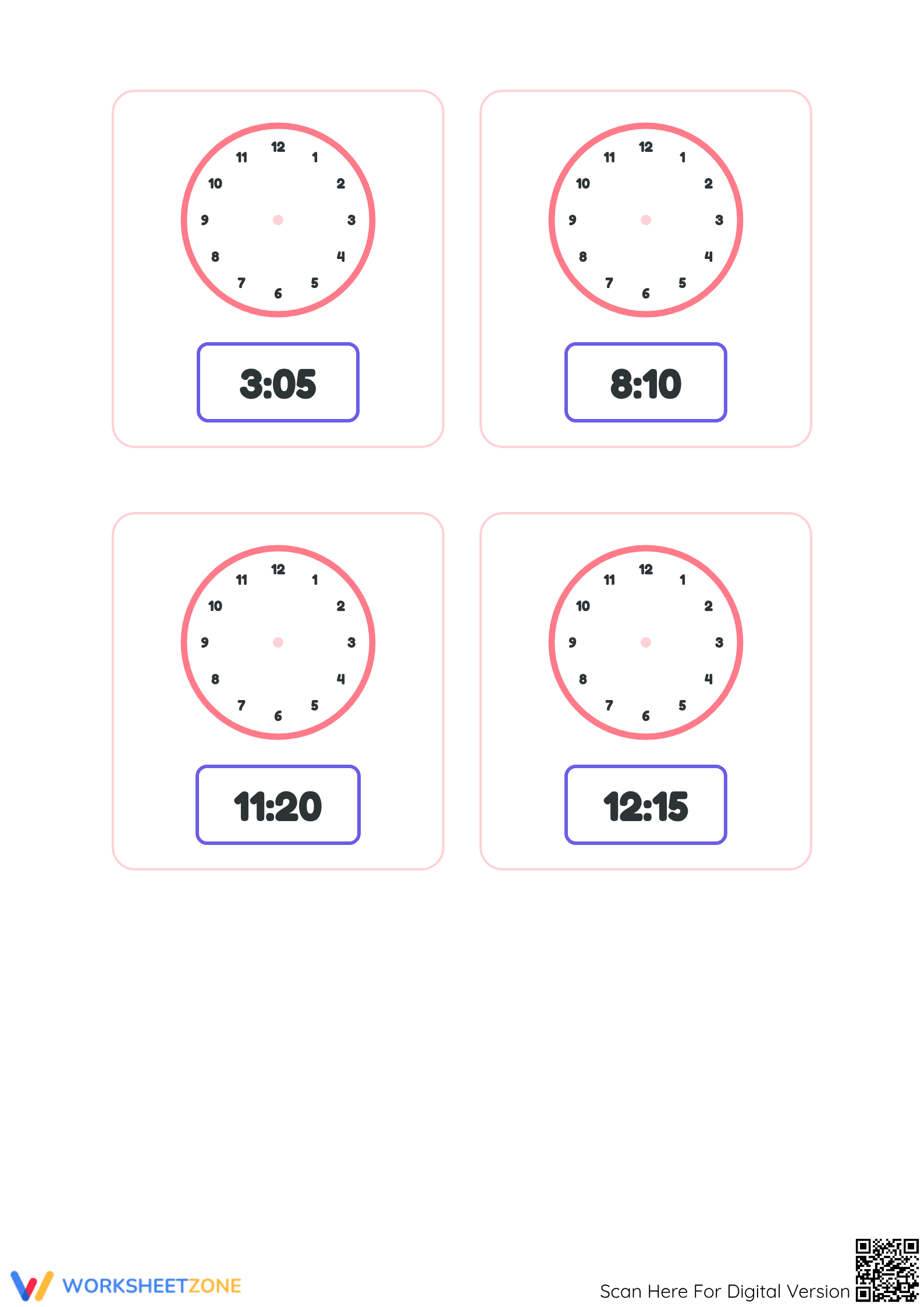
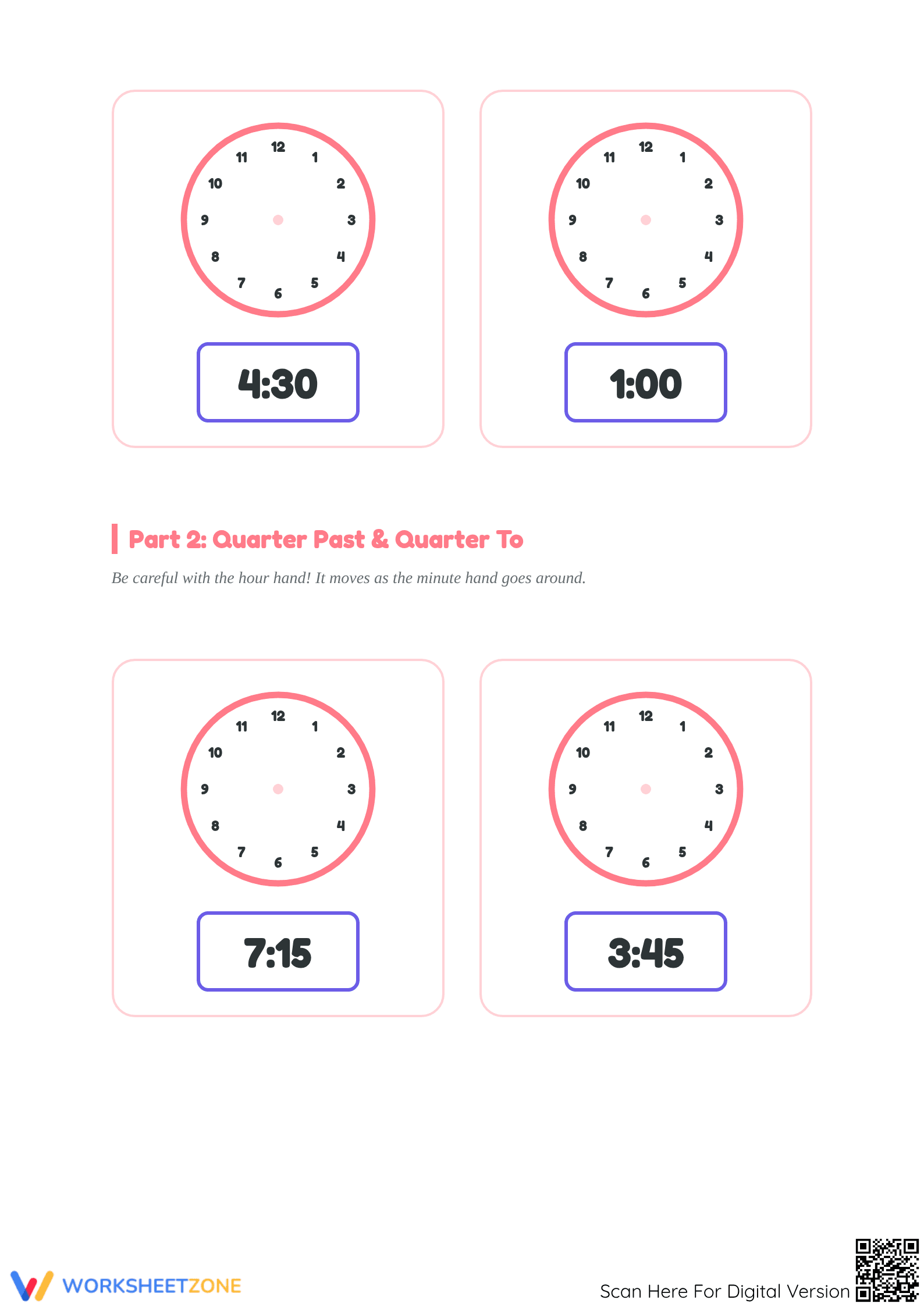

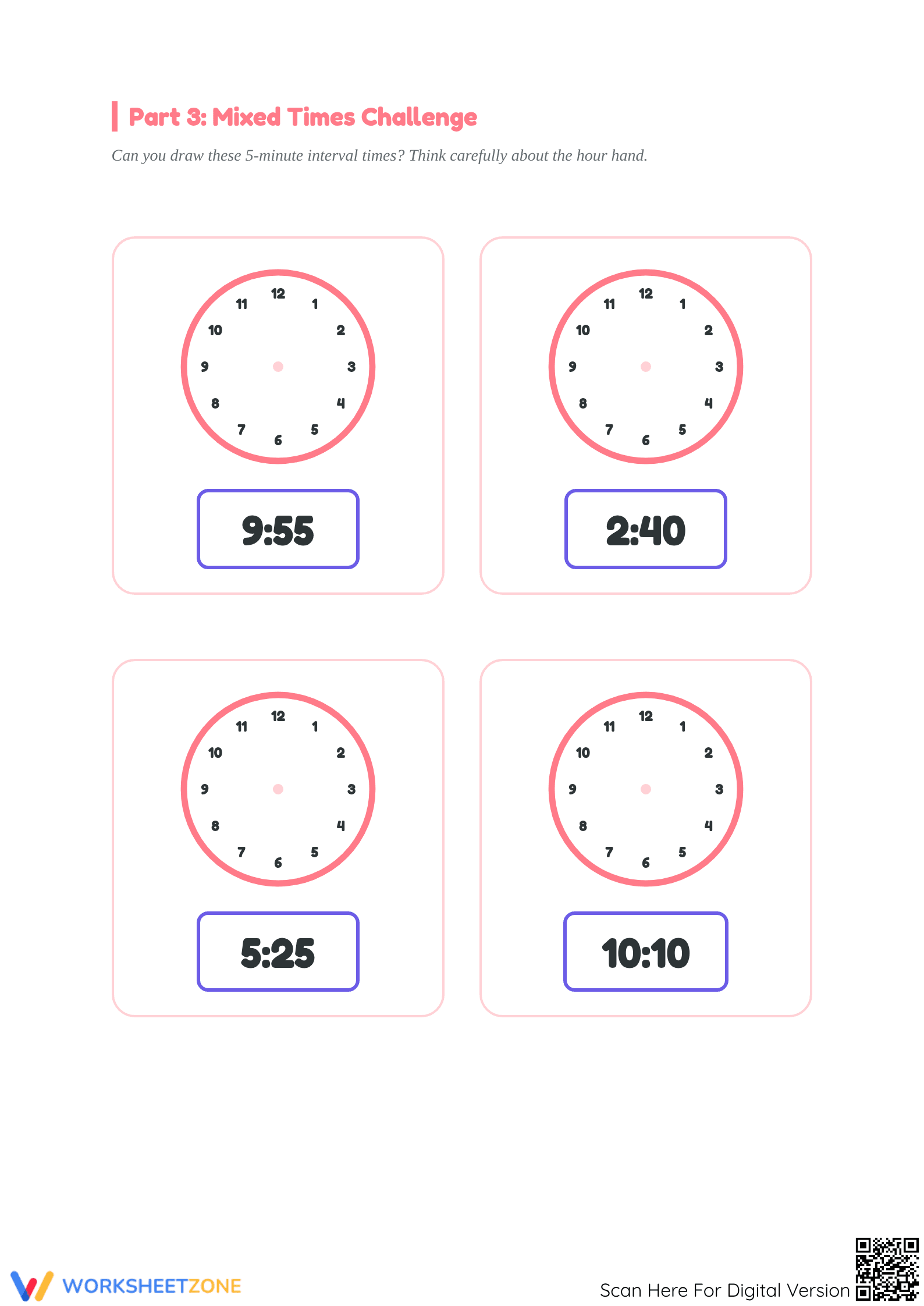

Printable Telling Time Worksheet | Grade 2-4 Math Practice
Paste this activity's link or code into your existing LMS (Google Classroom, Canvas, Teams, Schoology, Moodle, etc.).
Students can open and work on the activity right away, with no student login required.
You'll still be able to track student progress and results from your teacher account.
Mastering the analog clock is a foundational numeracy skill that bridges simple counting with complex temporal reasoning. This comprehensive 5-page practice set guides students through the mechanics of drawing clock hands to represent specific digital times. By translating digital inputs into physical visual representations, learners develop a concrete understanding of how hours and minutes interact.
At a Glance
- Grade: 2–4 · Subject: Math (Time)
- Standard:
2.MD.C.7— Tell and write time from analog and digital clocks to the nearest five minutes- Skill Focus: Drawing analog clock hands (Hours, Minutes, Intervals)
- Format: 5 pages · 18 problems · Answer key included · PDF
- Best For: Independent practice or formative assessment
- Time: 20–35 minutes
This packet contains five structured pages divided into three distinct parts. It features eighteen high-quality analog clock faces with empty centers, accompanied by digital time stamps. The layout includes ample space for student names and scores, a clear hierarchical progression from simple to complex intervals, and a complete answer key for rapid grading or self-correction.
Skill Progression
- Guided Practice: Part 1 introduces hour and half-hour intervals with foundational problems, allowing students to orient the shorter and longer hands without the distraction of minute-level complexity.
- Supported Practice: Part 2 expands to "quarter past" and "quarter to" positions, incorporating clocks that require precise hand placement to demonstrate an understanding of fifteen and forty-five minute segments.
- Independent Practice: The final challenge presents mixed times at five-minute intervals, requiring students to synthesize their knowledge of clock quadrants and hand length differentiation to achieve 100% accuracy.
The sequence follows a gradual-release model, moving from high-frequency time markers to specific 5-minute increments.
Standards Alignment
The primary standard addressed is 2.MD.C.7, which requires students to tell and write time from analog and digital clocks to the nearest five minutes. This resource specifically targets the "writing" aspect by asking students to graphically represent digital data. Both standard codes can be copied directly into lesson plans, IEP goals, or district curriculum mapping tools.
How to Use It
Use this worksheet as a summative assessment following a unit on time or as a targeted intervention for students struggling with hand differentiation. During completion, observe whether students are adjusting the hour hand slightly forward as the minute hand advances—a key indicator of conceptual mastery. Expected completion time is approximately thirty minutes for most third-grade learners.
Who It's For
This resource is designed for second through fourth-grade students requiring structured practice in temporal representation. It serves as an excellent resource for general education classrooms, special education small groups, or as a homework reinforcement tool. Pair this with a physical manipulative clock to provide a tactile anchor before transitioning to these printable drawing tasks.
The transition from digital to analog time representation is a critical cognitive step in developing "temporal literacy." According to Fisher & Frey (2014), the Gradual Release of Responsibility model is most effective when students move from teacher-modeled examples to independent graphical construction, as seen in this 18-task progression. By requiring students to draw hands rather than merely read them, this worksheet engages higher-order spatial reasoning skills and reinforces the base-60 nature of the clock face. The specific standard 2.MD.C.7 ensures that students meet national expectations for second-grade mastery while providing necessary scaffolding for third and fourth-grade remediation. Research from NAEP suggests that consistent practice with multiple clock formats—both digital and analog—is essential for long-term retention of time-telling concepts. This resource provides that essential repetition in a classroom-ready, standards-aligned format that simplifies data collection for educators.


