


























Views
Downloads

Essential Grade 2 Science: What Plants Need to Grow
Paste this activity's link or code into your existing LMS (Google Classroom, Canvas, Teams, Schoology, Moodle, etc.).
Students can open and work on the activity right away, with no student login required.
You'll still be able to track student progress and results from your teacher account.
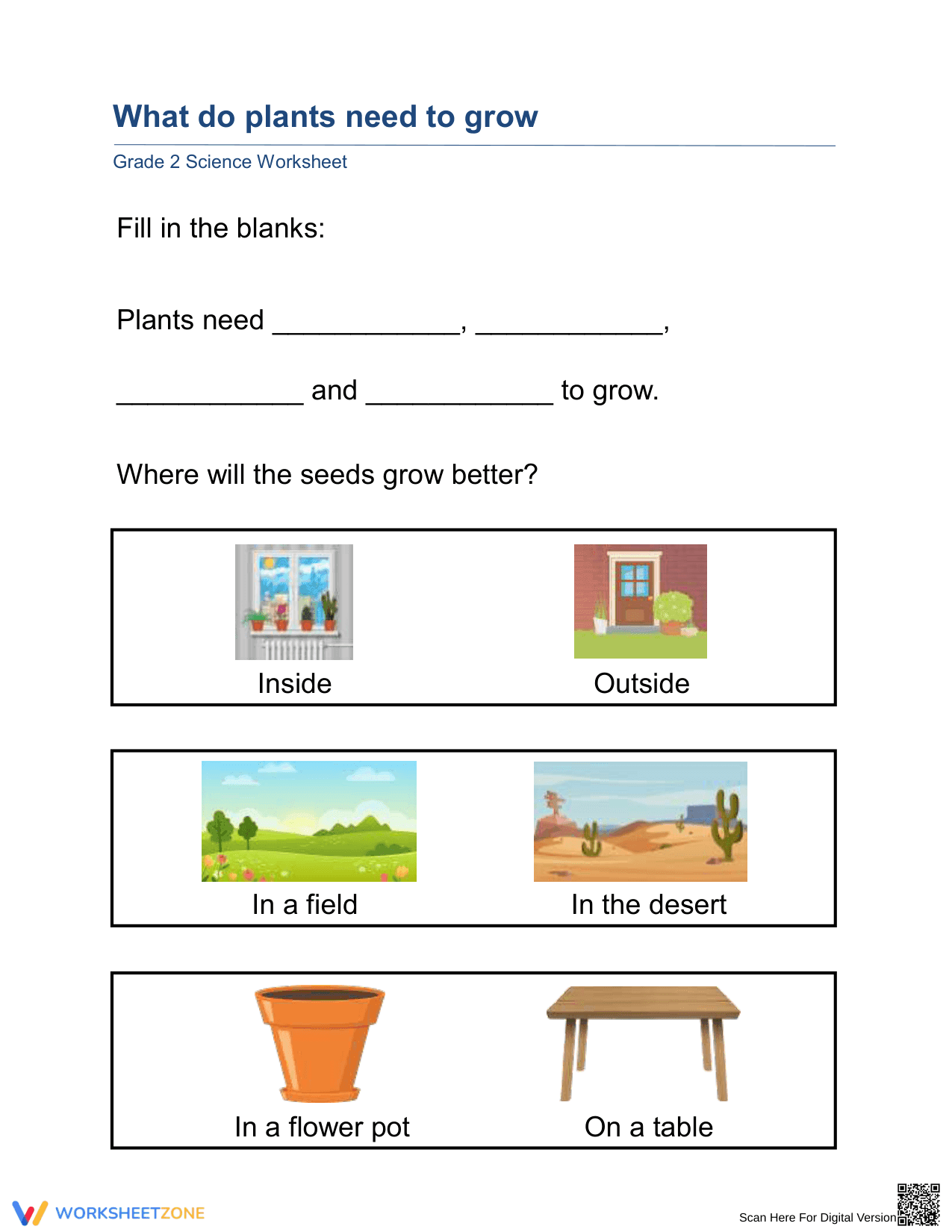
Identify what plants need to survive with this Grade 2 science worksheet. Students demonstrate their understanding of biological requirements by completing fill-in-the-blank sentences and evaluating growing environments. This resource ensures learners grasp the relationship between living things and their environment through clear visual and textual prompts.
At a Glance
- Grade: 2 · Subject: Living Things
- Standard:
2-LS2-1— Identify whether plants need sunlight and water to grow and survive- Skill Focus: Plant life cycles and survival requirements
- Format: 1 page · 4 problems · Answer key included · PDF
- Best For: Independent practice or quick formative assessment
- Time: 10–15 minutes
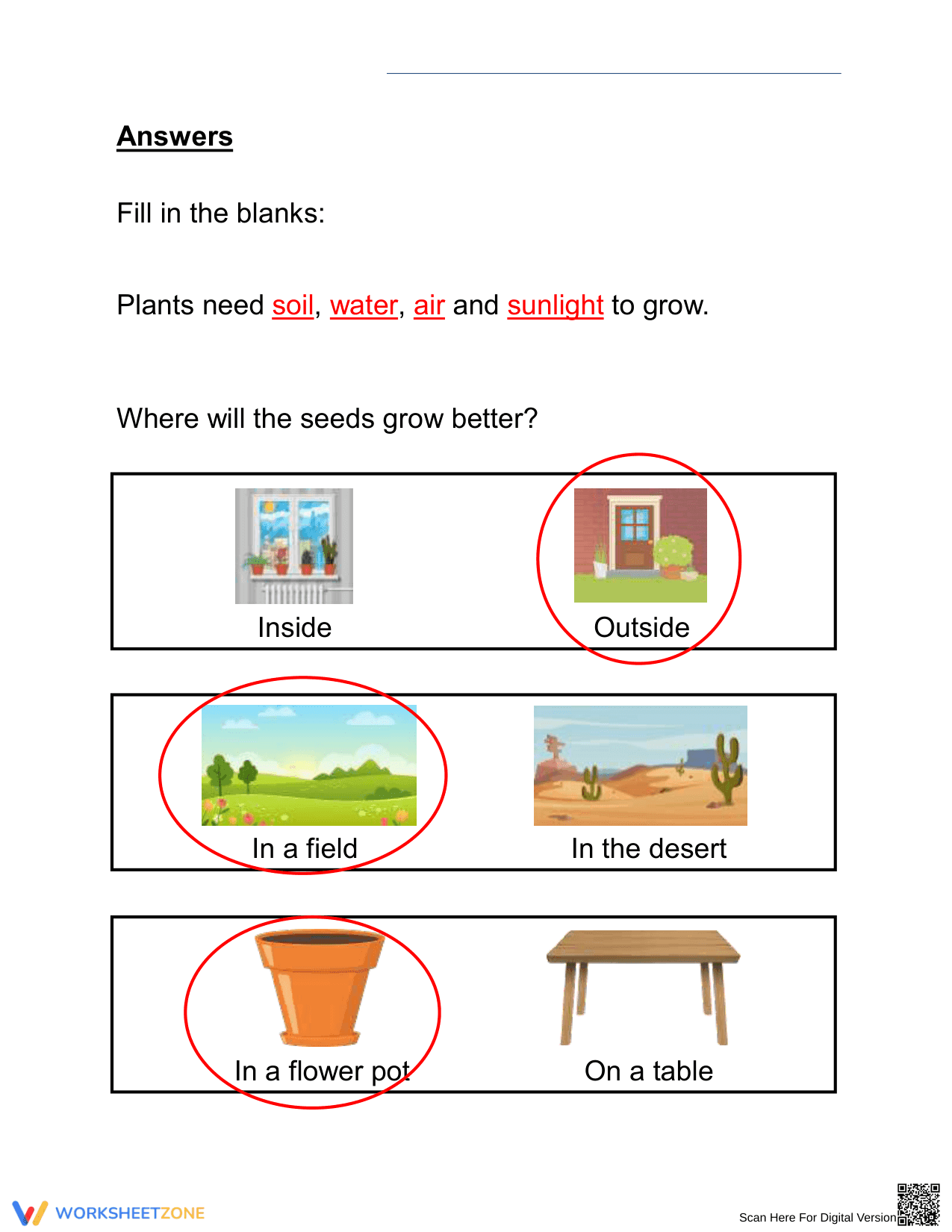
This single-page PDF reviews the four essential components plants require: sun, soil, water, and air. The worksheet begins with a fill-in-the-blank exercise to reinforce vocabulary, followed by three visual comparison tasks. These challenges ask students to determine where seeds will grow better, such as a field versus a desert. A full answer key is included.
The zero-prep workflow is designed for maximum efficiency. Teachers can print the single-page document in 30 seconds. Distribution to a class takes 1 minute, and the simple layout allows for a 2-minute review session at the end of the period. This streamlined design makes it an ideal choice for sub plans or transition activities during the school day.
This worksheet is aligned to standard 2-LS2-1. It requires students to apply knowledge about sunlight and water as factors for development. By evaluating environments, students engage with life science core ideas. Both standard codes can be copied directly into lesson plans, IEP goals, or district curriculum mapping tools to ensure compliance.
Use this worksheet as a check for understanding immediately following a lesson on the needs of living things. It serves as an excellent formative assessment to identify which students can distinguish between supporting and harsh environments. For a more interactive experience, have students work in pairs to discuss their reasoning for the "Where will the seeds grow better?" section. Completion time is roughly 15 minutes.
This resource is tailored for second grade but works for first-grade extension or third-grade review. Clear illustrations make it accessible for English Language Learners and students with IEPs who benefit from visual scaffolds. It pairs naturally with a seed-planting activity or a reading passage about plant life cycles.
According to the NGSS 2-LS2-1 standard, Grade 2 students must understand how plants depend on physical environments to meet their needs. This worksheet addresses this by requiring students to identify sun, soil, water, and air as the primary catalysts for growth. Research from Fisher & Frey (2014) emphasizes that combining cloze-style sentences with visual decision-making tasks accelerates the acquisition of science-specific academic language. By evaluating 4 environmental variables, learners move beyond rote memorization toward a functional understanding of biology. This 1-page resource provides a focused data point for teachers tracking progress toward life science mastery. Its structured format aligns with evidence-based instructional strategies that prioritize clarity and immediate feedback, making it a staple for elementary science classrooms.


