




























Views
Downloads
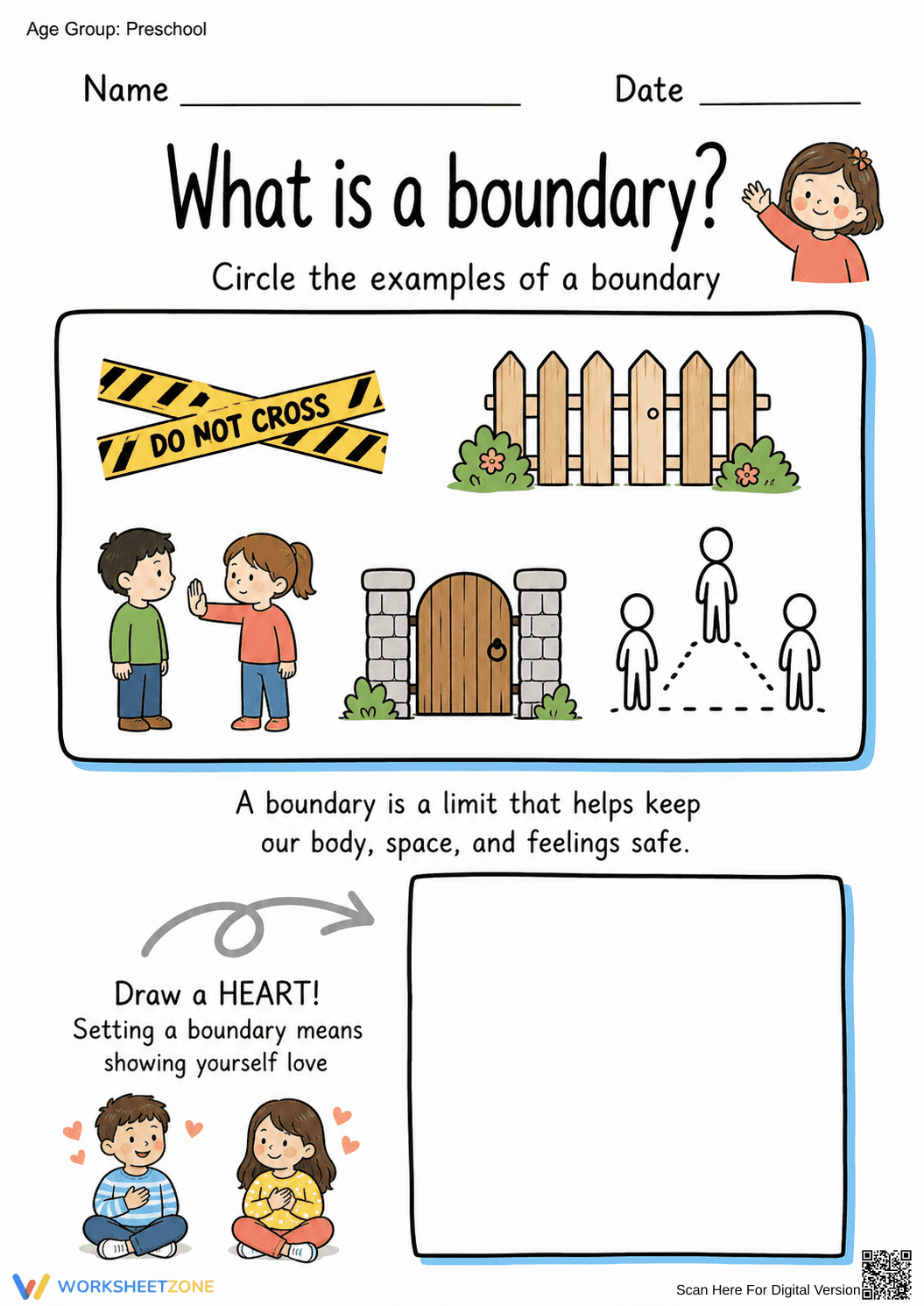
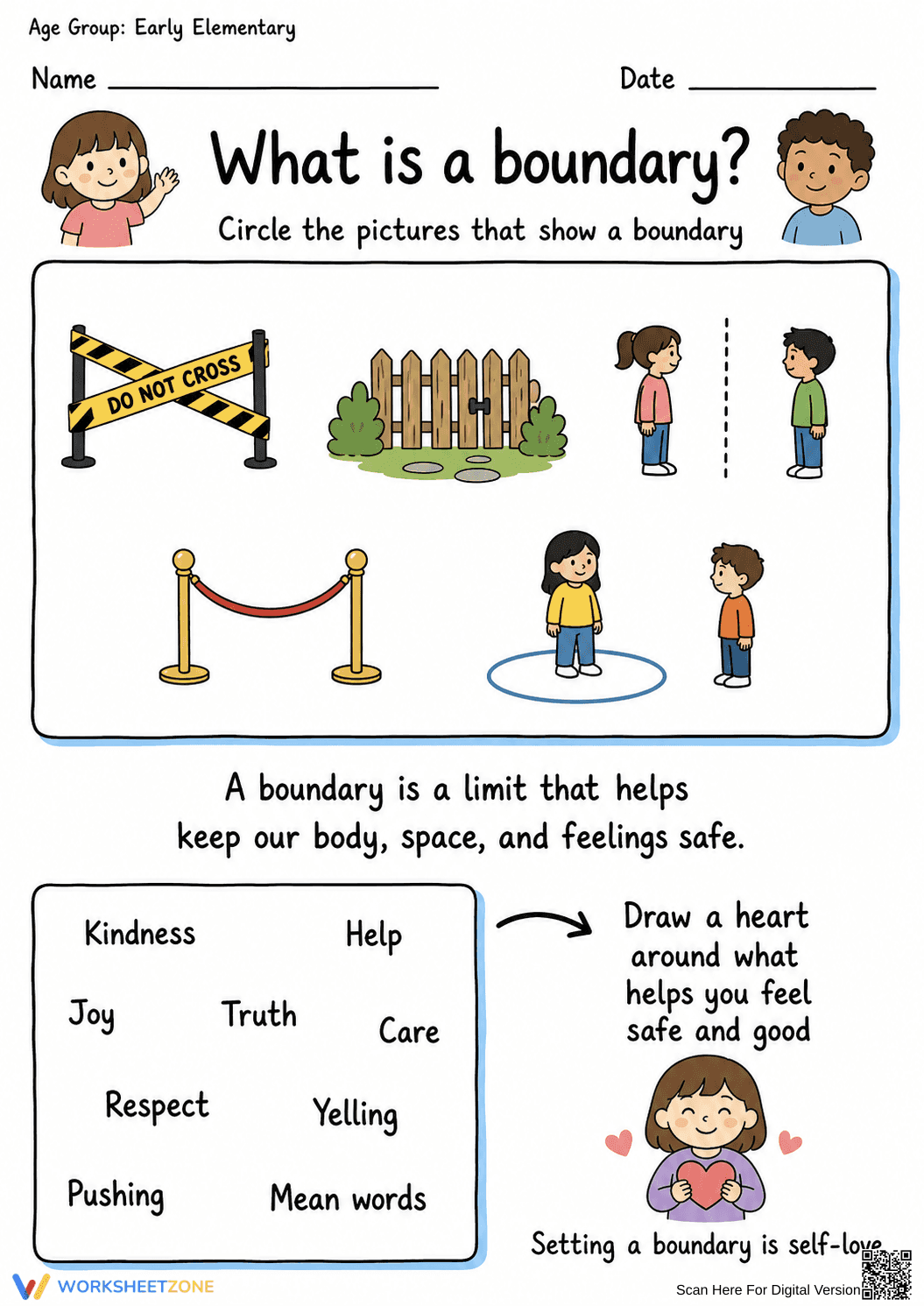
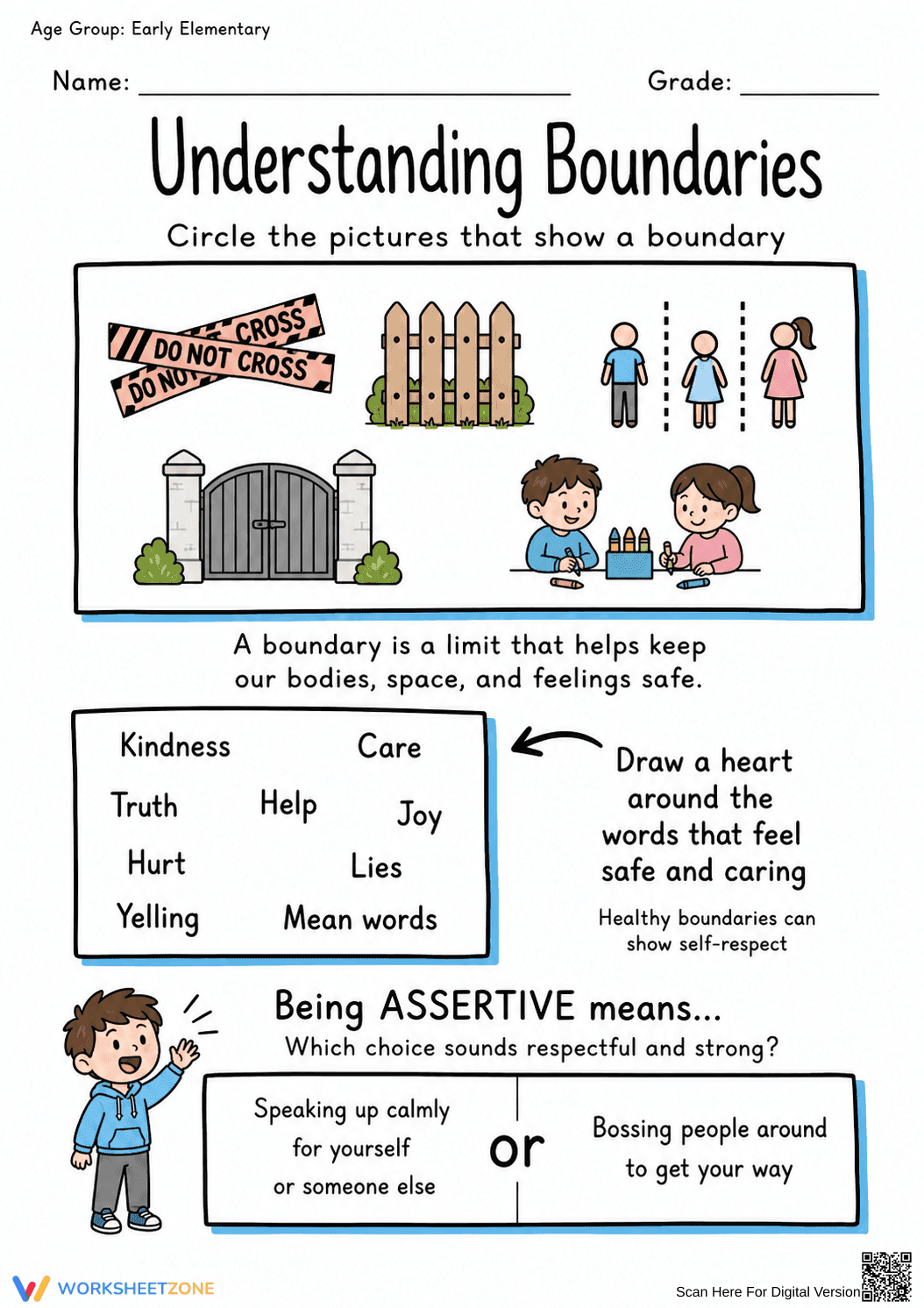

Personal Boundaries Worksheet (3 Levels) | Grade 1 Ready

Paste this activity's link or code into your existing LMS (Google Classroom, Canvas, Teams, Schoology, Moodle, etc.).
Students can open and work on the activity right away, with no student login required.
You'll still be able to track student progress and results from your teacher account.
This Grade 1 social-emotional learning worksheet helps students identify personal boundaries and understand how setting limits protects their feelings and bodies. By evaluating visual scenarios and categorizing safe versus unsafe words, young learners develop the foundational self-awareness needed to build healthy relationships and advocate for their own personal space.
At a Glance
- Grade: 1 · Subject: Social Emotional Learning
- Standard:
TEKS 1.13.B— Identify and practice skills to protect personal boundaries- Skill Focus: Identifying personal boundaries
- Format: 3 pages · 3 problems · No answer key · PDF
- Best For: Differentiated SEL instruction
- Time: 15–20 minutes
This comprehensive resource includes three distinct pages of boundary-setting activities tailored for early childhood development. Students will encounter visual identification tasks where they circle pictures representing physical and social limits, such as fences or personal space bubbles. The materials also feature a word-sorting exercise to identify safe, caring language, and a multiple-choice section introducing the concept of assertiveness.
- Below grade: Features highly visual, simplified scenarios with a basic drawing task to connect boundary-setting with self-love.
- On grade: Introduces a word bank where students must distinguish between positive and negative behaviors, alongside visual identification.
- Above grade: Adds a critical thinking component about assertiveness, requiring students to choose the most respectful way to communicate their limits.
All three versions are included to ensure every student can access the material at their current developmental stage.
Aligned to TEKS 1.13.B, this resource supports students as they identify and practice refusal skills to protect personal boundaries. It also reinforces core CASEL competencies in Self-Awareness and Relationship Skills by teaching children to recognize their own emotions and communicate their needs effectively. Both standard codes can be copied directly into lesson plans, IEP goals, or district curriculum mapping tools.
Deploy this activity during morning meetings or dedicated school counseling sessions to proactively teach personal space. Before direct instruction, use the visual examples to spark a class discussion about what makes us feel safe. As a formative assessment, observe which words students circle in the vocabulary section to gauge their understanding of respectful communication. Expected completion time ranges from 15 to 20 minutes.
This resource is designed for early elementary students, school counselors, and special education teachers focusing on social skills. The three distinct differentiation levels make it highly adaptable for mixed-ability classrooms or targeted intervention groups. It pairs perfectly with anchor charts about personal space or read-aloud books focusing on consent and self-respect.
Teaching young children to recognize and communicate their limits is a critical component of early childhood development. Aligned with TEKS 1.13.B, this resource helps students identify and practice skills to protect personal boundaries. According to RAND AIRS 2024, structured social-emotional learning interventions that explicitly teach self-advocacy and emotional regulation significantly reduce behavioral incidents in early elementary settings. By providing concrete visual examples and tiered vocabulary exercises, educators can effectively bridge the gap between abstract emotional concepts and practical, everyday peer interactions.


