




























Views
Downloads

Pumpkin Growth Needs Worksheet | Grade 3-8 Essential

Paste this activity's link or code into your existing LMS (Google Classroom, Canvas, Teams, Schoology, Moodle, etc.).
Students can open and work on the activity right away, with no student login required.
You'll still be able to track student progress and results from your teacher account.
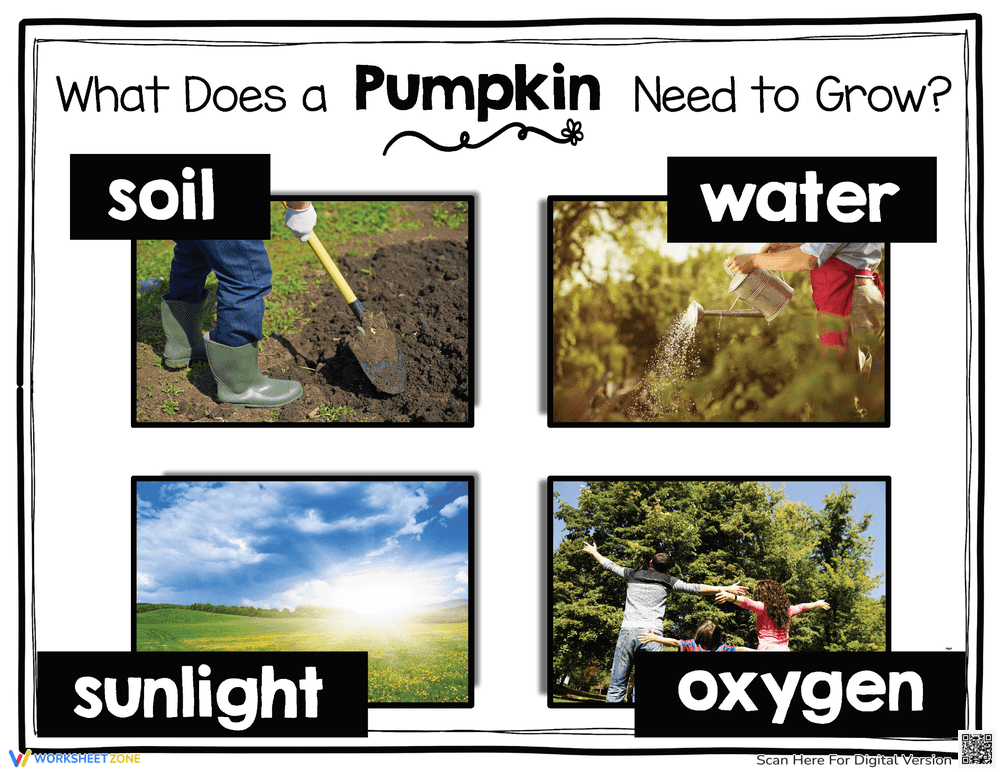
This Grade 3-8 science worksheet helps students identify the four fundamental requirements for pumpkin growth: soil, water, sunlight, and oxygen. By connecting visual cues with scientific vocabulary, learners build a foundational understanding of plant biology and life cycles. It is an ideal resource for reinforcing basic botanical concepts during autumn or Thanksgiving-themed lessons.
At a Glance
At a Glance
- Grade: 3-8 · Subject: Science
- Standard:
3-LS1-1— Develop models to describe that organisms have unique and diverse life cycles- Skill Focus: Plant growth requirements
- Format: 1 page · 4 tasks · Answer key included · PDF
- Best For: Quick science review or bell-ringer
- Time: 5–10 minutes
What's Inside
Inside this resource, you will find a single-page visual guide and activity focusing on the four pillars of plant health. The worksheet features high-quality images representing soil, water, sunlight, and oxygen, paired with clear labels. It includes a digital version accessible via QR code, ensuring flexibility for both physical classrooms and remote learning environments.
Zero-Prep Workflow
- Print: Generate the single-page PDF for your entire class in under 30 seconds.
- Distribute: Hand out the sheets as a morning warm-up or a quick exit ticket (1 minute).
- Review: Discuss the four essential needs as a whole group to check for immediate understanding (2 minutes).
This streamlined process makes the worksheet an excellent choice for substitute teacher folders or last-minute lesson additions.
Standards Alignment
This activity aligns with 3-LS1-1, focusing on the environmental factors necessary for an organism to complete its life cycle. It also supports 5-LS1-1 by emphasizing that plants acquire what they need for growth chiefly from air and water. Both standard codes can be copied directly into lesson plans, IEP goals, or district curriculum mapping tools.
How to Use It
Use this worksheet during the "Engage" phase of a 5E lesson plan to activate prior knowledge about gardening. It also serves as an effective formative assessment tool after a read-aloud about pumpkins. Teachers should observe if students can explain why each element is necessary, expecting a completion time of approximately 8 minutes for the full identification task.
Who It's For
This resource is designed for elementary and middle school students, particularly those needing visual supports or English Language Learners (ELLs). It pairs naturally with a pumpkin life cycle anchor chart or a hands-on seed-planting experiment. The clear imagery ensures accessibility for diverse learners across multiple grade levels from 3 through 8.
Research from Fisher & Frey (2014) emphasizes the importance of visual non-linguistic representations in developing scientific literacy. This worksheet utilizes that principle by pairing high-contrast photography with specific vocabulary terms like oxygen and soil. By isolating the four critical variables of pumpkin growth, the resource reduces cognitive load, allowing students to focus on the relationship between environmental inputs and biological outcomes. According to the RAND AIRS 2024 report, structured visual aids significantly improve retention of core disciplinary ideas in life sciences for students in grades 3 through 8. The inclusion of a digital access point further supports modern pedagogical needs for blended learning environments. This 3-LS1-1 aligned tool provides a concise, evidence-based method for verifying student mastery of basic plant needs, making it a reliable addition to any science curriculum or seasonal holiday unit.


