




























Views
Downloads

Essential Plant Needs Worksheet | Kindergarten Science Ready

Paste this activity's link or code into your existing LMS (Google Classroom, Canvas, Teams, Schoology, Moodle, etc.).
Students can open and work on the activity right away, with no student login required.
You'll still be able to track student progress and results from your teacher account.
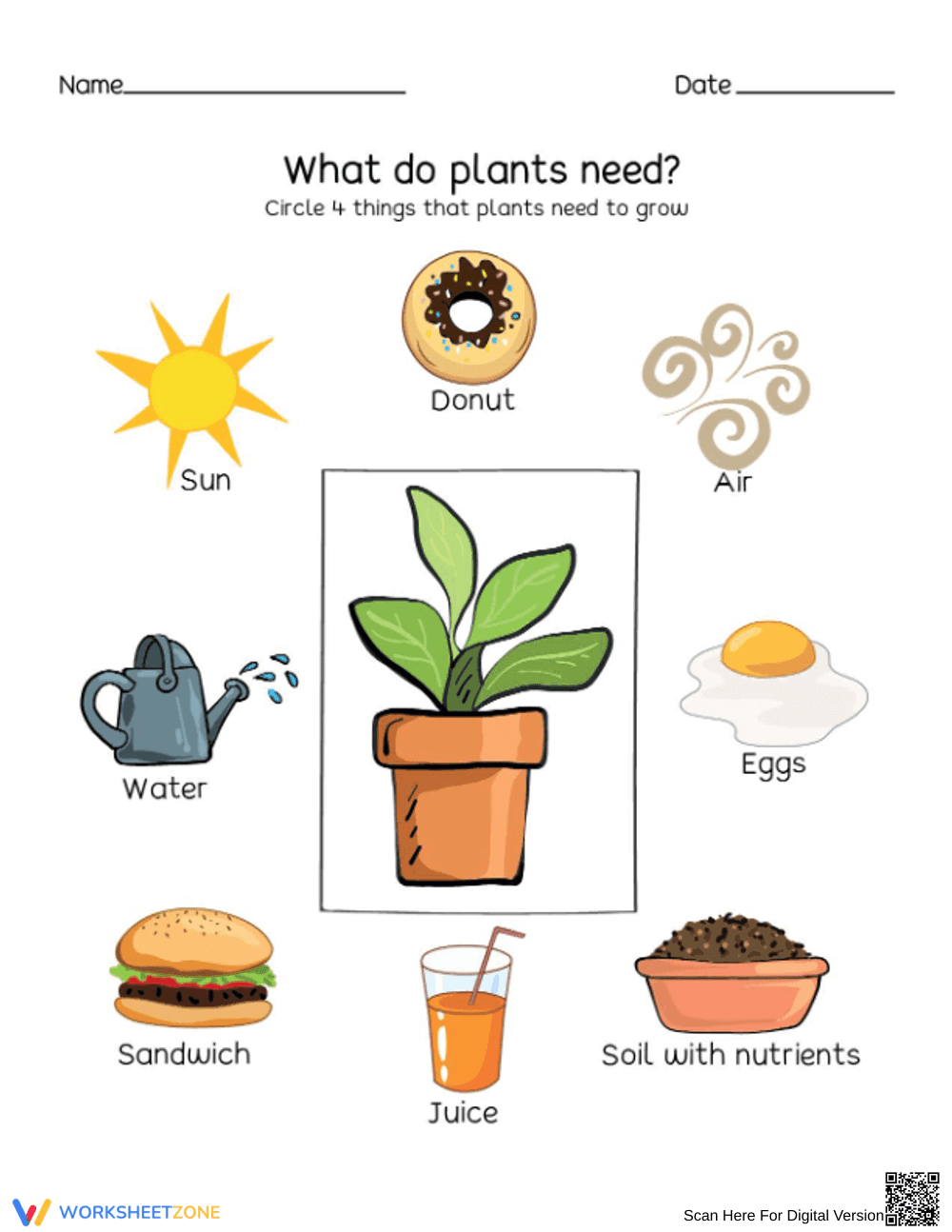
This Kindergarten science worksheet helps young learners identify the essential elements plants need for survival and growth. By distinguishing between biological requirements and non-essential items, students develop foundational observation skills. It is an effective tool for introducing life science concepts while practicing fine motor skills through circling tasks. Use this resource to spark curiosity about nature.
At a Glance
- Grade: Kindergarten · Subject: Science
- Standard:
K-LS1-1— Use observations to describe patterns of what plants need to survive- Skill Focus: Plant life cycles and survival needs
- Format: 1 page · 4 tasks · Answer key included · PDF
- Best For: Initial life science lessons and reviews
- Time: 5–10 minutes
What's Inside
This single-page PDF features a clear, centered illustration of a potted plant surrounded by eight distinct icons. Four icons represent actual plant needs—sun, air, water, and soil with nutrients—while the others represent non-needs like donuts and sandwiches. The layout is designed for early childhood learners with large, labeled illustrations and a simple, direct instruction to circle the four correct items required for growth.
Zero-Prep Workflow
This resource is designed for immediate classroom implementation with a total teacher prep time of under 2 minutes. The zero-prep workflow is simple: Print (1 minute), Distribute (30 seconds), and Review (30 seconds). Simply print the PDF, distribute it to students with pencils or crayons, and let them work independently. The clear visual cues make it an ideal choice for emergency sub plans or quick morning work.
Standards Alignment
The worksheet is aligned to `K-LS1-1`, requiring students to use observations to describe patterns of what plants need to survive. Specifically, it focuses on the essential requirements of light, water, air, and nutrients found in soil. This standard code can be copied directly into lesson plans, IEP goals, or district curriculum mapping tools to ensure instructional coherence across the Kindergarten science curriculum.
How to Use It
Introduce this worksheet after a short read-aloud about gardens or a direct instruction session on living vs. non-living things. As a formative assessment, observe which students can correctly differentiate between human food and plant nutrients. The expected completion time is 10 minutes, making it a perfect transition activity before a hands-on planting project or a nature walk around the school grounds to see real examples.
Who It's For
This activity is tailored for Kindergarten students, including English Language Learners who benefit from the clear visual labels and icons. It serves as a great companion to a classroom bean-growing experiment or an anchor chart about the parts of a plant. The simple circling task ensures that the cognitive load remains focused on the scientific content rather than complex literacy demands, making it accessible for all learners.
Research by Fisher & Frey (2014) emphasizes the importance of visual literacy and scaffolds in early science education to bridge the gap between observation and conceptual understanding. This Kindergarten worksheet aligns with the K-LS1-1 standard by providing students with a structured environment to practice identifying biological patterns. By using recognizable icons to represent what plants need—such as water, sun, air, and soil—the resource supports the development of evidence-based reasoning in young learners. Studies in ScienceDirect TpT Analysis suggest that focused, single-skill practice helps solidify core scientific vocabulary before students transition to more complex life science models. This printable offers a high-utility, low-barrier entry point for students to master the foundational concept that plants have specific requirements for survival, distinct from the needs of animals or humans. It ensures that students can accurately distinguish between living needs and human conventions using a clear, evidence-based observation framework.


