


























Views
Downloads

Printable What Animals Eat Worksheet | Grade 1 Science
Paste this activity's link or code into your existing LMS (Google Classroom, Canvas, Teams, Schoology, Moodle, etc.).
Students can open and work on the activity right away, with no student login required.
You'll still be able to track student progress and results from your teacher account.
Help first graders master biology basics with this straightforward matching activity. This animal diets worksheet focuses on identifying common food sources, ensuring students understand that living things require specific nutrients to survive. Connecting animals to their natural meals builds a strong foundation for understanding ecosystems and life cycles visually.
At a Glance
- Grade: 1 · Subject: Science
- Standard:
1-LS1-1— Use external parts to understand how animals meet survival needs- Skill Focus: Animal Diet Identification
- Format: 2 pages · 4 problems · Answer key included · PDF
- Best For: Morning work or science centers
- Time: 10–15 minutes
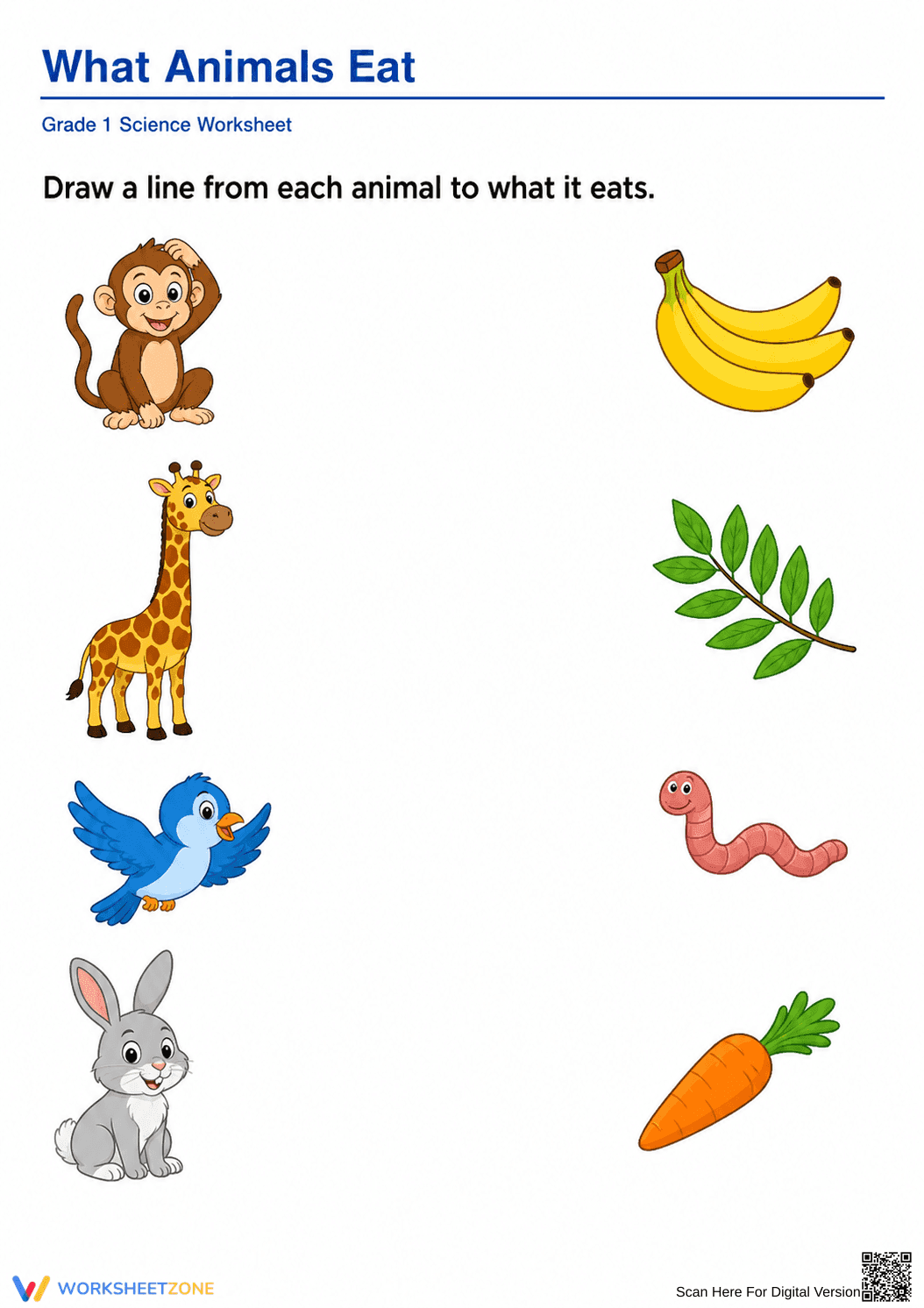
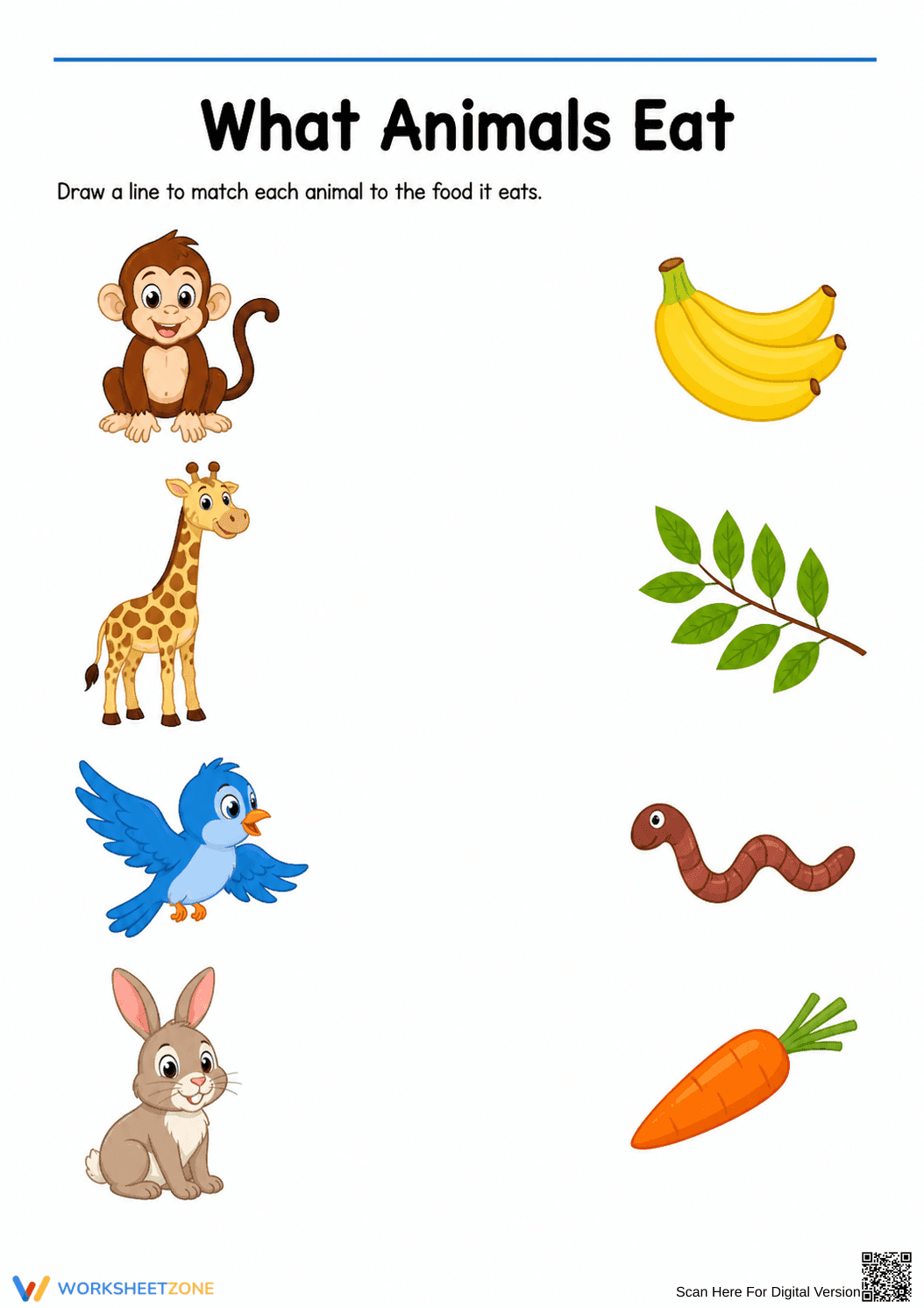
This resource features a single-page student activity and a corresponding answer key for quick grading. The worksheet presents four familiar animals—a monkey, a giraffe, a bird, and a rabbit—alongside four food items: bananas, leaves, a worm, and a carrot. The clear, engaging illustrations are easily recognizable by early elementary students, facilitating independent work without overwhelming text.
Zero-Prep Workflow
- Print (1 minute): Generate copies of the single-page activity sheet for your entire class.
- Distribute (1 minute): Hand out the worksheets during morning work or a science block transition.
- Review (3 minutes): Check student responses using the provided answer key for immediate feedback.
Total teacher preparation time is under two minutes, making this ideal for emergency sub plans or last-minute lesson additions.
Aligned to Next Generation Science Standard 1-LS1-1, this worksheet helps students understand how animals use their external parts to help them survive, grow, and meet their needs. By matching animals to their specific food sources, students categorize organisms by dietary habits and recognize fundamental survival requirements. Both standard codes can be copied directly into lesson plans, IEP goals, or district curriculum mapping tools.
Use this worksheet as a formative assessment immediately after direct instruction on living things and their basic needs. Observe students as they draw lines to identify those needing additional scaffolding with animal classification. Alternatively, place this activity in a science center for independent practice. Students can easily complete the matching tasks within a 10 to 15-minute window during a dedicated science block.
Designed primarily for Grade 1 students, this activity is also highly suitable for Kindergarten enrichment or Grade 2 review. It is particularly effective for English Language Learners (ELLs) because its visual nature reduces linguistic load while maintaining strict focus on core science concepts. Pair this worksheet with a short non-fiction read-aloud about herbivores and carnivores to extend the learning experience.
The importance of visual-spatial matching in early childhood science education is well-documented. Fisher & Frey (2014) state that graphic organizers and visual matching tasks facilitate the gradual release of responsibility, providing concrete representations of biological relationships. This worksheet addresses NGSS 1-LS1-1, supporting the fundamental requirement for first-grade students to recognize that animal survival depends on specific environmental interactions, such as food consumption. Research suggests that structured, single-skill worksheets improve scientific vocabulary retention and conceptual understanding. This resource provides a targeted approach to animal diet identification, enabling young learners to categorize animals by their future food chain roles. A clear answer key supports immediate feedback, a critical factor for student engagement and mastery. By integrating these evidence-based practices, educators can ensure foundational science concepts are firmly established.


