


























Views
Downloads
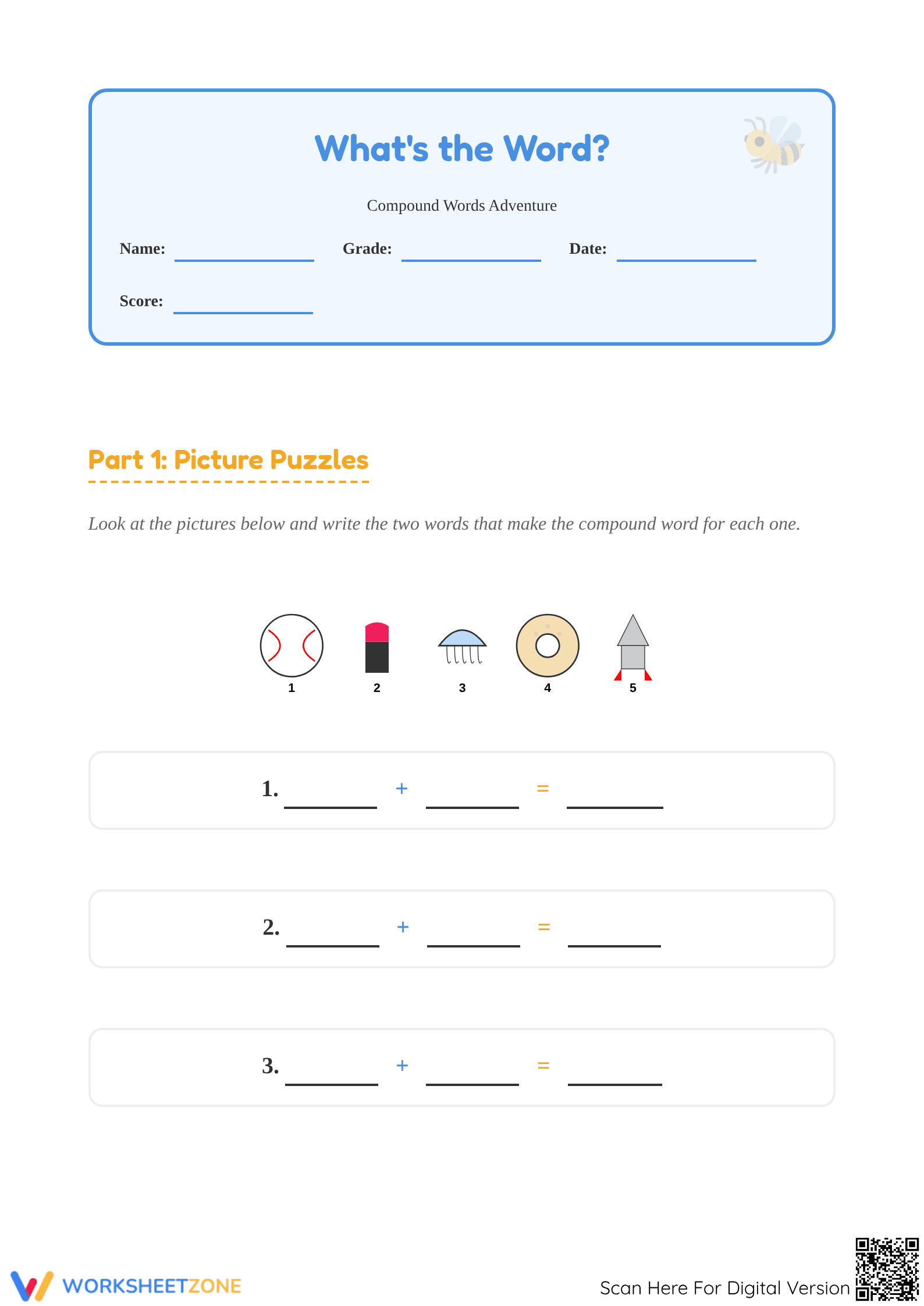


What's the Word? Compound Words Printable | Grade 1 ELA
Paste this activity's link or code into your existing LMS (Google Classroom, Canvas, Teams, Schoology, Moodle, etc.).
Students can open and work on the activity right away, with no student login required.
You'll still be able to track student progress and results from your teacher account.
This Grade 1 compound words worksheet helps students master the skill of identifying how two individual words combine to create a single new meaning. By breaking down compound words into their component parts, young learners strengthen their phonics and vocabulary foundations. It provides a structured way for students to practice word analysis and spelling through engaging visual puzzles.
At a Glance
- Grade: 1 · Subject: ELA
- Standard:
CCSS.ELA-LITERACY.L.1.6— Use words and phrases acquired through reading and responding to texts- Skill Focus: Compound word decomposition
- Format: 2 pages · 10 problems · Answer key included · PDF
- Best For: Independent practice or morning work
- Time: 15–20 minutes
This two-page PDF resource features ten carefully selected compound word challenges divided into two distinct parts. Part one uses visual "Picture Puzzles" to provide scaffolded support, while part two offers "extra challenges" for independent application. The layout is clean and spacious, making it ideal for first-grade handwriting. A comprehensive answer key is provided for quick teacher or parent grading.
Zero-Prep Workflow
- Print: Open the two-page PDF and hit print for your entire class (30 seconds).
- Distribute: Pass out the worksheets to your first graders for an immediate start (1 minute).
- Review: Use the included answer key to verify the 10 responses (under 5 minutes).
Total teacher preparation time is less than two minutes, making this an ideal solution for substitute plans, busy morning routines, or literacy centers.
Standards Alignment
Aligned to CCSS.ELA-LITERACY.L.1.6: "Use words and phrases acquired through conversations, reading and being read to, and responding to texts, including using frequently occurring conjunctions to signal simple relationships." This worksheet specifically targets the lexical understanding of how words form meanings. Both standard codes can be copied directly into lesson plans, IEP goals, or district curriculum mapping tools.
How to Use It
This worksheet is most effective when used as a formative assessment after an introductory lesson on word parts. Hand it out during independent practice time to gauge student understanding of how individual words merge. An excellent formative tip is to observe if students can correctly identify the base words like "base" and "ball" from the visual cue but struggle to write the merged result. Expect students to complete both pages within 15 to 20 minutes.
Who It's For
This resource is designed for Grade 1 students, though it can serve as a remediation tool for Grade 2 learners. Visual learners benefit significantly from the picture puzzles in Part 1. It pairs naturally with a compound word anchor chart or a shared reading session of a text containing common compound words like "backpack" or "sunflower."
Research by Fisher & Frey (2014) emphasizes the importance of word consciousness and the explicit teaching of word parts to boost early literacy. This worksheet aligns with the CCSS.ELA-LITERACY.L.1.6 standard by requiring students to decompose compound words, a fundamental lexical skill. By identifying that "base" + "ball" equals "baseball," students are participating in morphological analysis, which has been shown to improve reading comprehension and spelling accuracy in the primary grades. Educational frameworks like NAEP highlight that early mastery of these structures predicts future success in more complex linguistic tasks. This resource provides the necessary repetition for students to internalize these patterns without the burden of heavy teacher preparation. The 10 included tasks offer a balanced mix of visual and linguistic challenges that cater to the diverse needs of a first-grade classroom while ensuring that core state standards are met with fidelity.


