


























Views
Downloads

Essential Days of the Week Sequencing | Grade 1 ELA
Paste this activity's link or code into your existing LMS (Google Classroom, Canvas, Teams, Schoology, Moodle, etc.).
Students can open and work on the activity right away, with no student login required.
You'll still be able to track student progress and results from your teacher account.
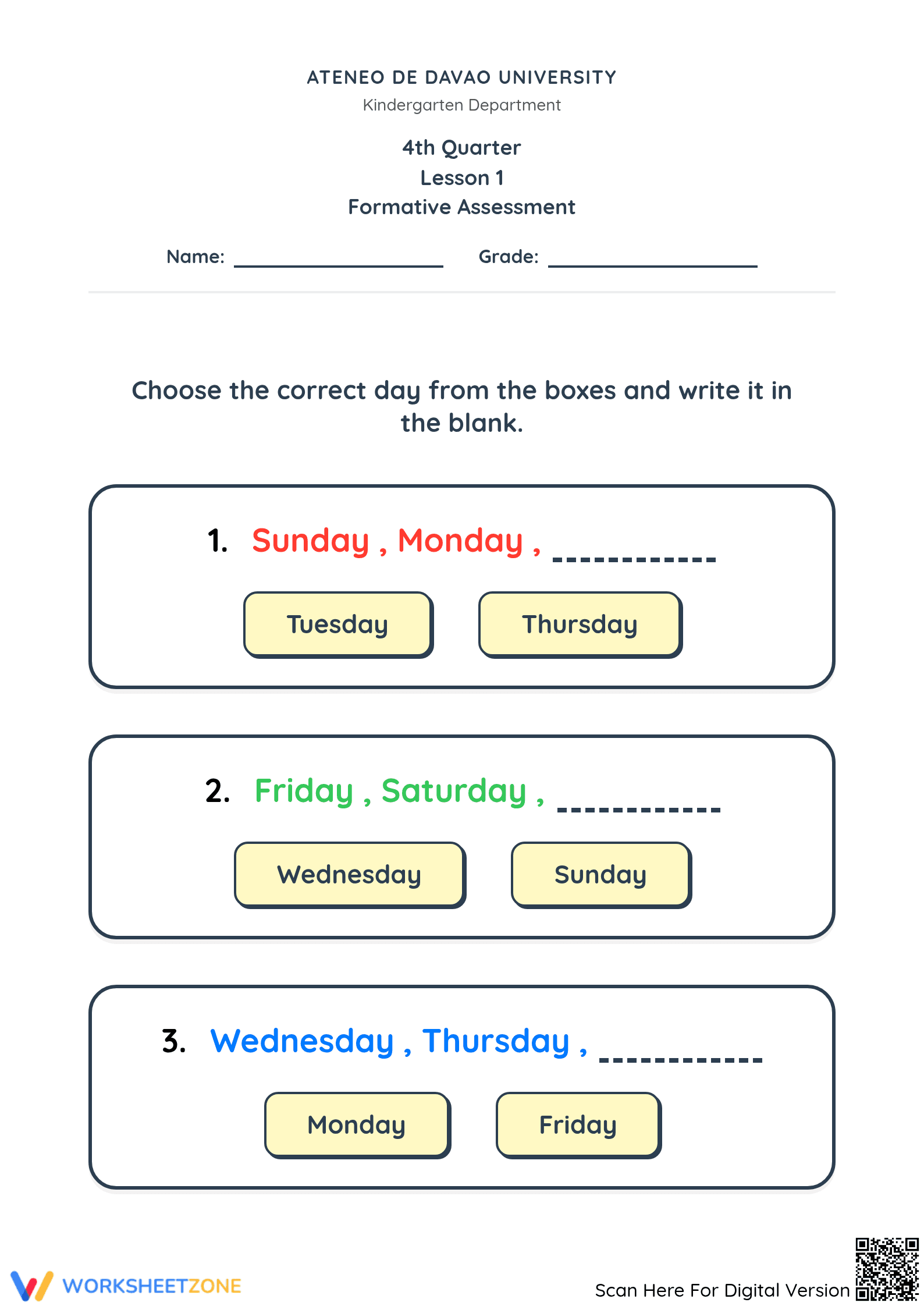
This Grade 1 ELA worksheet focuses on chronological sequencing by asking students to identify which day of the week follows a specific pair. By practicing the order of Sunday through Saturday, learners strengthen their temporal awareness and spelling of proper nouns. It provides a clear, structured format for early learners to demonstrate mastery of the weekly cycle.
At a Glance
- Grade: 1 · Subject: English Language Arts
- Standard:
CCSS.ELA-LITERACY.L.1.2— Capitalize dates and names of people; sequence and spell days correctly.- Skill Focus: Weekly Chronology & Sequencing
- Format: 2 pages · 4 problems · Answer key included · PDF
- Best For: Morning work or formative assessment
- Time: 5–10 minutes
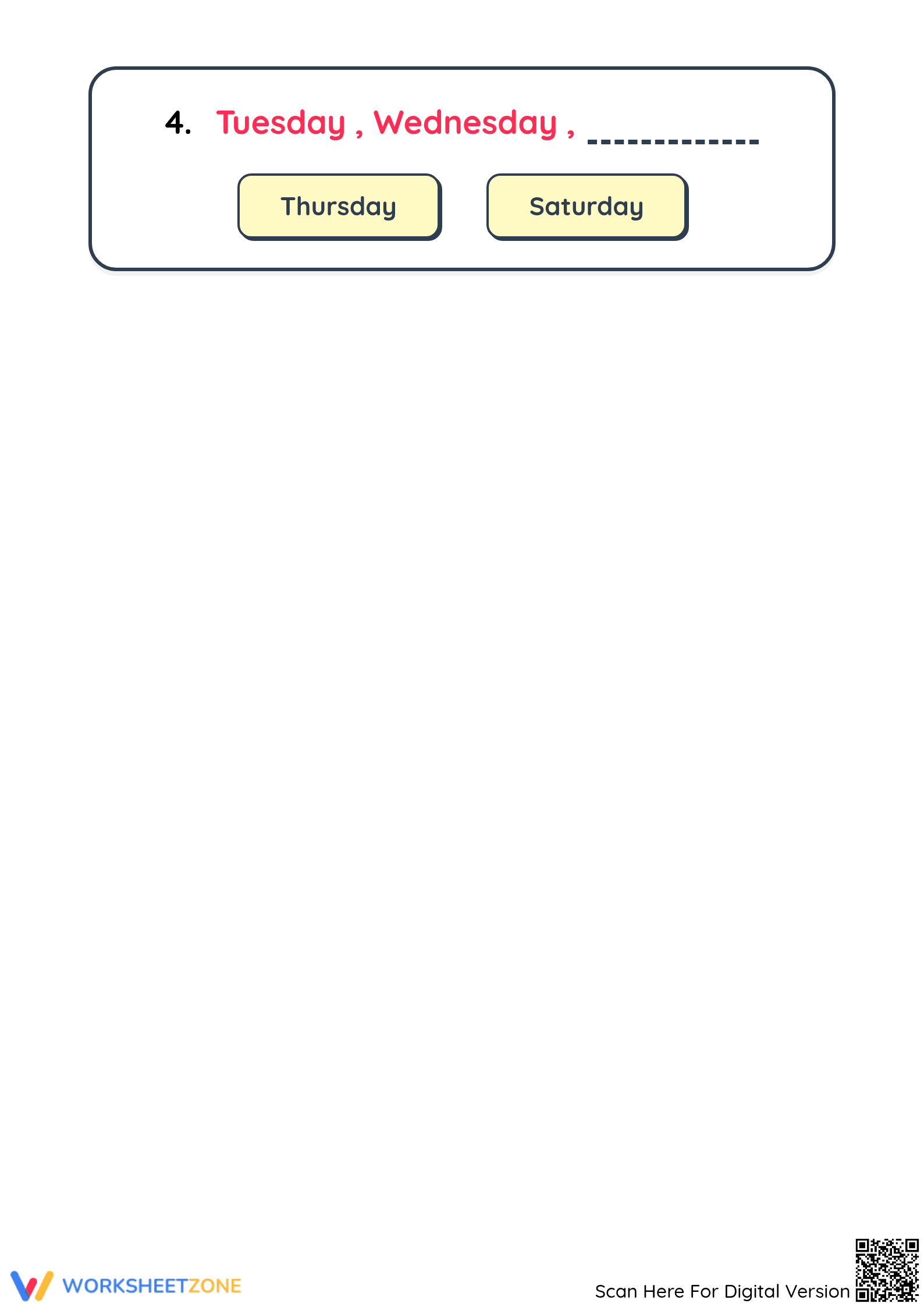
The resource consists of two printable pages featuring four distinct sequencing boxes. Each box presents two consecutive days and a blank line for the third. Students are provided with two multiple-choice options in a "word bank" style format below the prompt, encouraging them to write the correct day on the line. A full answer key is included for rapid grading.
Zero-Prep Workflow
- Print: Open the PDF and print the two-page document for your entire class in under 30 seconds.
- Distribute: Hand out the sheets during your morning meeting, calendar block, or as a transition activity.
- Review: Use the included answer key to grade quickly or review the sequence as a whole-group choral response.
Total teacher preparation time is under two minutes, making this an ideal solution for sub plans or unexpected schedule gaps.
Standards Alignment
This worksheet aligns with `CCSS.ELA-LITERACY.L.1.2`, which requires students to demonstrate command of the conventions of standard English capitalization, including dates and days of the week. It also supports foundational math standards regarding time and cycles. Both standard codes can be copied directly into lesson plans, IEP goals, or district curriculum mapping tools.
How to Use It
Use this as a formative assessment after a lesson on the calendar to check for individual understanding. It works exceptionally well as a "bell ringer" activity to settle the class. Teachers should observe if students can identify the pattern mentally or if they need to recite the entire "Days of the Week" song to find the answer. Completion typically takes 5 to 10 minutes.
Who It's For
This is ideal for first-grade students, though it serves as an excellent review for second graders or a challenge for advanced kindergarteners. It is particularly helpful for English Language Learners (ELL) who are mastering basic temporal vocabulary. Pair this with a classroom wall calendar or a daily weather chart for maximum instructional impact.
According to research from Fisher & Frey (2014), the use of scaffolded sequencing tasks helps primary students transition from rote memorization to functional literacy. This worksheet applies those principles by providing a limited choice set to reduce cognitive load while focusing on the specific skill of chronological order. Mastery of the `CCSS.ELA-LITERACY.L.1.2` standard through these 4 targeted tasks ensures that students can correctly identify and capitalize the days of the week in their own writing. By isolating the "what comes next" logic, the resource builds the foundational temporal reasoning required for more complex scheduling and time-management skills in later grades. This structured approach is a proven method for reinforcing high-frequency vocabulary and proper noun conventions in early childhood education settings.


