


























Views
Plays


Printable Spelling Test Worksheet | Grade 3 ELA
Paste this activity's link or code into your existing LMS (Google Classroom, Canvas, Teams, Schoology, Moodle, etc.).
Students can open and work on the activity right away, with no student login required.
You'll still be able to track student progress and results from your teacher account.
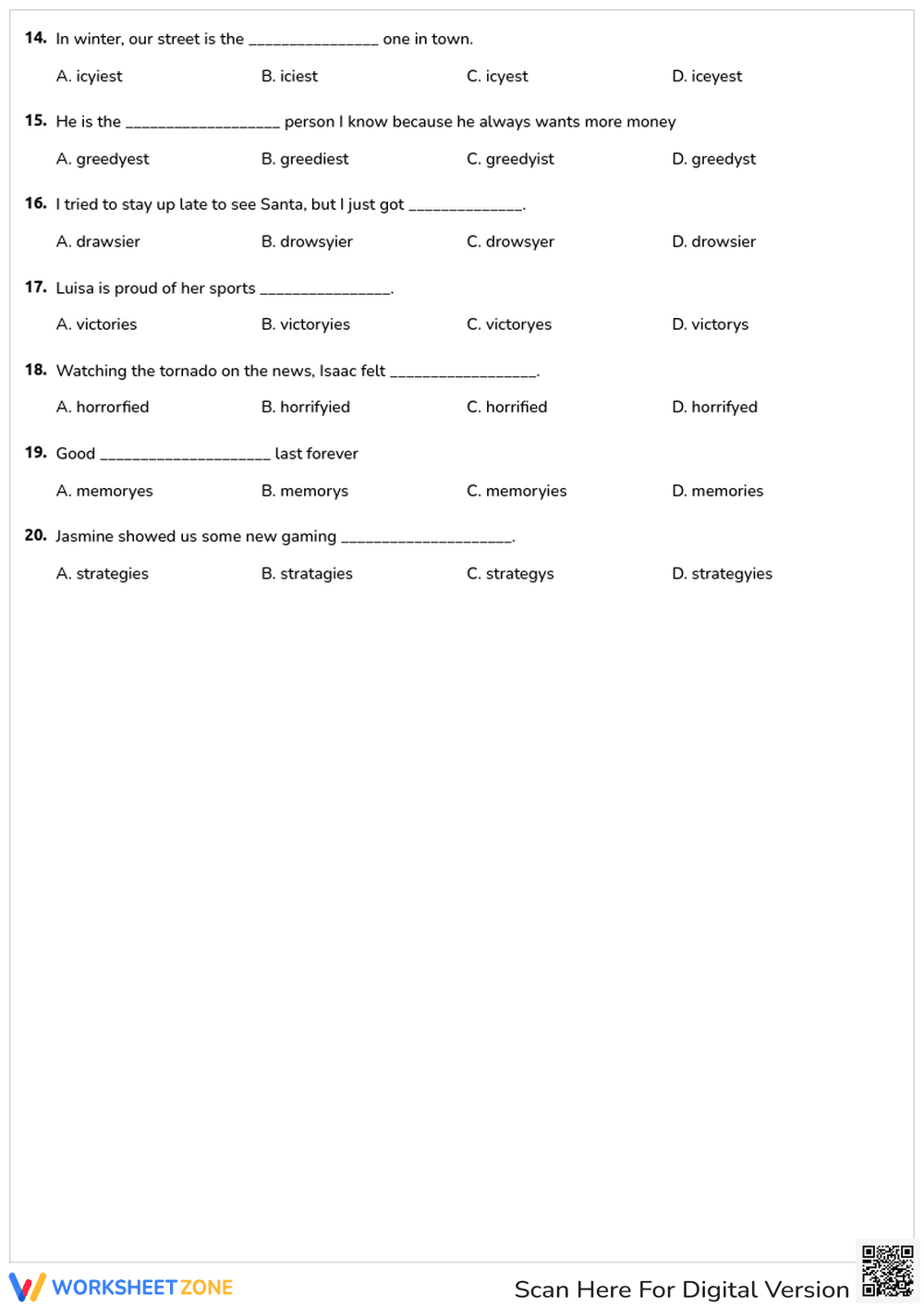
This Grade 3 spelling worksheet evaluates students' ability to correctly spell words when adding suffixes. By choosing the accurately spelled word to complete each sentence, learners demonstrate their understanding of spelling rules, specifically changing "y" to "i" before adding endings like "-es," "-er," and "-est."
At a Glance
- Grade: 3 · Subject: ELA
- Standard:
CCSS.ELA-LITERACY.L.3.2.E— Spell words correctly when adding suffixes to base words- Skill Focus: Spelling with Suffixes
- Format: 2 pages · 20 problems · Answer key included · PDF
- Best For: Weekly assessment or review
- Time: 15–20 minutes
What's Inside
This two-page printable assessment features 20 multiple-choice questions. Each item presents a complete sentence with a missing word, followed by four spelling variations. Students must identify the correct spelling to complete the sentence. The resource focuses on the spelling generalization of changing a base word's final "y" to an "i" before adding suffixes. A complete answer key is included.
Zero-Prep Workflow
This resource is designed for immediate classroom implementation with a streamlined zero-prep workflow:
- Print (1 minute): Simply print the two-page PDF assessment and the accompanying answer key.
- Distribute (1 minute): Hand out the test to students during your designated language arts block.
- Review (3 minutes): Use the provided key to quickly score the 20 multiple-choice items.
With under two minutes of total teacher prep time, this worksheet is an excellent option for busy educators or as a reliable activity for a substitute teacher's sub plan.
Standards Alignment
This worksheet is strictly aligned to CCSS.ELA-LITERACY.L.3.2.E: Use conventional spelling for high-frequency and other studied words and for adding suffixes to base words. It supports foundational reading skills by reinforcing decoding strategies. Both standard codes can be copied directly into lesson plans, IEP goals, or district curriculum mapping tools.
How to Use It
Teachers can utilize this resource in multiple ways to support spelling instruction. It serves perfectly as an end-of-week summative assessment to measure mastery of the "y to i" spelling rule. Alternatively, it can be used as an independent practice activity during literacy centers. As a formative assessment observation tip, watch to see if students are sounding out the words or if they are visually recognizing the correct spelling pattern among the distractors. Expected completion time ranges from 15 to 20 minutes.
Who It's For
This worksheet is primarily designed for third-grade students developing their conventional spelling skills. It is also appropriate for second graders needing an advanced challenge or fourth graders requiring a review of foundational spelling rules. For differentiation, teachers can read the sentences aloud to support students with reading accommodations. This assessment pairs naturally with a direct instruction lesson or anchor chart explaining how to drop the "y" and add "i" before suffixes.
Mastering spelling patterns is a critical component of early literacy development. According to Fisher & Frey (2014), explicit instruction and targeted assessment of spelling generalizations significantly improve both reading fluency and writing proficiency across elementary grades. This resource directly supports CCSS.ELA-LITERACY.L.3.2.E by requiring students to spell words correctly when adding suffixes to base words. By evaluating 20 distinct items where the final "y" changes to "i" before adding endings like "-es" or "-er," educators can accurately pinpoint which students have internalized this morphological rule and which require further intervention. Regular, structured practice with multiple-choice distractors helps solidify visual memory for correct word forms, reducing common spelling errors in independent writing tasks. This targeted approach ensures students build the automaticity necessary for higher-level reading comprehension and effective written communication across all academic subjects.


