


























Views
Plays
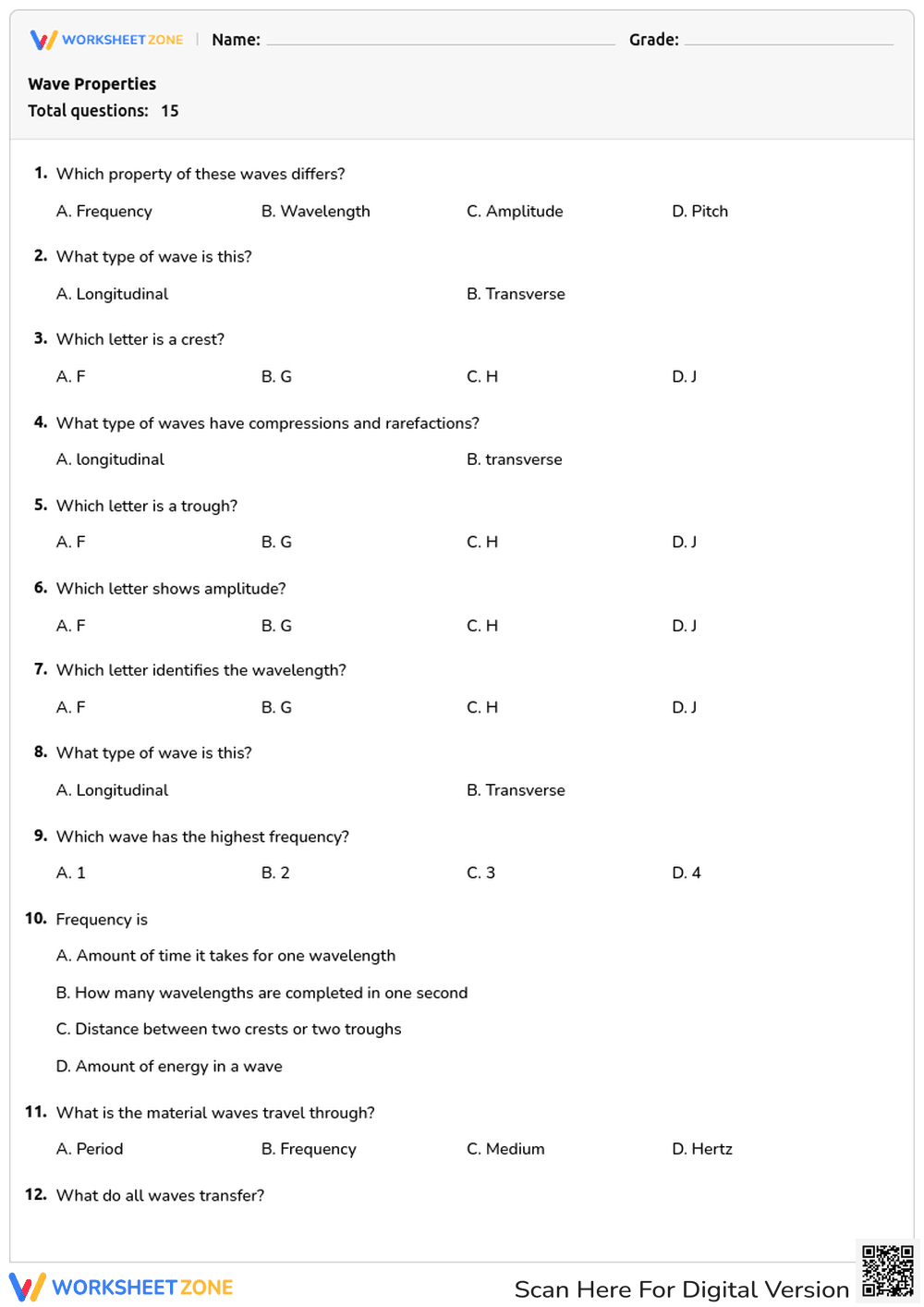


Wave Properties Worksheet | Essential Grade 8 Science
Paste this activity's link or code into your existing LMS (Google Classroom, Canvas, Teams, Schoology, Moodle, etc.).
Students can open and work on the activity right away, with no student login required.
You'll still be able to track student progress and results from your teacher account.
This Wave Properties worksheet provides middle school students with 15 targeted multiple-choice questions to master the fundamental characteristics of transverse and longitudinal waves. Students will identify wave anatomy, calculate wave speed, and define key terminology like frequency and medium. It ensures a solid foundation in physical science before moving to complex wave interactions.
At a Glance
- Grade: 6-8 · Subject: Physics
- Standard:
MS-PS4-1— Use mathematical models to describe wave properties and energy relationships- Skill Focus: Wave anatomy and calculations
- Format: 2 pages · 15 problems · Answer key included · PDF
- Best For: Formative assessment or quick review
- Time: 15–20 minutes
The resource consists of a two-page PDF containing 15 multiple-choice items. The first page features 12 questions focusing on visual identification of wave parts (crest, trough, wavelength, amplitude) and conceptual definitions. The second page concludes with three higher-level questions regarding units of measurement, the wave speed equation, and comparative properties. A clear, legible font and organized layout make it accessible for all learners.
Zero-Prep Workflow
- Print: Generate copies for your entire class in under 1 minute.
- Distribute: Hand out the 2-page assessment as a bell-ringer or exit ticket.
- Review: Use the included answer key to provide immediate feedback in under 5 minutes.
This efficiency makes it an ideal choice for emergency sub plans or quick classroom transitions where teacher prep time is limited.
Standards Alignment
The primary alignment is `MS-PS4-1`, which requires students to use mathematical representations to describe a simple model for waves. This worksheet supports that goal by requiring students to identify the correct equation for wave speed (Speed = Wavelength x Frequency) and understand the relationship between frequency and period. Both standard codes can be copied directly into lesson plans, IEP goals, or district curriculum mapping tools.
How to Use It
Use this worksheet as a formative assessment immediately following a direct instruction lesson on wave behavior. It serves as an excellent check for understanding to identify misconceptions about the difference between transverse and longitudinal waves. Alternatively, assign it as a homework task to reinforce vocabulary before a laboratory exploration of sound or light waves. Expect students to finish within 20 minutes.
Who It's For
This resource is tailored for Grade 6, 7, and 8 science students. It is particularly helpful for learners who benefit from visual diagrams and structured choices. It pairs naturally with a wave-on-a-string simulation or an anchor chart displaying wave anatomy. The clear language supports English Language Learners (ELLs) in mastering technical physics vocabulary.
According to the RAND AIRS 2024 report on science instructional materials, high-quality formative assessments that isolate specific variables—such as amplitude and frequency—significantly improve student retention of physical science concepts. This worksheet aligns with those findings by providing 15 discrete tasks that require students to distinguish between similar wave properties. By focusing on the MS-PS4-1 standard, the resource ensures that middle school learners develop the necessary mathematical and conceptual frameworks required for high school physics. The inclusion of visual identification tasks alongside algebraic equations supports a multi-modal approach to science literacy. Research from Fisher & Frey (2014) emphasizes that such structured practice is essential for the gradual release of responsibility, moving students from guided recognition to independent application of the wave speed formula. This worksheet serves as a reliable tool for measuring student progress toward mastery in the Energy, Sound, and Light domain.


