


























Views
Downloads

Essential Vowel Digraphs Practice: Grade 1 Phonics Guide
Paste this activity's link or code into your existing LMS (Google Classroom, Canvas, Teams, Schoology, Moodle, etc.).
Students can open and work on the activity right away, with no student login required.
You'll still be able to track student progress and results from your teacher account.
Mastering vowel teams is essential for reading success. This three-page resource provides students with visual prompts to identify and distinguish between common vowel digraphs in high-frequency words. By matching pictures to vowel sounds, learners build foundational decoding skills necessary for fluent reading and accurate spelling in the primary grades.
At a Glance
- Grade: Grade 1 · Subject: ELA
- Standard:
CCSS.ELA-LITERACY.RF.1.3.C— Know common vowel team conventions for representing long vowel sounds- Skill Focus: Vowel Digraphs Identification
- Format: 3 pages · 8 problems · Answer key included · PDF
- Best For: Independent Phonics Practice and Literacy Centers
- Time: 15–20 minutes
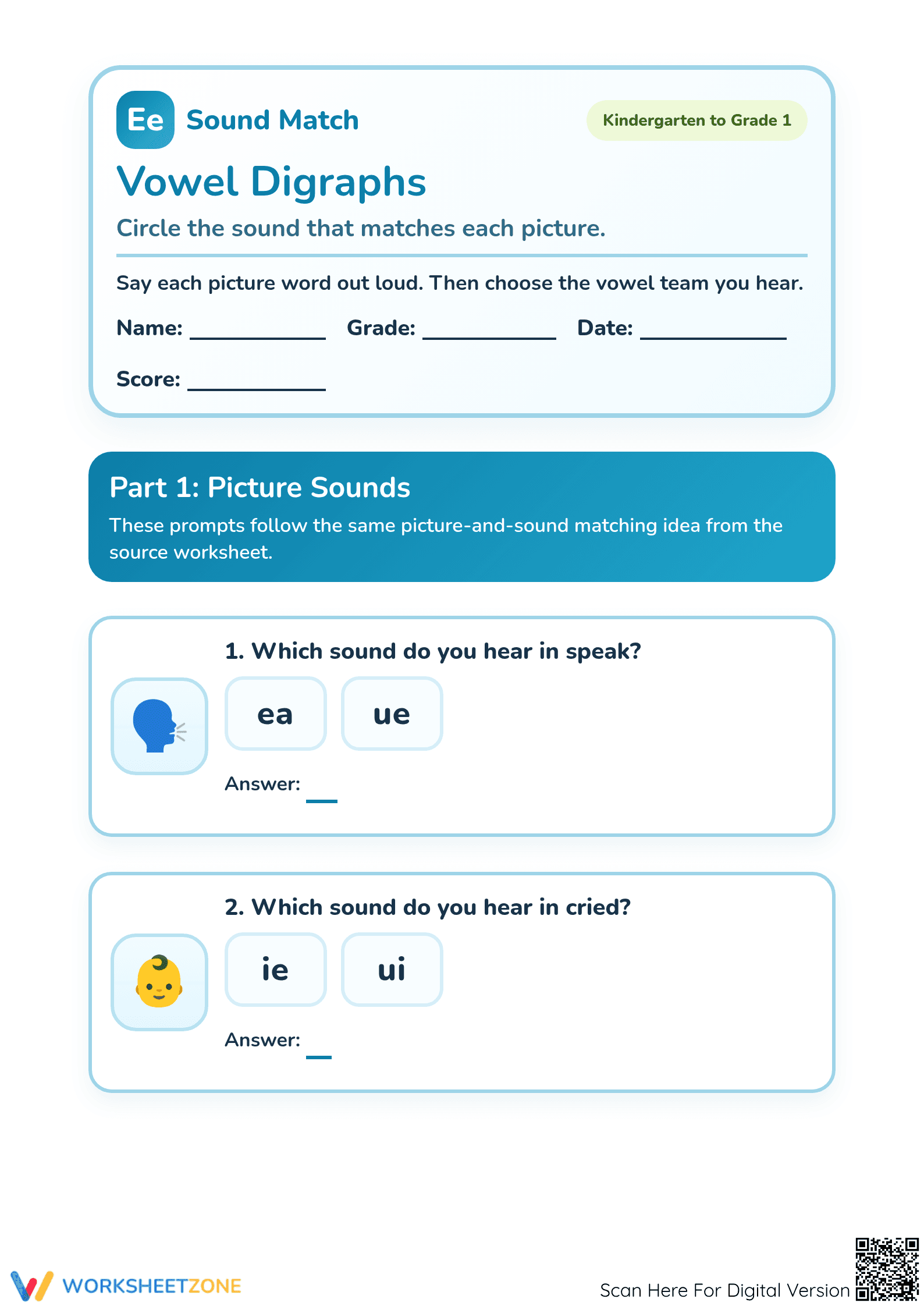
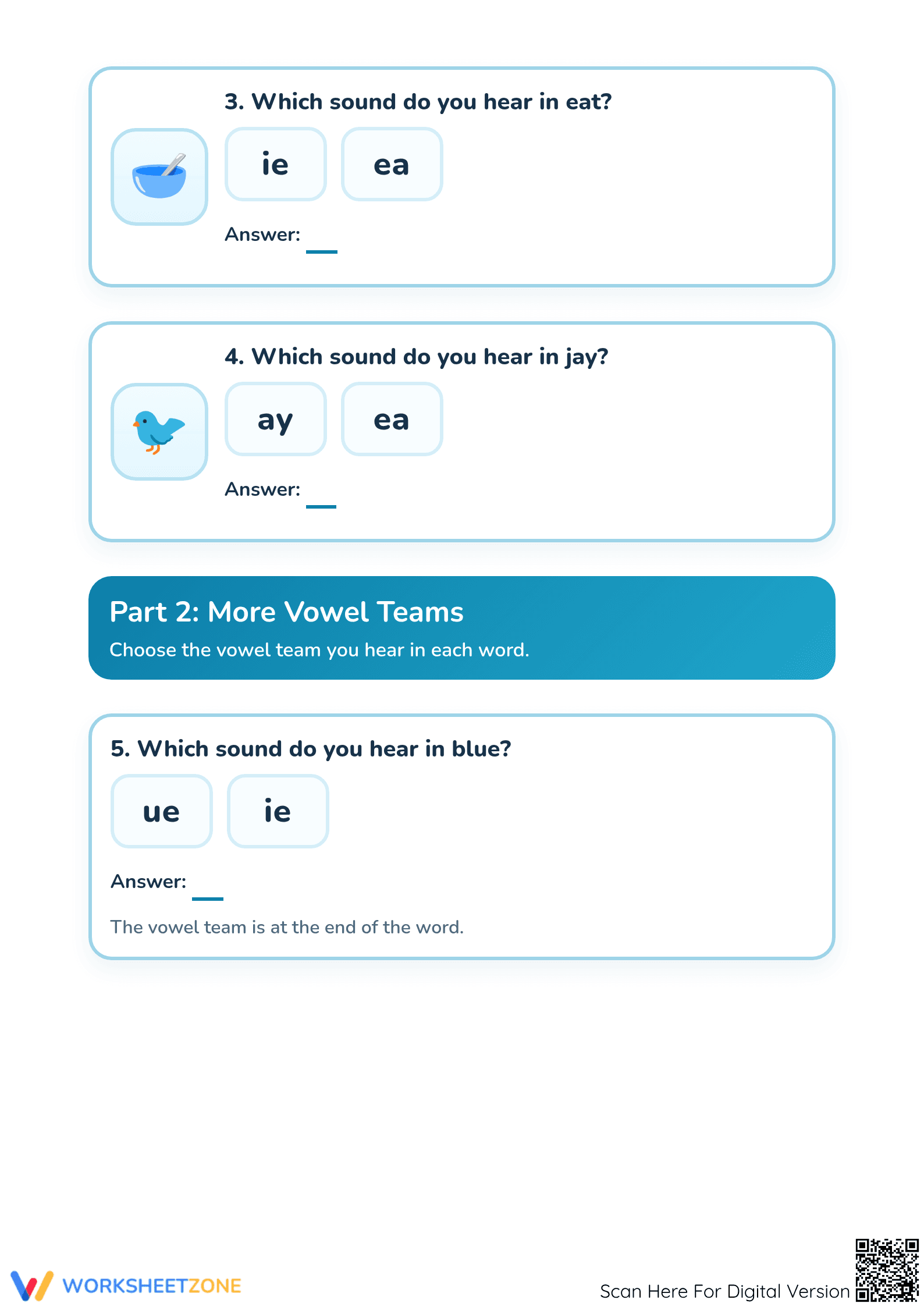
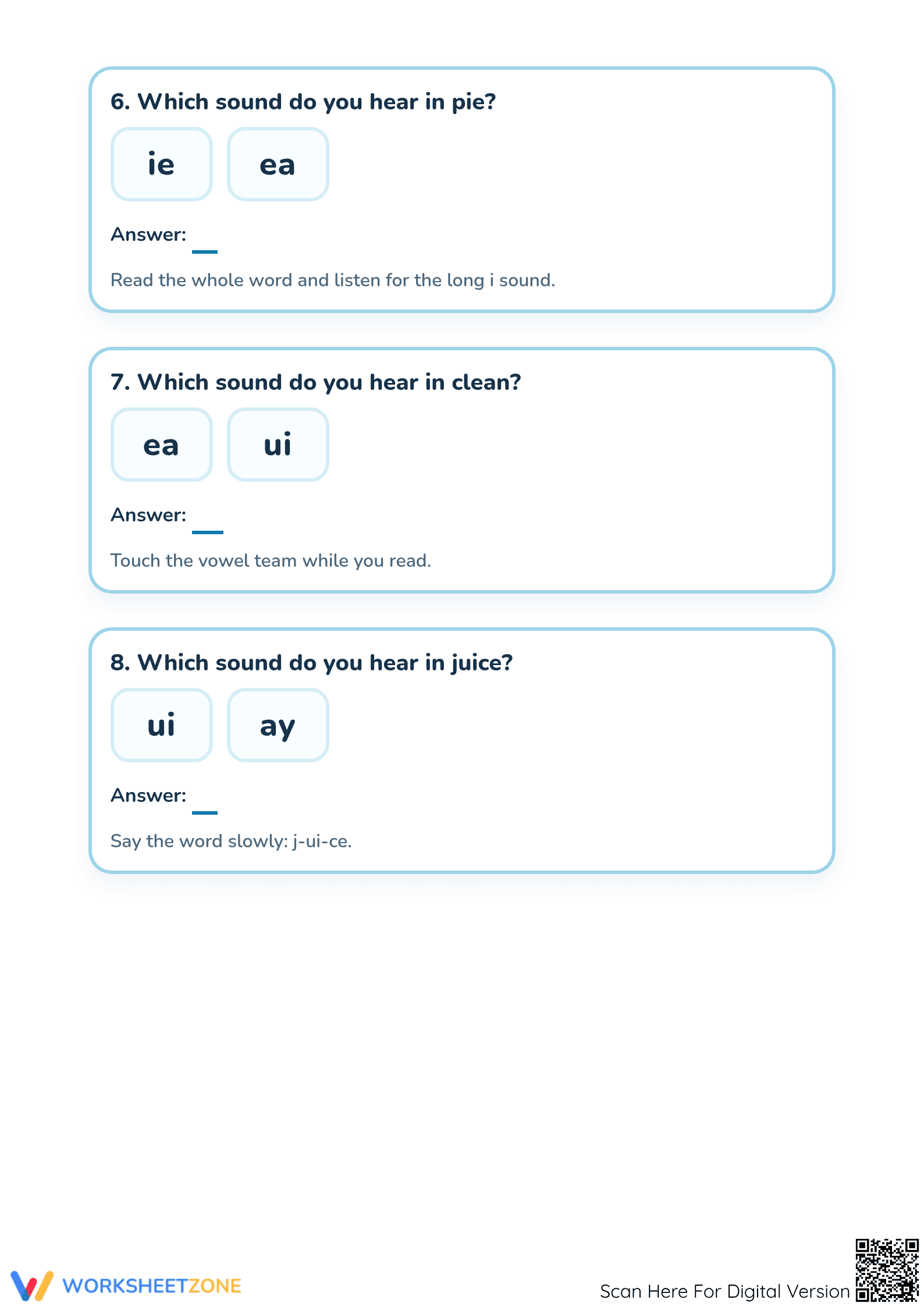
This packet contains three pages of interactive phonics practice. Part 1 features picture-driven prompts where students choose the correct vowel digraph from two options. Part 2 expands this with additional teams and phonetic hints. The resource covers eight problems and includes a full answer key for efficient grading and immediate feedback during small-group instruction.
- Guided Practice: Items 1-2 introduce the matching format using high-contrast images and simple digraph choices like 'ea' and 'ue'.
- Supported Practice: Items 3-5 require students to listen for vowel sounds in various positions within words like 'blue' and 'jay'.
- Independent Application: Items 6-8 provide textual hints that encourage students to decode slowly, reinforcing the sound-symbol connection for long vowel sounds.
This follows a gradual-release model for student success.
The primary focus is CCSS.ELA-LITERACY.RF.1.3.C, which requires students to know common vowel team conventions for long vowel sounds. By identifying digraphs like 'ie' and 'ui', students demonstrate mastery of irregular patterns. This standard code can be copied directly into lesson plans, IEP goals, or district curriculum mapping tools.
Use this worksheet during the independent practice phase of a phonics lesson. It is ideal for small-group literacy centers or as a formative assessment tool. Observe students as they complete the final page to check for phonetic decoding accuracy and correct pronunciation. Expected completion time is 15 to 20 minutes.
This resource is designed for first graders or advanced kindergartners. It works well for Tier 2 reading intervention or home-schooling. Pair this worksheet with a decodable passage featuring target vowel teams or a classroom anchor chart for additional support during the activity to ensure student confidence.
Mastering vowel digraphs is a critical milestone in early literacy, marking the transition from simple CVC patterns to complex phonetic decoding. This worksheet aligns with CCSS.ELA-LITERACY.RF.1.3.C, focusing on common vowel teams like 'ea', 'ay', and 'ie'. Research from Fisher & Frey (2014) emphasizes scaffolding phonics instruction through visual cues and immediate application, a principle reflected in the picture-to-sound matching tasks here. By requiring students to discriminate between similar-sounding vowel teams, the resource builds orthographic mapping skills necessary for reading fluency. The inclusion of guided hints supports the gradual release of responsibility, ensuring students move toward independent mastery of irregular phonetic structures. Educators can utilize these three pages to bridge the gap between initial phonemic awareness and the complex word recognition demands of primary-grade texts. This structured approach ensures that learners develop the precision required for both reading and spelling accuracy.


