


























Views
Downloads


Vowel Digraphs Worksheet | Printable Grade 1 Phonics
Paste this activity's link or code into your existing LMS (Google Classroom, Canvas, Teams, Schoology, Moodle, etc.).
Students can open and work on the activity right away, with no student login required.
You'll still be able to track student progress and results from your teacher account.
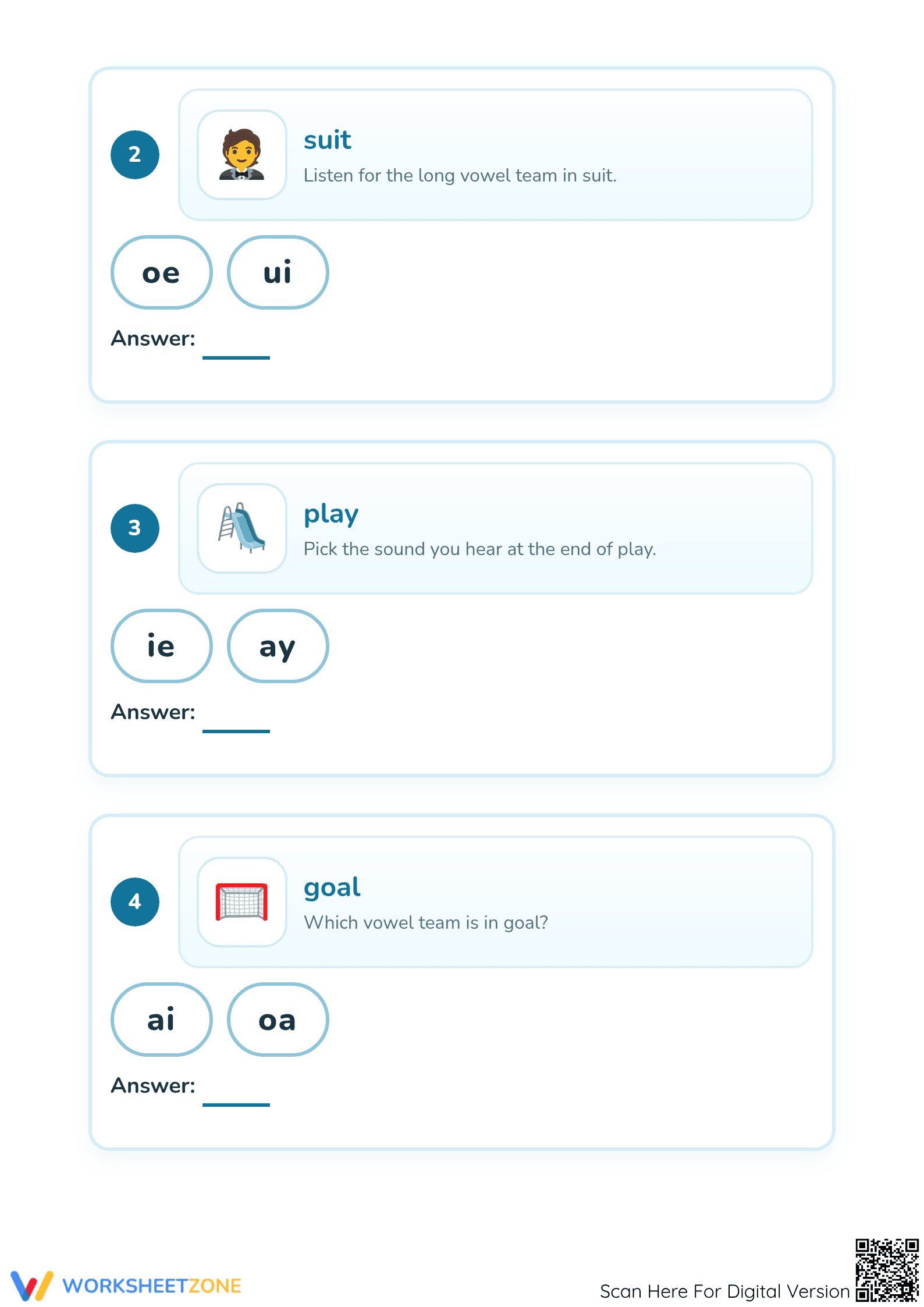
Identifying vowel digraphs is a fundamental step toward reading fluency for early learners. This worksheet provides a structured way for students to connect visual picture cues with the specific vowel teams that create long vowel sounds. By engaging with words like "head," "suit," and "goal," students build the phonemic awareness necessary for decoding.
At a Glance
- Grade: Grade 1 · Subject: ELA Phonics
- Standard:
CCSS.ELA-LITERACY.RF.1.3.C— Know final -e and common vowel team conventions for representing long vowel sounds- Skill Focus: Vowel Digraphs & Teams
- Format: 3 pages · 8 problems · Answer key included · PDF
- Best For: Literacy centers and independent phonics practice
- Time: 15–20 minutes
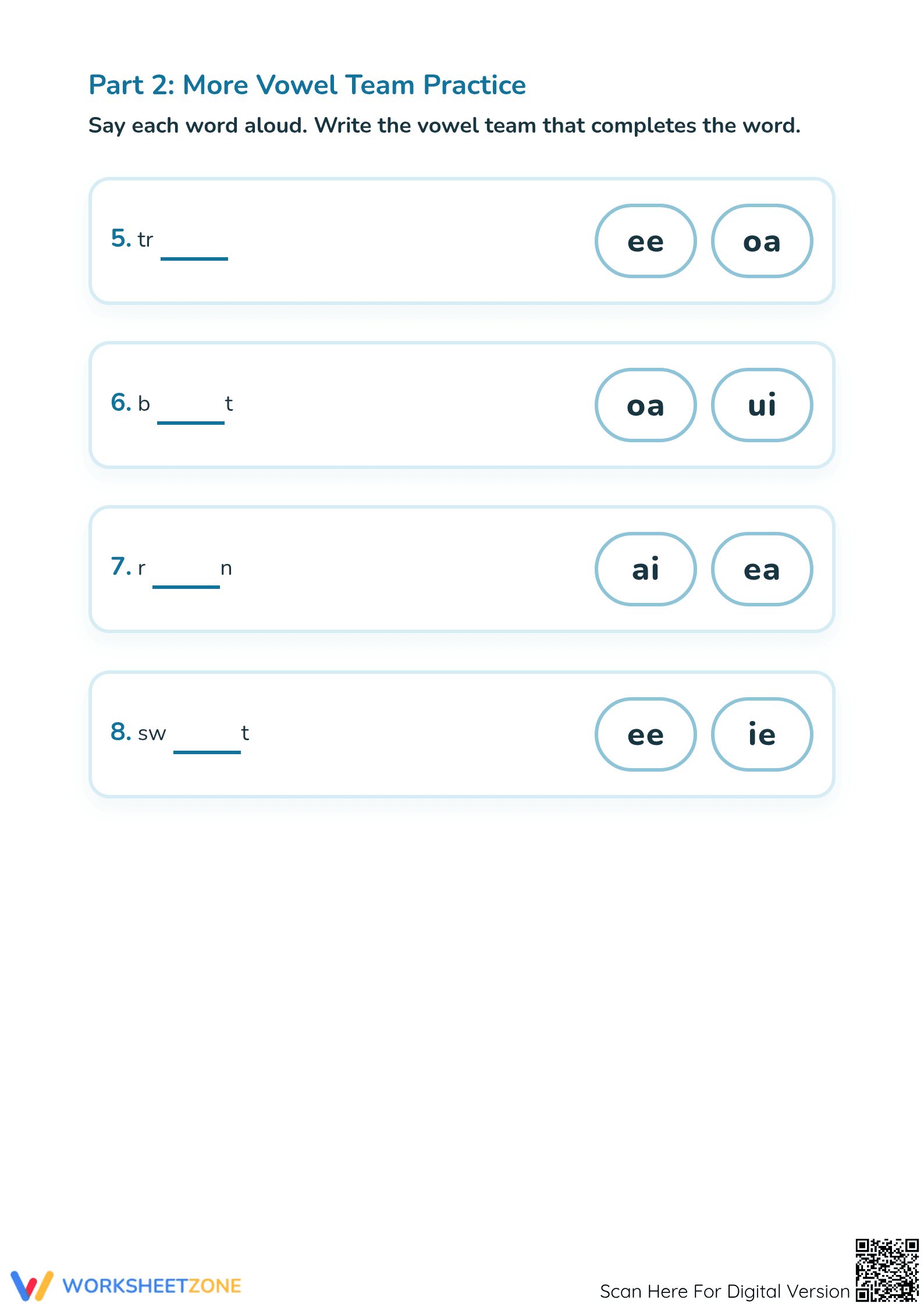
This three-page PDF resource includes two distinct sections designed to scaffold learning. Part 1 features four picture-based questions where students select the correct vowel team from two options. Part 2 shifts to more independent practice, requiring students to write the correct digraph to complete word stems. A full answer key is provided for immediate feedback and grading.
Skill Progression
- Guided practice begins with clear picture cards and a multiple-choice format, reducing cognitive load as students isolate specific sounds in words like "play" or "boat" using provided visual prompts.
- Supported practice continues in the second half, where students must still choose between two vowel teams but must actively write the letters into the blanks to complete the word structure.
- Independent practice is achieved once students can recognize these patterns without visual aids, moving from identifying "oa" in "goal" to spelling it correctly in "boat" using the provided choice bank.
This gradual-release model ensures students build confidence before tackling complex phonics tasks.
Standards Alignment
This resource aligns strictly with CCSS.ELA-LITERACY.RF.1.3.C: "Know final -e and common vowel team conventions for representing long vowel sounds." It specifically targets the "vowel team" component by focusing on digraphs like ay, ai, ea, ee, oa, and ui. Both standard codes can be copied directly into lesson plans, IEP goals, or district curriculum mapping tools.
How to Use It
Educators can utilize this worksheet during small-group literacy instruction or as a focused activity in a phonics center. A great formative-assessment tip is to have students say the word aloud before circling their choice; if they misidentify the sound, you can provide immediate phonological correction. The expected completion time range is 15 to 20 minutes depending on reading level.
Who It's For
This worksheet is ideal for Grade 1 students, though it serves as an excellent extension for Kindergarten or a remediation tool for Grade 2. It pairs naturally with a short-vowel versus long-vowel anchor chart or a decodable text focused on vowel teams like "The Boat in the Rain." Differentiation is built-in through the transition from image-based matching to text-based completion.
According to research by Fisher & Frey (2014) on the gradual release of responsibility, structured practice that combines visual cues with phonetic choices significantly enhances orthographic mapping in early readers. This worksheet specifically addresses standard CCSS.ELA-LITERACY.RF.1.3.C by isolating vowel digraphs such as "ea," "oa," and "ee." By requiring students to match pictures to sounds and then transition to writing the digraphs themselves, the activity reinforces the connection between phonemes and graphemes. Research indicates that students who master these common vowel team conventions early on demonstrate higher reading comprehension scores in later primary grades because their decoding becomes automatic. This printable resource provides exactly the kind of repeated, focused exposure needed to solidify these linguistic patterns. It serves as a reliable bridge between basic letter-sound recognition and the mastery of complex multi-syllabic words that characterize advanced primary reading.


