


























Views
Downloads

Grade 1 Vowel Digraphs — Printable No-Prep Worksheet
Paste this activity's link or code into your existing LMS (Google Classroom, Canvas, Teams, Schoology, Moodle, etc.).
Students can open and work on the activity right away, with no student login required.
You'll still be able to track student progress and results from your teacher account.
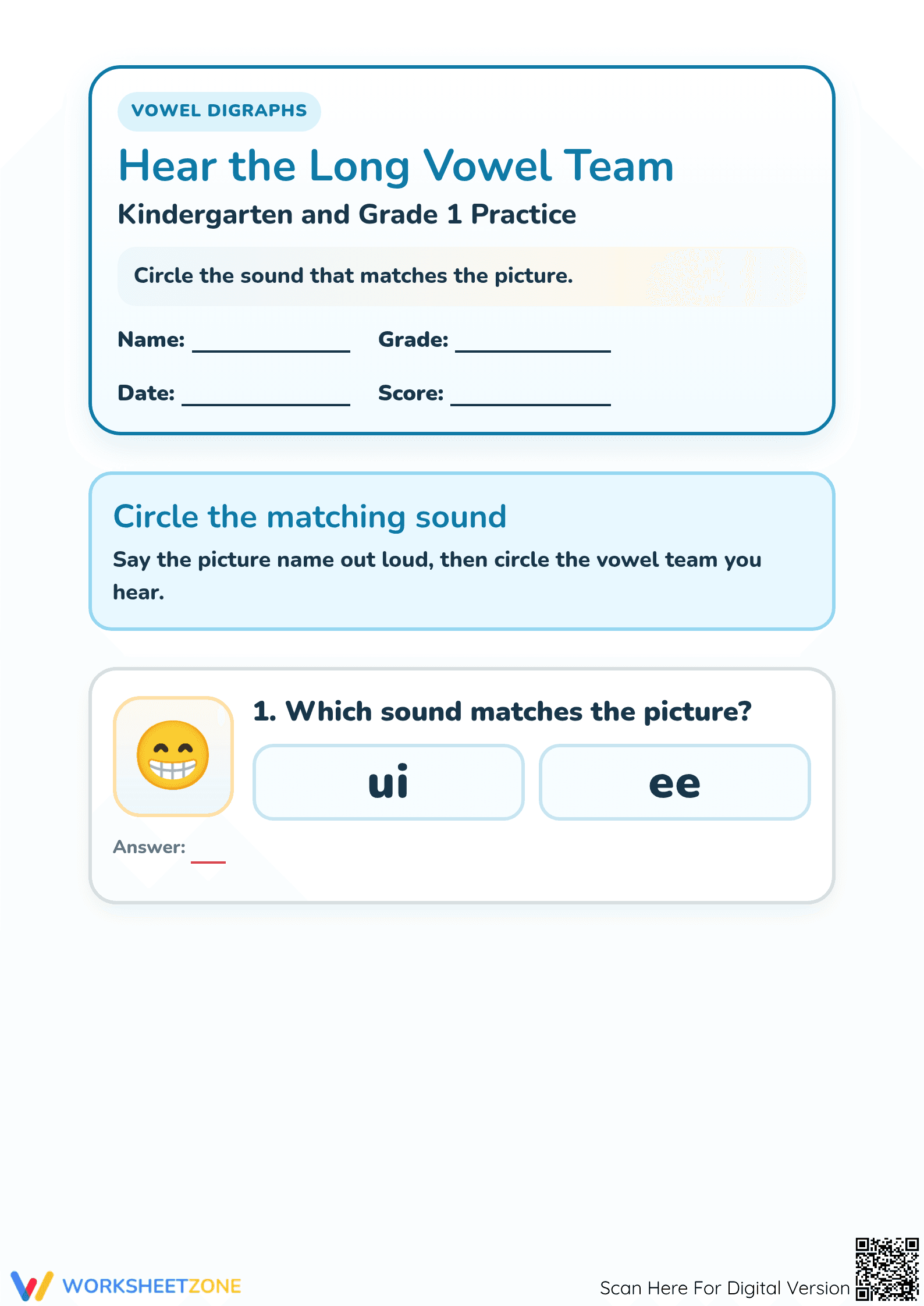
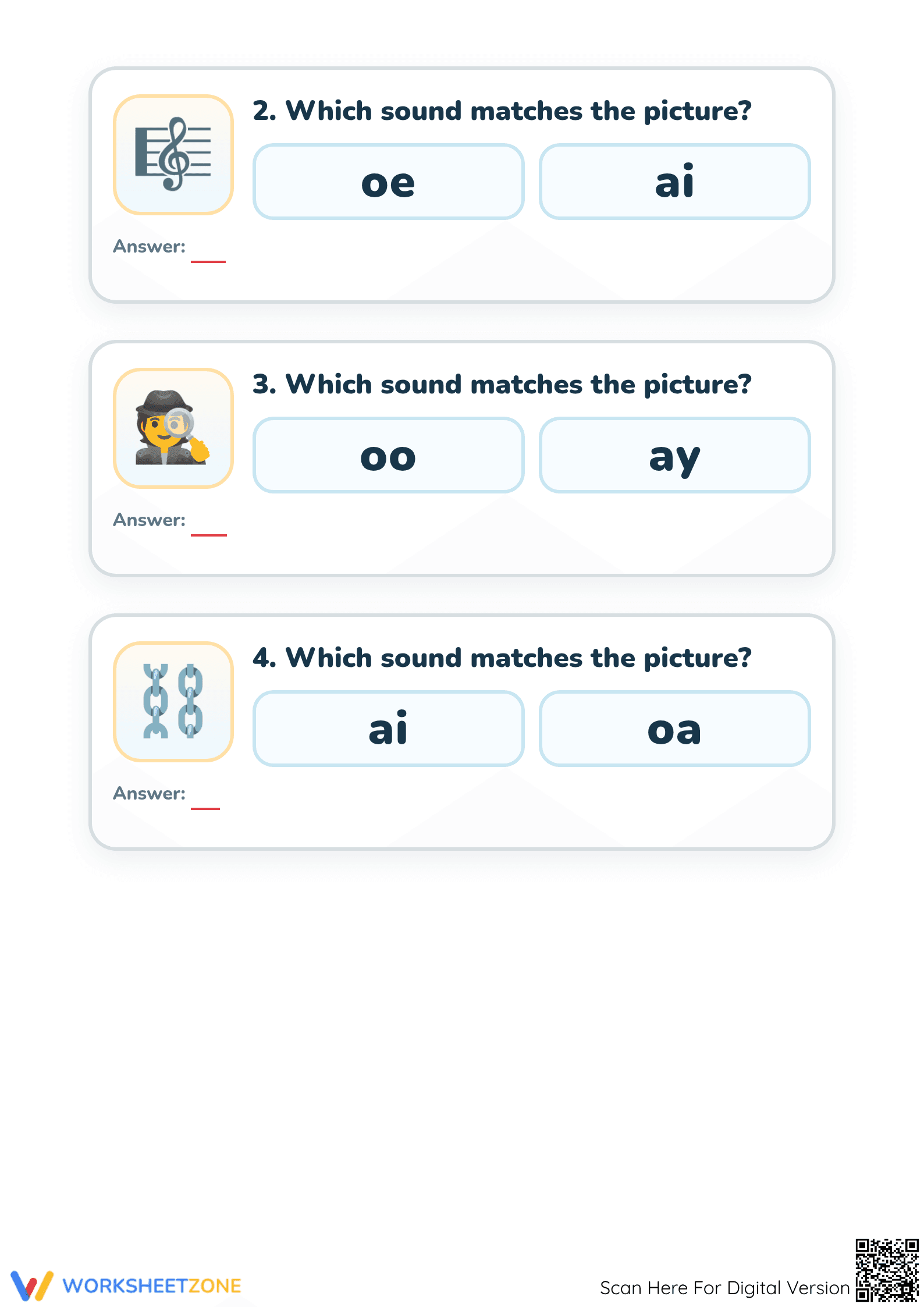
This Kindergarten and Grade 1 phonics worksheet helps students master the identification of long vowel digraphs through visual association. By matching sounds to pictures like a smile, music notes, and a chain, learners solidify their understanding of vowel teams such as 'ee', 'ai', and 'oa'. This resource ensures students can accurately recognize these foundational spelling patterns in isolation before applying them to reading.
At a Glance
- Grade: 1 · Subject: ELA
- Standard:
CCSS.ELA-LITERACY.RF.1.3.C— Recognize common vowel team conventions for representing long vowel sounds- Skill Focus: Vowel Digraph Identification
- Format: 2 pages · 4 problems · Answer key included · PDF
- Best For: Independent phonics practice and centers
- Time: 5–10 minutes
The "Hear the Long Vowel Team" pack includes two high-quality pages featuring four distinct identification tasks. Each problem presents a clear illustration followed by two vowel digraph options, such as 'ui' vs 'ee' for a smile. The clean layout minimizes distractions, while the included answer key allows for rapid grading or student self-correction during independent work time.
The zero-prep workflow for this resource is designed for efficiency. Educators can print the 2-page PDF in 30 seconds and distribute it immediately to students. Because the instructions are self-explanatory, learners can begin working without lengthy verbal directions, and the total teacher preparation time is under 2 minutes. This makes it an ideal choice for unexpected sub plans or morning work routines.
This worksheet is primarily aligned to `CCSS.ELA-LITERACY.RF.1.3.C`, which requires students to know final -e and common vowel team conventions for representing long vowel sounds. By focusing on digraphs like 'ai' and 'oa', it also supports Kindergarten standards related to phonological awareness and letter-sound correspondence. Both standard codes can be copied directly into lesson plans, IEP goals, or district curriculum mapping tools.
Use this worksheet as a quick formative assessment after a direct instruction lesson on long vowel sounds. Teachers can circulate while students work, observing if they say the picture name out loud to hear the vowel sound before circling their choice. It also works perfectly as a quiet exit ticket to gauge which students might need additional small-group support with specific digraphs like 'oe' or 'ui'.
This resource is designed for Kindergarten and Grade 1 students who are beginning to transition from CVC words to more complex vowel patterns. It provides a structured entry point for English Language Learners (ELLs) who benefit from the strong visual cues provided for each task. Pair this worksheet with a short reading passage featuring the same vowel teams to help students see these patterns in a connected text.
Fisher & Frey (2014) emphasize the gradual release of responsibility in foundational literacy skills, particularly when students are transitioning from phonemic awareness to grapheme-phoneme correspondence. This Vowel Digraphs worksheet aligns with evidence-based practices by requiring students to decode visual prompts and map them to specific vowel team conventions like CCSS.ELA-LITERACY.RF.1.3.C. Research from the NAEP consistently indicates that early mastery of long vowel sounds is a critical predictor of second-grade reading fluency and comprehension. By providing targeted identification tasks, this resource allows educators to assess vowel team recognition without the cognitive load of complex sentence structures. According to Fisher & Frey (2014), systematic phonics instruction—when paired with immediate feedback through answer keys—significantly reduces the formation of persistent spelling errors in early learners. This printable tool serves as an essential scaffold for primary students building the orthographic mapping skills necessary for proficient reading and phonological processing.


