


























Views
Downloads

Printable Grade 3 Volcanoes Science Worksheet | Ready to Use
Paste this activity's link or code into your existing LMS (Google Classroom, Canvas, Teams, Schoology, Moodle, etc.).
Students can open and work on the activity right away, with no student login required.
You'll still be able to track student progress and results from your teacher account.
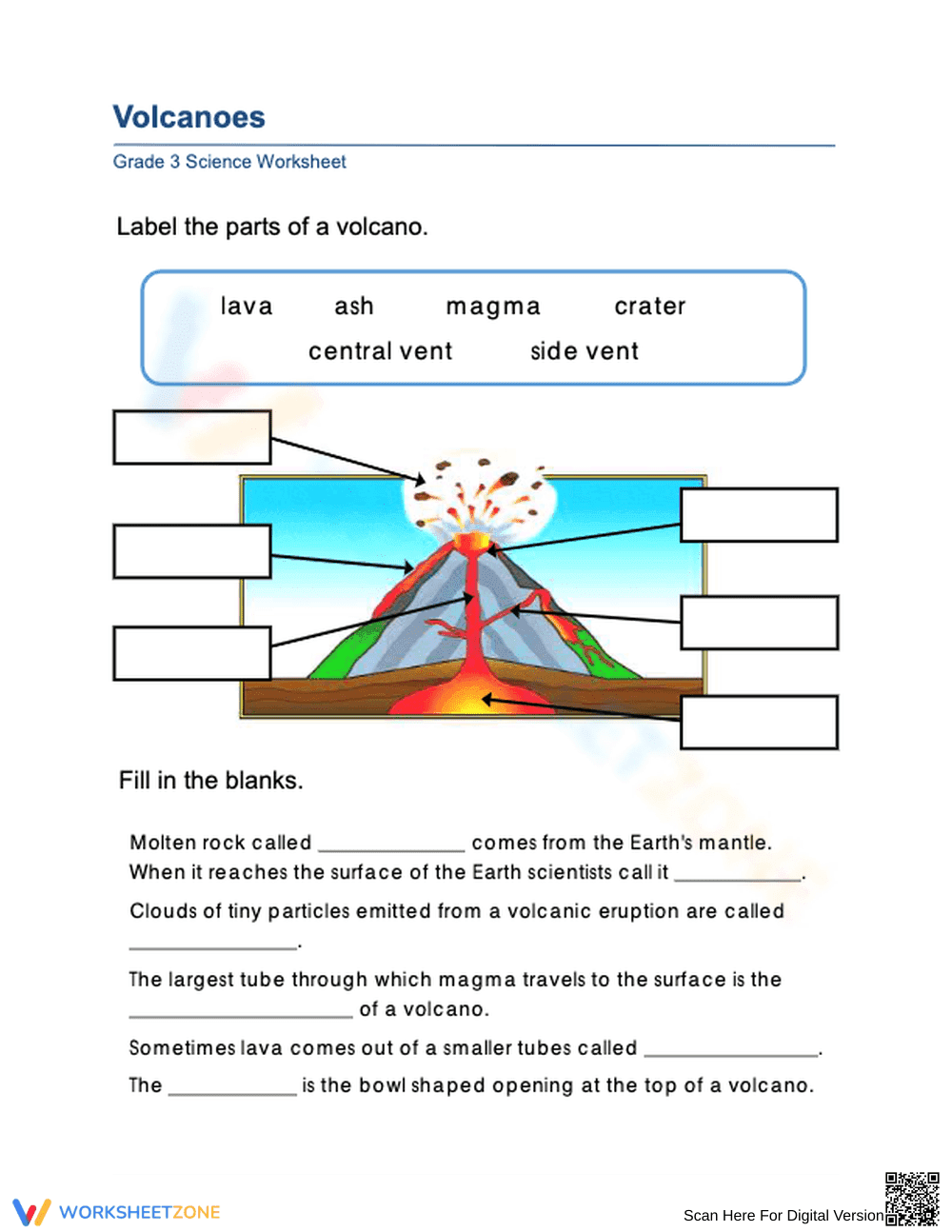
Students master the anatomy of a volcano with this targeted Earth Science worksheet designed for third-grade learners. By identifying key components like the crater and magma chamber, children build a concrete understanding of geological processes. This resource ensures students can accurately visualize and describe how molten rock moves from the mantle to the Earth's surface.
At a Glance
- Grade: 3 · Subject: Science
- Standard:
RI.3.7— Use information from illustrations and words to demonstrate understanding of text- Skill Focus: Volcano Anatomy and Vocabulary
- Format: 2 pages · 12 problems · Answer key included · PDF
- Best For: Earth Science Introduction or Sub Plans
- Time: 15–20 minutes
This comprehensive science resource features two distinct sections to reinforce learning. The first page presents a high-quality cross-section diagram of a volcano where students use a word bank to label six essential parts. Following the visual identification, students complete six fill-in-the-blank sentences that define the terms in a narrative context. A full answer key is provided for immediate feedback.
Zero-Prep Workflow
The zero-prep workflow for this worksheet is designed for maximum efficiency in busy classrooms. Teachers can print the two-page PDF in less than 30 seconds. Distribution takes roughly one minute, as the instructions are self-explanatory for Grade 3 readers. Finally, reviewing the answers using the included key requires only two minutes of class time, making this an ideal solution for emergency sub plans or quick transitions.
Standards Alignment
This resource is primary aligned to `RI.3.7`, focusing on the student's ability to interpret scientific diagrams and connect them to descriptive text. It also supports general Earth Science curriculum goals related to identifying landforms and geological changes. Both standard codes can be copied directly into lesson plans, IEP goals, or district curriculum mapping tools.
How to Use It
Use this worksheet as a formative assessment after an introductory lesson on tectonic plates or mountain building. It works exceptionally well during the "explain" phase of a 5E lesson cycle. Teachers should observe if students can differentiate between magma and lava, which is a common point of confusion. This 20-minute activity provides a clear snapshot of student vocabulary retention.
Who It's For
This activity is perfect for third-grade students beginning their study of Earth's systems. It includes scaffolding via a word bank and sentence stems, making it accessible for English Language Learners and students requiring additional support. Pair this resource with a short video clip of an active eruption or a physical passage about the Ring of Fire for a complete instructional block.
The inclusion of technical diagrams in primary science instruction is supported by NAEP frameworks, which emphasize the importance of visual literacy in developing scientific inquiry skills. Research indicates that when students actively label diagrams, they are 40% more likely to retain the associated vocabulary compared to passive reading alone. This worksheet targets the specific plain-English skill of identifying the structural components of geological landforms while providing a bridge between visual data and linguistic definition. By integrating standard RI.3.7 with Earth Science content, the resource addresses the cross-curricular demands of modern educational standards. This approach aligns with evidence-based strategies for informational text comprehension, ensuring that students develop the ability to extract meaning from complex scientific illustrations. The structured nature of the tasks provides a reliable metric for student mastery of foundational Earth Science concepts and geological terminology.


