


























Views
Downloads
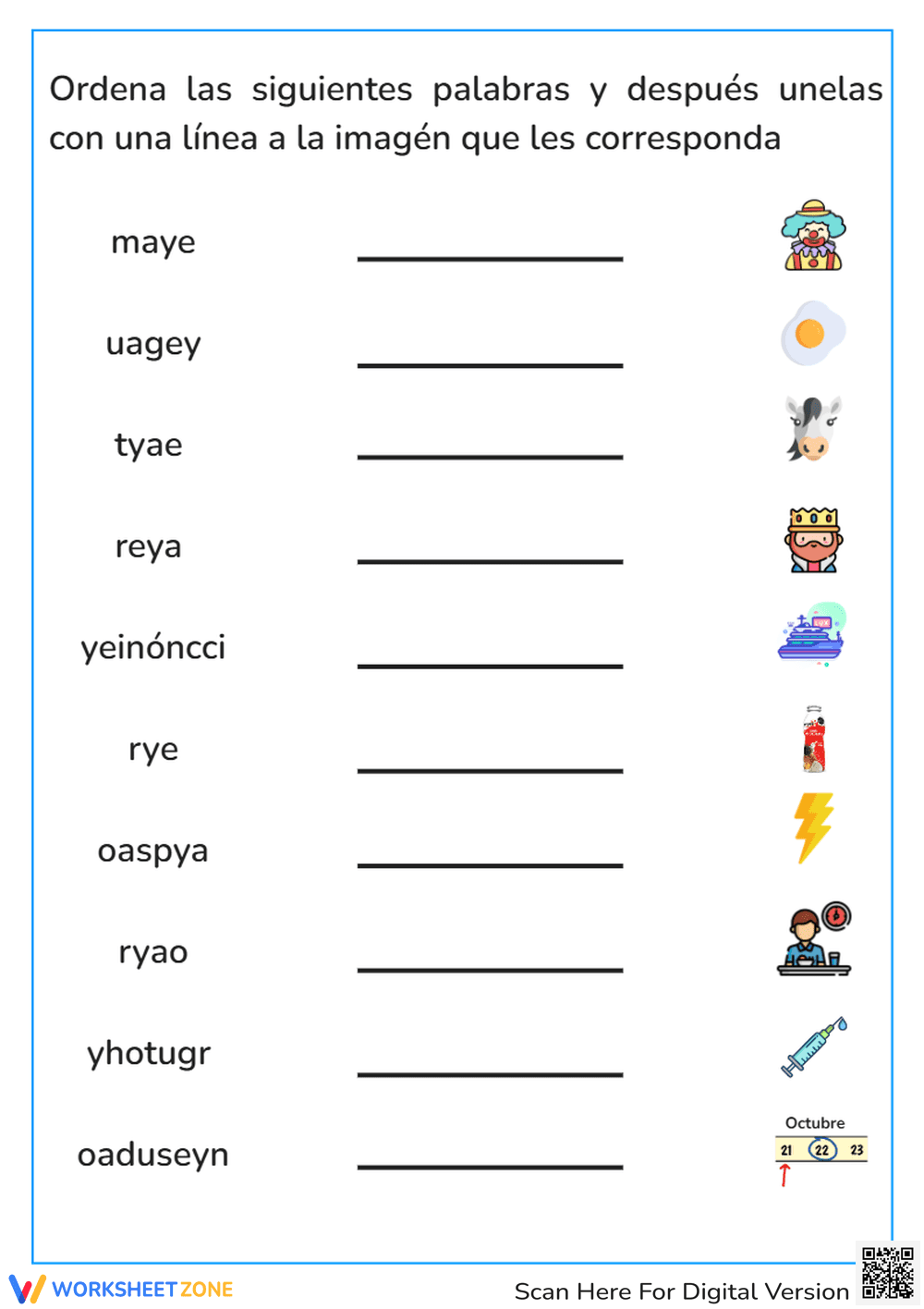

Spanish Letter Y Vocabulary Worksheet | Grade 2 Essential
Paste this activity's link or code into your existing LMS (Google Classroom, Canvas, Teams, Schoology, Moodle, etc.).
Students can open and work on the activity right away, with no student login required.
You'll still be able to track student progress and results from your teacher account.
This Grade 2 Spanish vocabulary worksheet helps students master words containing the letter Y through a combination of orthographic processing and visual matching. By unscrambling letters to form correct Spanish words and linking them to corresponding illustrations, students develop essential spelling and decoding skills. This resource ensures learners can accurately identify and write common vocabulary, fostering confidence in their bilingual literacy journey.
At a Glance
- Grade: 2 · Subject: Spanish Language Arts
- Standard:
CCSS.ELA-LITERACY.L.2.2.D— Generalize learned spelling patterns when writing words- Skill Focus: Spanish Letter Y Vocabulary
- Format: 1 page · 10 problems · Answer key included · PDF
- Best For: Independent literacy centers or morning work
- Time: 15–20 minutes
The worksheet features 10 distinct tasks designed to challenge and support Grade 2 learners. Each task presents a scrambled Spanish word containing the letter Y, such as "yema," "payaso," and "desayuno." Students must correctly reorder the letters on the provided lines and then draw a line to the matching icon on the right side of the page.
Teacher preparation for this activity is minimal, taking less than 2 minutes. First, print the single-page PDF for each student in the cohort. Second, distribute the sheets during your literacy block or as a transition activity; the instructions are self-explanatory, allowing for immediate student engagement. Finally, review the answers as a whole group using the included answer key to provide instant feedback on spelling and vocabulary accuracy. This zero-prep design makes it an ideal choice for substitute teacher folders or emergency lesson plans.
This resource is primarily aligned with `CCSS.ELA-LITERACY.L.2.2.D`, which requires students to generalize learned spelling patterns when writing words. By focusing on the specific phonetic and orthographic behavior of the letter Y in Spanish, the worksheet provides targeted practice in word construction. Additionally, it supports vocabulary acquisition goals by connecting written forms to visual meanings. Both standard codes can be copied directly into lesson plans, IEP goals, or district curriculum mapping tools.
Assign this worksheet during the "You Do" phase of a gradual release lesson on Spanish phonics. It serves as an excellent formative assessment tool; observe students as they attempt to unscramble the longer words like "inyección" to identify who may need additional support with multi-syllabic decoding. The activity is designed to be completed in approximately 15 to 20 minutes, making it a perfect fit for a rotating literacy station or a quiet independent work period following direct instruction.
This worksheet is specifically designed for Grade 2 students in bilingual, dual-language, or Spanish immersion programs. It provides necessary differentiation for students who benefit from visual scaffolds when learning new vocabulary.
According to research by Fisher & Frey (2014) on word study and vocabulary acquisition, the use of visual cues paired with orthographic manipulation—such as unscrambling letters—significantly strengthens the neural pathways associated with word recognition and spelling retention. This Grade 2 Spanish worksheet focuses on the letter Y, requiring students to decode phonemes and map them to graphemes while connecting the abstract word to a concrete visual representation. By engaging in these 10 specific tasks, learners move beyond rote memorization toward active linguistic processing. This resource aligns with CCSS.ELA-LITERACY.L.2.2.D, which emphasizes generalizing learned spelling patterns when writing words. The integration of image-to-word matching provides the necessary scaffolding for second-language learners and bilingual students to build a robust mental lexicon. Such structured practice is essential for developing fluency in Spanish literacy and ensuring students can accurately identify and spell high-frequency vocabulary in diverse contexts.


