


























Views
Plays



Grade 5 Verb Moods Meme Worksheet | Essential Practice
Paste this activity's link or code into your existing LMS (Google Classroom, Canvas, Teams, Schoology, Moodle, etc.).
Students can open and work on the activity right away, with no student login required.
You'll still be able to track student progress and results from your teacher account.
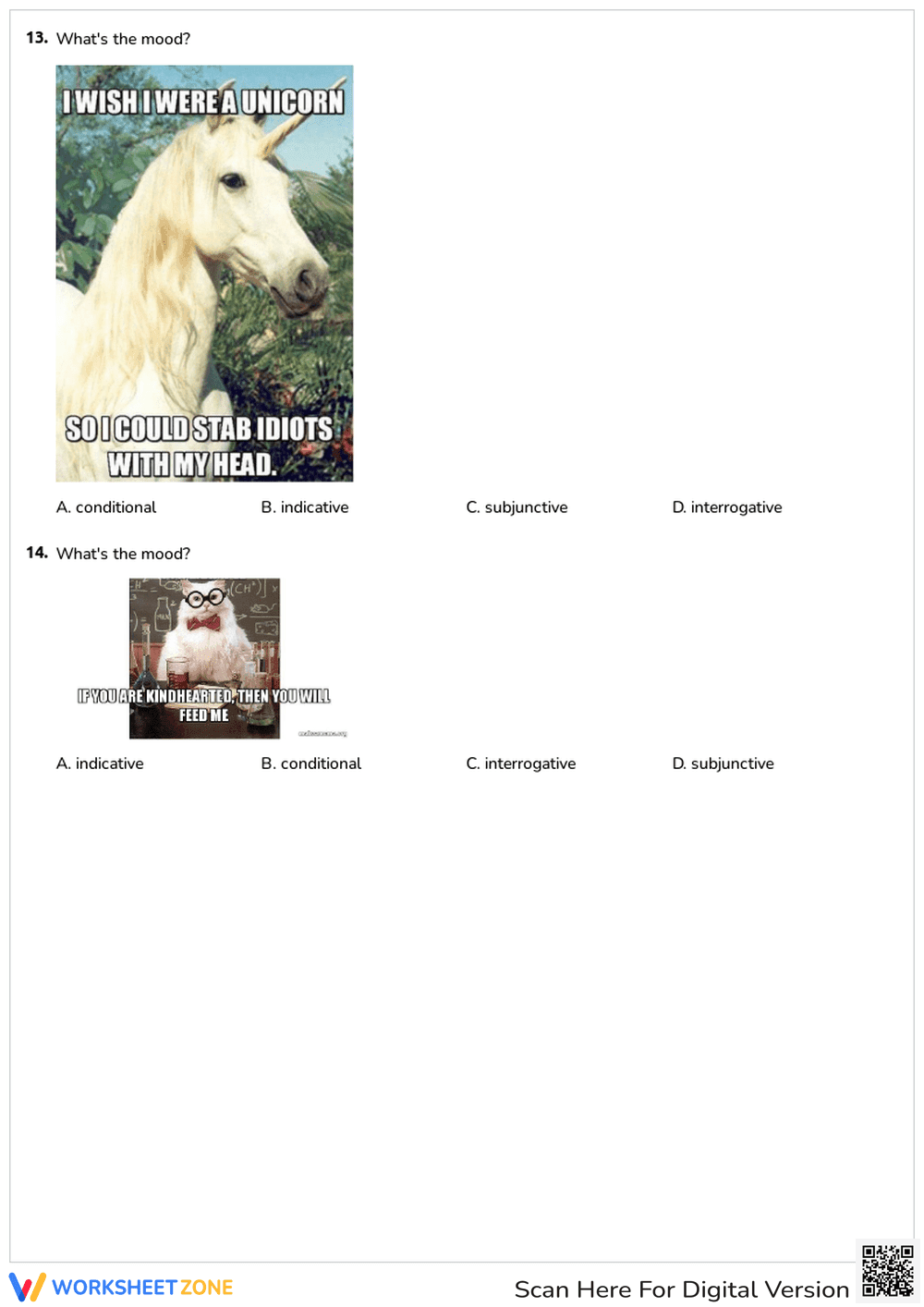
This Grade 5 ELA worksheet uses popular memes to help students identify and differentiate between various verb moods. By connecting complex grammatical concepts to relatable visual humor, students master the nuances of indicative, imperative, interrogative, conditional, and subjunctive forms. It provides a high-engagement path to grammar proficiency and sentence analysis.
At a Glance
- Grade: 5 · Subject: ELA Grammar
- Standard:
CCSS.ELA-LITERACY.L.8.1.C— Form and use verbs in the indicative, imperative, interrogative, conditional, and subjunctive mood- Skill Focus: Verb Mood Identification
- Format: 5 pages · 14 problems · Answer key included · PDF
- Best For: Engaging grammar review or bell-ringers
- Time: 15–20 minutes
What's Inside: The packet contains 14 multiple-choice questions spread across 5 pages. Each question features a unique, high-quality meme image with text that exemplifies a specific verb mood. Students must analyze the sentence structure and intent to select the correct mood from four options. A comprehensive answer key is provided for rapid grading and immediate student feedback.
Teachers can implement this resource in under two minutes. Simply print the 5-page PDF and distribute it to students as a warm-up or independent practice. Because the meme format is self-explanatory and highly engaging, students can begin working immediately with zero teacher setup. It also serves as an excellent emergency sub plan for middle-grade ELA classrooms.
Standards Alignment: This resource aligns with `CCSS.ELA-LITERACY.L.8.1.C`, which requires students to form and use verbs in the indicative, imperative, interrogative, conditional, and subjunctive moods. While formally introduced in middle school, these concepts are vital for upper elementary students developing sophisticated writing styles. Both standard codes can be copied directly into lesson plans, IEP goals, or district curriculum mapping tools.
How to Use It: Use this worksheet during the independent practice phase of a lesson to assess individual student understanding of verb moods. It is also effective as a formative assessment; observe if students can explain why a specific meme, such as the Yoda or Grumpy Cat examples, represents an imperative versus a conditional mood. Completion typically takes 15 to 20 minutes depending on student familiarity.
Who It's For: This resource is designed for Grade 5 students but is highly effective for Grade 6-8 remediation or ESL learners who benefit from visual context clues. It pairs naturally with a verb mood anchor chart or a direct instruction lesson on sentence types. The humor makes it particularly effective for students who typically struggle with traditional grammar drills.
Research by Fisher & Frey (2014) emphasizes the importance of visual scaffolds and high-interest materials in developing linguistic competence. This worksheet applies these principles by using memes to provide context for CCSS.ELA-LITERACY.L.8.1.C, helping students identify verb moods like the subjunctive or interrogative through relatable cultural touchstones. By reducing the cognitive load associated with abstract grammar rules, the 14-task format allows for focused repetition and mastery. According to the RAND AIRS 2024 report, instructional materials that leverage multi-modal learning—such as combining text with visual humor—show higher rates of student retention in grammar-heavy subjects. This printable PDF ensures that students remain cognitively active while practicing the identification of complex verb forms, making it a robust tool for any ELA classroom seeking to bridge the gap between formal grammar and modern communication.


