




























Views
Downloads

Velocity-Time Graphs Worksheet | Essential Grade 9 Science

Paste this activity's link or code into your existing LMS (Google Classroom, Canvas, Teams, Schoology, Moodle, etc.).
Students can open and work on the activity right away, with no student login required.
You'll still be able to track student progress and results from your teacher account.
This physical science worksheet equips Grade 9 students to interpret velocity-time graphs by calculating acceleration, displacement, distance, and average speed across 14 rigorous items. Students extract values directly from coordinate grids, compute line slopes to find acceleration, and calculate geometric areas beneath curves to quantify total displacement and directional distance.
At a Glance
- Grade: 9 · Subject: Physical Science
- Standard:
HS-PS2-1— Analyze motion data graphically to determine acceleration, displacement, and relationships in one dimension- Skill Focus: Velocity-time graphs, acceleration slope, and geometric area displacement
- Format: 4 student pages · 14 problems · 2-page answer key · Printable PDF
- Best For: Kinematics reinforcement, homework, or formative assessment
- Time: 25–40 minutes of instructional time
What's Inside
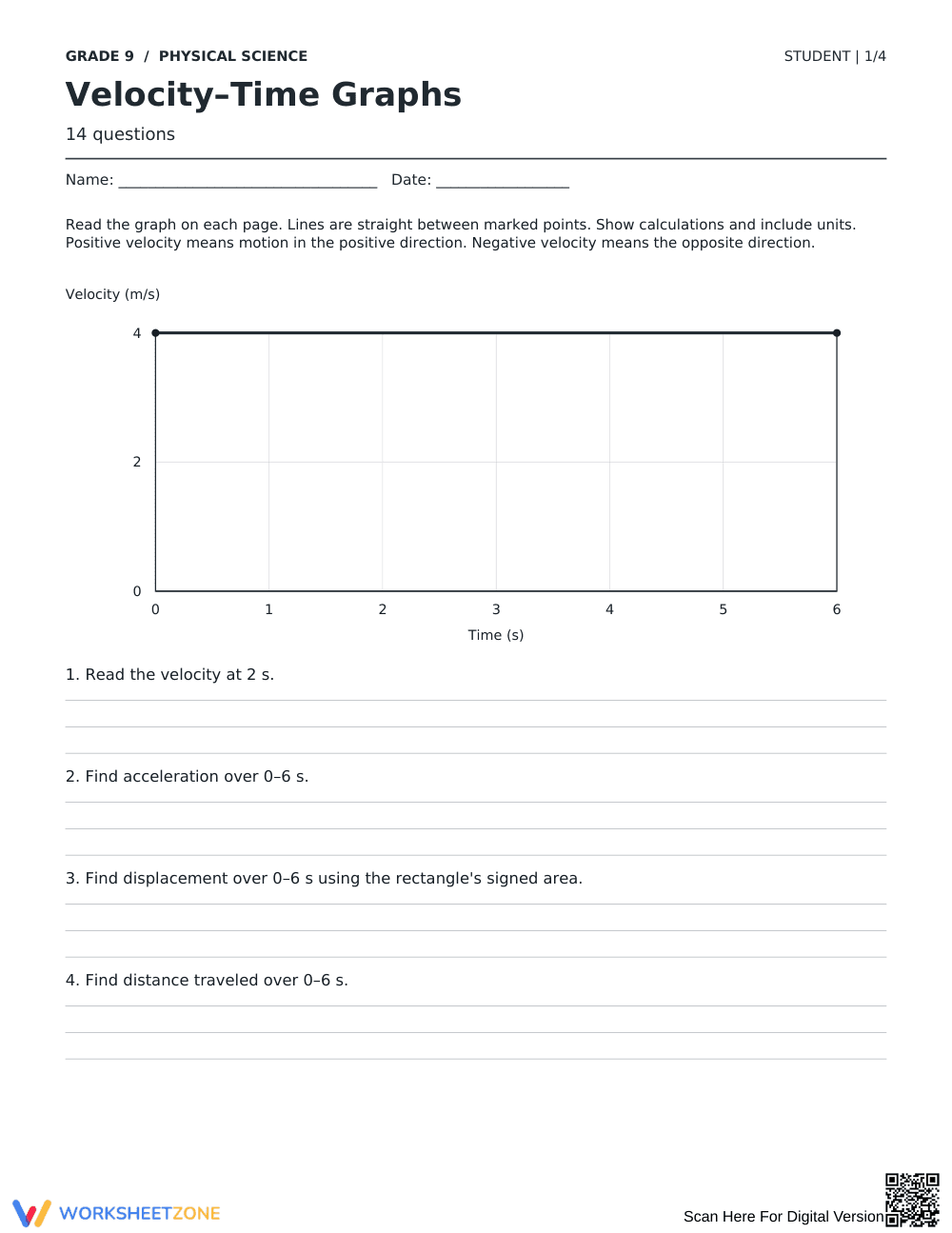
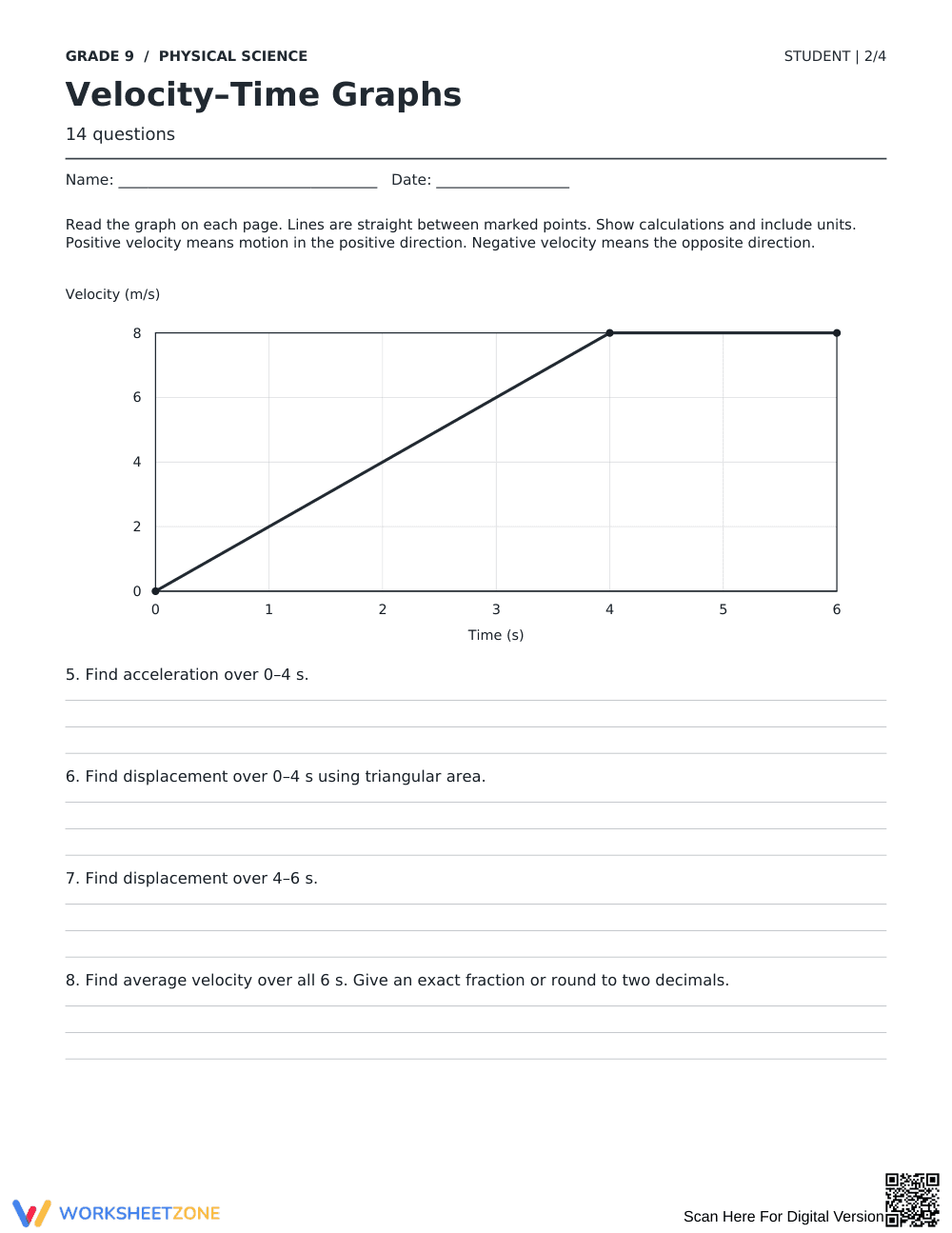
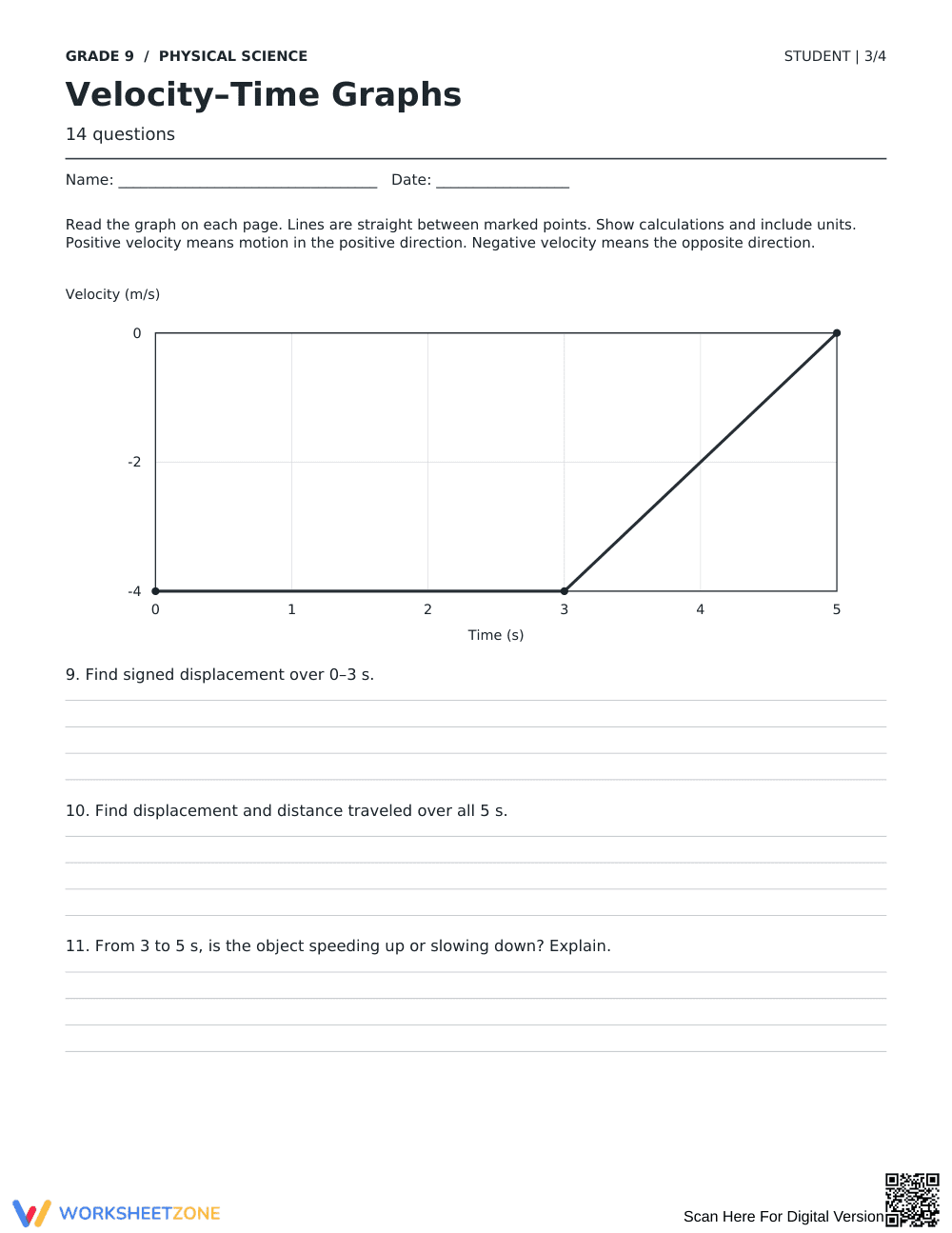
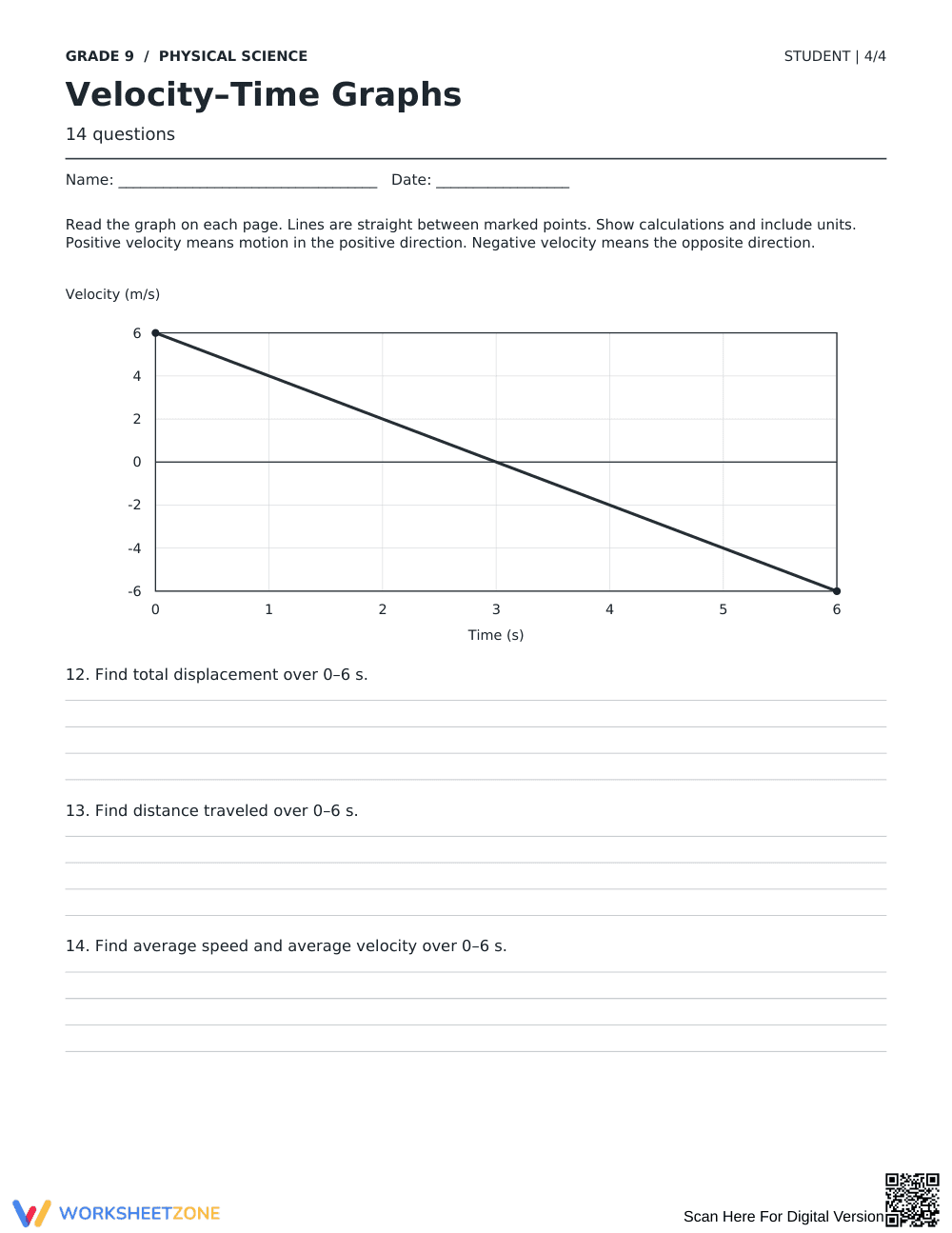
The resource spans 4 student pages featuring four distinct kinematics graphs paired with lined calculation prompts. Students encounter constant velocity, uniform positive acceleration, negative velocity, and sign-changing linear motion across the coordinate grids. A complete 2-page answer key provides step-by-step arithmetic, geometric formulas, and model explanations for every question.
Skill Progression
- Guided practice (Questions 1–4): Students read coordinate pairs from a horizontal line, evaluate zero slope for acceleration, and apply basic rectangular area formulas.
- Supported practice (Questions 5–11): Learners calculate positive slope on slanted segments, find triangular area, interpret negative velocity vectors, and explain changing object speeds.
- Independent practice (Questions 12–14): Students tackle a continuous line crossing the time axis, distinguishing net vector displacement from scalar total distance and computing average velocity versus speed.
This sequence mirrors the gradual-release framework, shifting learners systematically from direct reading to complex kinematic reasoning.
Standards Alignment
The central activity aligns directly with `HS-PS2-1`: Analyze data to support the claim that Newton's second law of motion describes the mathematical relationship among the net force on a macroscopic object, its mass, and its acceleration. This worksheet provides foundational graphical competence, supported mathematically by CCSS.MATH.CONTENT.HSF.IF.B.4 through interpreting key features of linear functions. Both standard codes can be copied directly into lesson plans, IEP goals, or district curriculum mapping tools.
How to Use It
Deploy this activity immediately after direct instruction on motion graphs or as mid-unit guided practice. For formative assessment, examine student responses to Question 12 during circulating rounds; observing whether students subtract negative area below the time axis reveals if they understand displacement as a vector quantity. Students generally complete the 14 questions in 25 to 40 minutes during individual work or paired peer problem-solving.
Who It's For
This resource serves Grade 9 physical science and introductory physics students developing quantitative graph-reading fluency. Scaffolded grids assist struggling learners through explicit visual intervals, while advanced students gain rigorous vector calculation practice. Pair this handout with a direct instruction lesson on kinematic equations or a reference anchor chart illustrating motion slopes.
Mastering kinematics under standard HS-PS2-1 requires secondary science students to bridge conceptual motion theories with concrete quantitative graph analysis. Interpreting velocity-time graphs to determine acceleration and displacement demands both slope calculation and geometric integration beneath functional curves. According to Fisher & Frey (2014), structured instructional scaffolds that transition students from guided geometric readings to complex independent problem sets foster sustainable disciplinary literacy in STEM environments. When students unpack piecewise motion and confront negative velocity domains, they resolve persistent misconceptions regarding scalar distance versus vector displacement. This 14-item physical science worksheet operationalizes gradual-release modeling across four progressive visual scenarios, enabling high school learners to master mathematical representations before transitioning into multi-step Newton's second law problem solving. The rigorous progression guarantees that students cultivate algebraic fluency, graphical comprehension, and evidence-based scientific argumentation necessary for advanced physical science coursework.


