


























Views
Downloads

Essential Valentine's Day Reading & Math Worksheet Gr 4-5
Paste this activity's link or code into your existing LMS (Google Classroom, Canvas, Teams, Schoology, Moodle, etc.).
Students can open and work on the activity right away, with no student login required.
You'll still be able to track student progress and results from your teacher account.
This integrated Valentine's Day Reading and Math worksheet provides Grade 3-5 students with high-interest practice in context clues and fraction operations. Students solve themed word problems and complete cloze passages to build vocabulary and computational fluency. It delivers a comprehensive seasonal review that ensures holiday celebrations remain academically rigorous and focused on core standards.
At a Glance
- Grade: 3-5 · Subject: ELA & Math
- Standard:
CCSS.ELA-LITERACY.L.4.4.A— Use context clues to determine the meaning of unknown words- Skill Focus: Context Clues & Fraction Word Problems
- Format: 3 pages · 18 tasks · Answer key included · PDF
- Best For: Seasonal skill review and morning work
- Time: 25–35 minutes
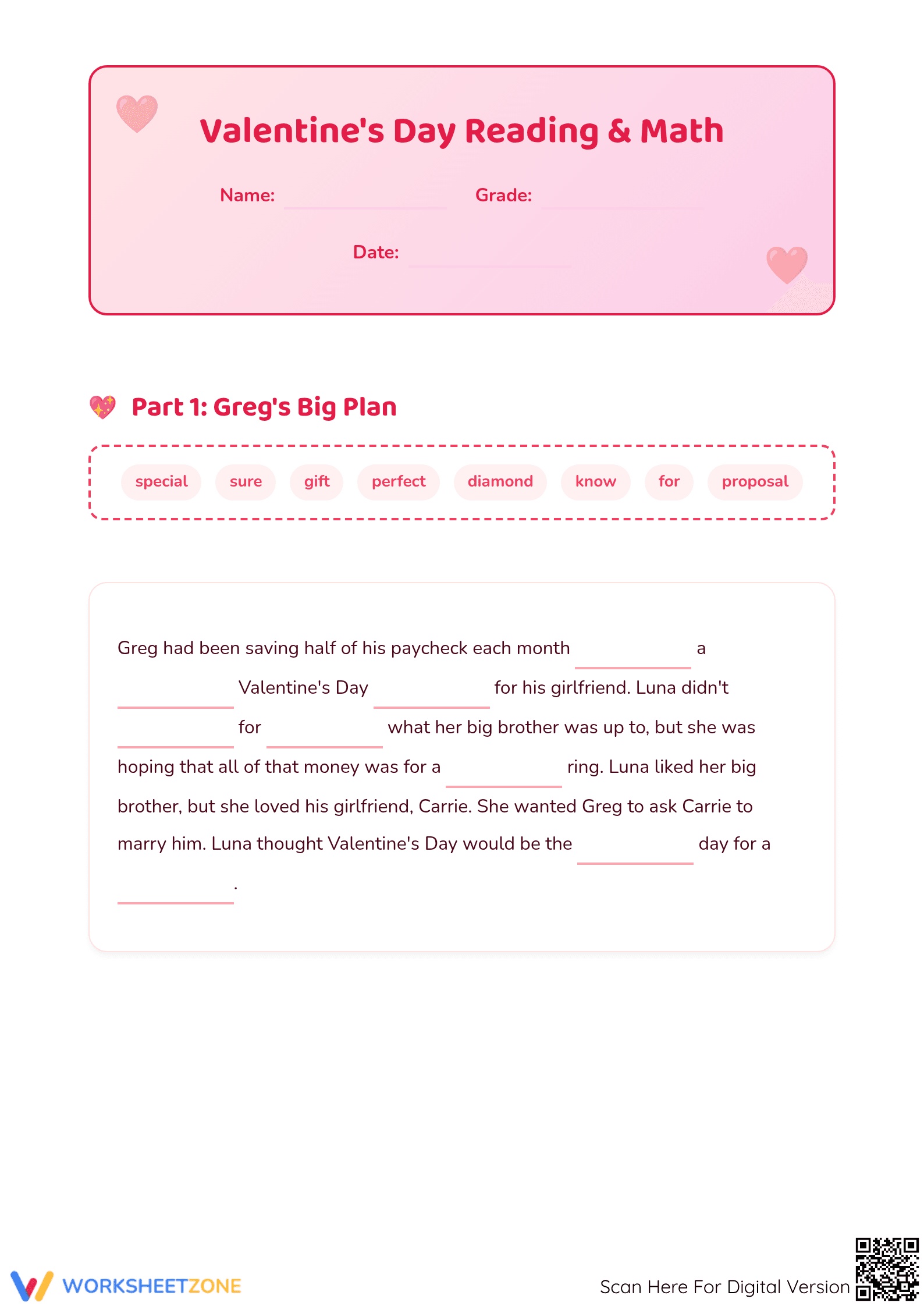
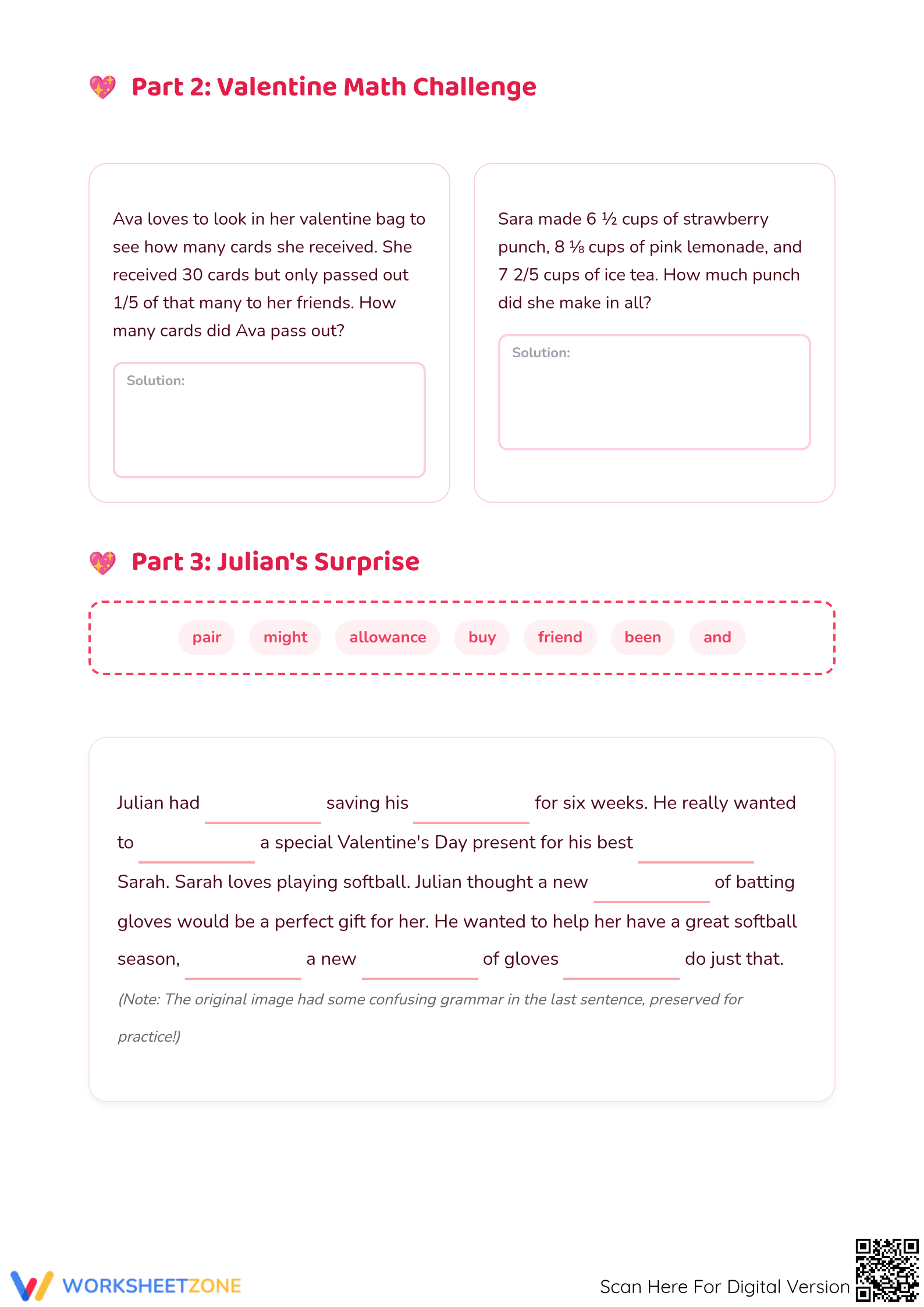
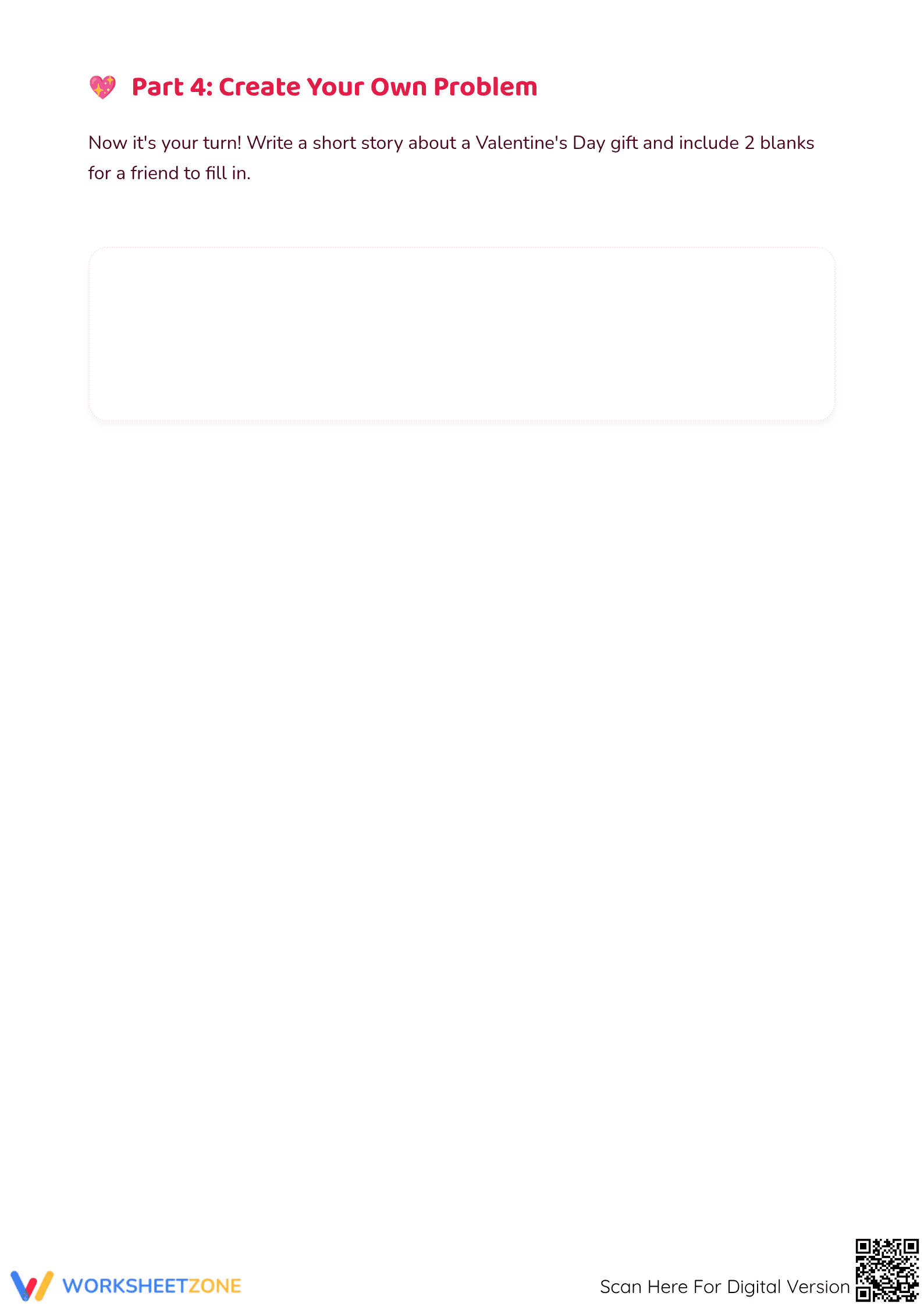
The packet contains four distinct sections across three pages. Two "Cloze" reading passages, "Greg's Big Plan" and "Julian's Surprise," utilize word banks to support vocabulary acquisition and narrative comprehension. The math section challenges students with multi-step word problems requiring fraction multiplication and the addition of mixed numbers with unlike denominators. A final creative writing prompt allows for student-led problem design.
Zero-Prep Workflow
- Step 1: Print the three-page PDF for your class in under 30 seconds.
- Step 2: Distribute the packets as independent work or literacy/math center activities without any teacher setup.
- Step 3: Review student responses using the provided comprehensive answer key for quick formative assessment or self-grading.
This resource is a perfect fit for sub plans or as a "print-and-go" option during busy holiday weeks.
Standards Alignment
The primary ELA standard addressed is `CCSS.ELA-LITERACY.L.4.4.A`, which requires students to use context as a clue to the meaning of a word or phrase. The math portion aligns with `CCSS.MATH.CONTENT.5.NF.A.1`, focusing on adding and subtracting fractions with unlike denominators. Both standard codes can be copied directly into lesson plans, IEP goals, or district curriculum mapping tools to document seasonal evidence of learning.
How to Use It
Use this packet as a themed "Choice Board" option during Valentine's Day celebrations to maintain instructional focus. It also serves as an excellent formative assessment tool; observe how students approach the mixed-number addition problem to identify those needing additional support with finding common denominators. Completion typically takes 30 minutes, making it an ideal bridge between morning meetings and holiday parties.
Who It's For
This resource is tailored for upper elementary students in Grades 3, 4, and 5 who benefit from scaffolded literacy tasks and real-world math applications. The inclusion of word banks provides necessary differentiation for English Language Learners (ELL) and students with IEPs. It pairs naturally with a direct instruction lesson on finding common denominators or a mini-lesson on utilizing narrative context clues.
Research from the ScienceDirect TpT Analysis (2024) indicates that seasonal materials significantly increase engagement by leveraging holidays like Valentine's Day to reinforce difficult skills such as fraction operations. By embedding `CCSS.ELA-LITERACY.L.4.4.A` within a narrative, students are more likely to persist through complex decoding. The study highlights that integrated ELA and math worksheets provide a cohesive experience mirroring the cognitive demands of real-world solving. This worksheet targets Grade 3-5 fluency through 18 tasks balancing practice with scaffolded support like word banks. Practitioners can utilize this data-driven resource to ensure holiday-themed activities meet rigorous demands while providing a ready solution that minimizes burnout and maximizes instructional minutes. This standalone summary confirms the worksheet's alignment with evidence-based practices for seasonal skill maintenance.


