


























Views
Downloads
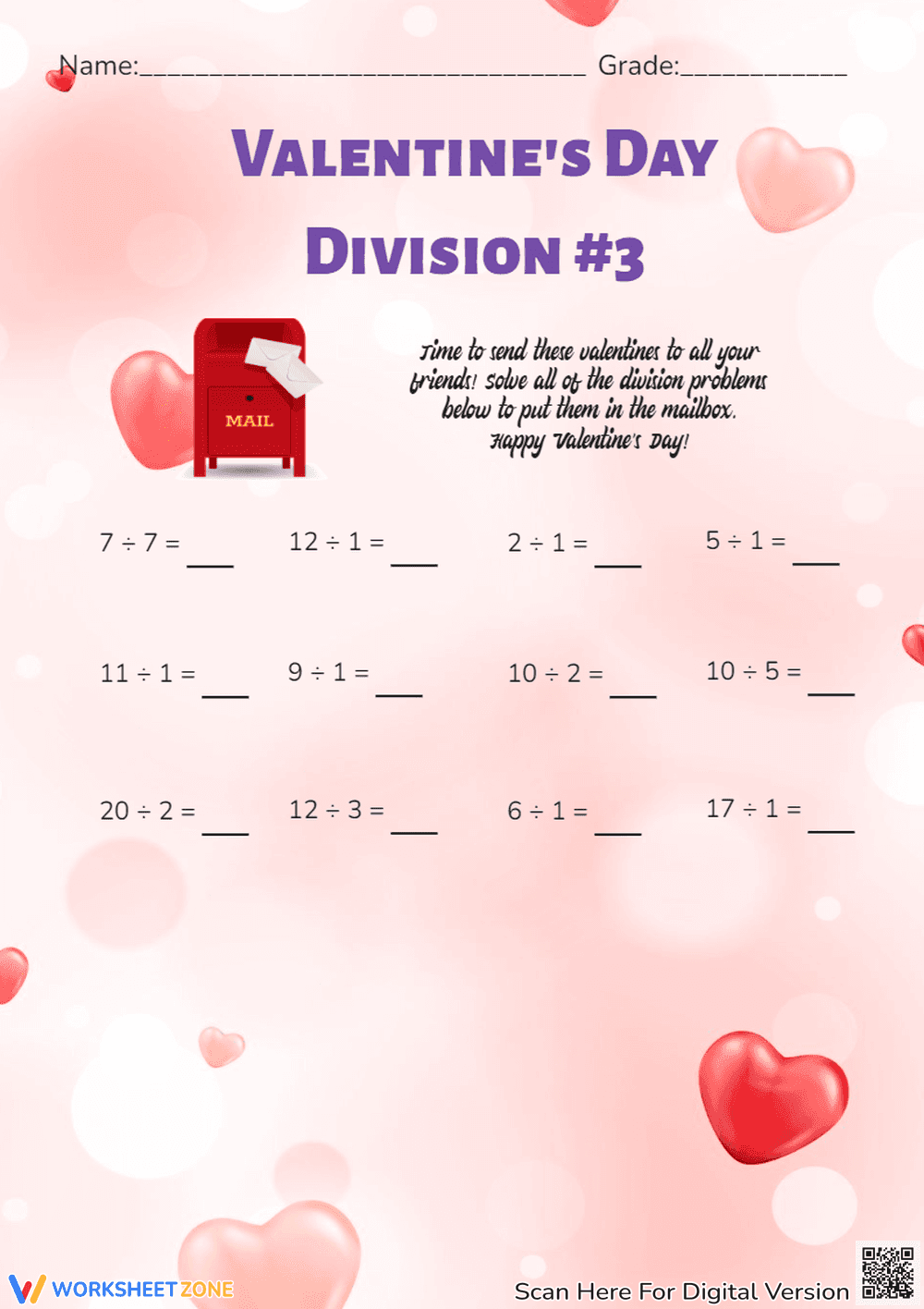

Grade 3 Valentine's Day Division — Printable Worksheet
Paste this activity's link or code into your existing LMS (Google Classroom, Canvas, Teams, Schoology, Moodle, etc.).
Students can open and work on the activity right away, with no student login required.
You'll still be able to track student progress and results from your teacher account.
This Grade 3 division worksheet provides immediate practice with basic math facts through a festive Valentine's Day theme. Students solve twelve distinct division problems to strengthen their mental math capabilities and operational fluency. By focusing on divisors like one, two, three, and five, this resource ensures students build the confidence necessary for more complex multi-digit operations.
At a Glance
- Grade: 3 · Subject: Division
- Standard:
CCSS.MATH.CONTENT.3.OA.C.7— Fluently divide within 100 using strategies such as the relationship between multiplication and division- Skill Focus: Basic Division Facts
- Format: 1 page · 12 problems · Answer key included · PDF
- Best For: Seasonal morning work or quick assessment
- Time: 10–15 minutes
The resource features a clean, themed layout with twelve horizontal division equations. It specifically targets the identity property of division (dividing by 1) and introductory division by small integers. The single-page PDF format includes a clear header for student names and grades, alongside a decorative mailbox graphic that frames the mathematical tasks. A comprehensive answer key is provided to facilitate rapid grading or student self-correction.
This resource is designed for a zero-prep classroom environment. First, print the single-page PDF (30 seconds). Second, distribute the sheets to students during a transition period or as a seasonal bell-ringer (1 minute). Third, review the twelve answers as a whole group or use the included key for individual feedback (under 2 minutes). Total teacher preparation time is less than two minutes, making it an ideal choice for substitute plans or busy holiday schedules.
The primary focus is CCSS.MATH.CONTENT.3.OA.C.7, which requires students to fluently multiply and divide within 100. By the end of Grade 3, students should know from memory all products of two one-digit numbers. This worksheet supports that goal by reinforcing the inverse relationship between multiplication and division. Both standard codes can be copied directly into lesson plans, IEP goals, or district curriculum mapping tools.
Use this worksheet as a formative assessment during the month of February to gauge student mastery of basic divisors. It works best after direct instruction on the identity property of division. Teachers can observe students as they work; those struggling with "12 ÷ 3" may need additional support with skip-counting or arrays. Expect most third graders to complete the twelve problems within ten to fifteen minutes.
This resource is tailored for third-grade students but serves as an excellent review for fourth graders needing a fluency refresher. It is particularly helpful for students who benefit from themed, visually engaging materials to maintain focus. Pair this worksheet with a division anchor chart or a set of physical manipulatives for students who require concrete representation of the equations.
Mathematical fluency in the early grades is a critical predictor of success in middle school algebra. According to research from Fisher & Frey (2014), the gradual release of responsibility model is most effective when supported by targeted, high-frequency practice of foundational skills like division. This worksheet aligns with that pedagogical approach by providing a focused set of twelve problems that reinforce the CCSS.MATH.CONTENT.3.OA.C.7 standard. By isolating basic division facts, the resource allows students to achieve cognitive automaticity, reducing the mental load required for later multi-step word problems. The inclusion of the identity property (dividing by one) specifically addresses a common area of student confusion identified in the NAEP mathematics framework. Educators can utilize this tool to provide the supported practice phase of instruction, ensuring that students transition from conceptual understanding to procedural mastery within a structured, seasonal context.


