


























Views
Downloads
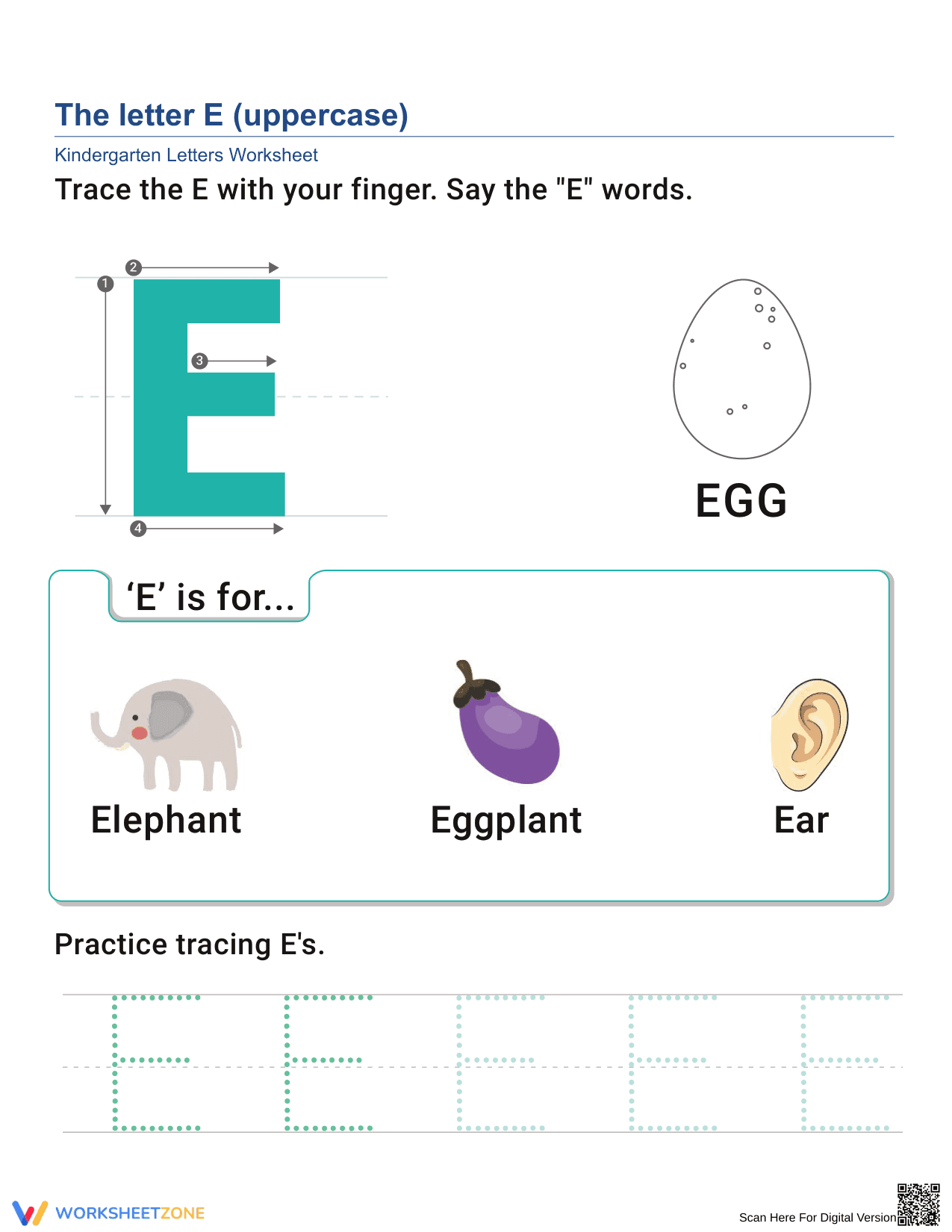

Uppercase Letter E Worksheet | Essential Grade K ELA
Paste this activity's link or code into your existing LMS (Google Classroom, Canvas, Teams, Schoology, Moodle, etc.).
Students can open and work on the activity right away, with no student login required.
You'll still be able to track student progress and results from your teacher account.
This uppercase letter E worksheet helps early learners master letter recognition and formation through tactile tracing and phonics association. Students develop the fine motor skills necessary for handwriting while building a foundational vocabulary of words starting with the letter E, ensuring a strong start to their literacy journey.
At a Glance
- Grade: Kindergarten · Subject: ELA
- Standard:
CCSS.ELA-LITERACY.RF.K.1.D— Recognize and name all upper- and lowercase letters of the alphabet- Skill Focus: Uppercase Letter E Recognition
- Format: 1 page · 10 tasks · No answer key needed · PDF
- Best For: Initial letter introduction and handwriting practice
- Time: 10–15 minutes
The worksheet features a large finger-tracing guide with directional arrows, four illustrated vocabulary words including egg, elephant, eggplant, and ear, and a dedicated row for pencil-to-paper tracing. This 1-page PDF provides a clear, uncluttered layout designed specifically for young students to focus on a single character without distraction.
Skill Progression
- Guided practice: Students begin with a large-scale finger trace, following numbered arrows to internalize the letter's shape and stroke order.
- Supported practice: Learners identify and say four "E" words, connecting the visual letter form to its initial phonetic sound through high-quality illustrations.
- Independent practice: Five dotted-line tracing exercises allow students to practice precise pencil control and independent letter formation.
This sequence follows a gradual-release model to ensure students move from tactile exploration to independent writing mastery.
Standards Alignment
This resource aligns with `CCSS.ELA-LITERACY.RF.K.1.D`, which requires students to recognize and name all upper- and lowercase letters of the alphabet. It also supports foundational phonics by introducing initial letter sounds and building print awareness. Both standard codes can be copied directly into lesson plans, IEP goals, or district curriculum mapping tools.
How to Use It
Use this worksheet during your morning meeting or as a dedicated center activity during your "Letter of the Week" unit. For a formative assessment, observe if students follow the correct stroke order—top-to-bottom, then left-to-right—during the tracing phase. Expected completion time for most kindergarten students is 10 to 15 minutes.
Who It's For
This is designed for preschool and kindergarten students who are beginning their literacy journey. It is also suitable for Grade 1 students needing handwriting intervention or English Language Learners (ELL) building basic vocabulary. Pair this with a letter E anchor chart or a read-aloud book featuring Elmer the Elephant for a complete lesson.
According to the RAND AIRS 2024 report, multisensory approaches to letter recognition—combining visual, auditory, and kinesthetic tasks—significantly improve retention in early childhood education. This worksheet utilizes these principles by requiring students to see the letter, say the associated words, and trace the form with both fingers and pencils. By focusing on the uppercase letter E (CCSS.ELA-LITERACY.RF.K.1.D), the resource provides the repetitive, structured practice necessary for students to achieve automaticity in letter naming. Research from Fisher & Frey (2014) emphasizes that such foundational skills are the primary predictors of later reading fluency. This printable resource ensures that students build a strong orthographic mapping of the letter E, which is a critical component of the Science of Reading framework. Educators can confidently integrate this into their daily literacy blocks to support diverse learners in mastering the alphabet.


