


























Views
Downloads


Printable Units of Time Worksheet | Complete Grade 2 Math
Paste this activity's link or code into your existing LMS (Google Classroom, Canvas, Teams, Schoology, Moodle, etc.).
Students can open and work on the activity right away, with no student login required.
You'll still be able to track student progress and results from your teacher account.
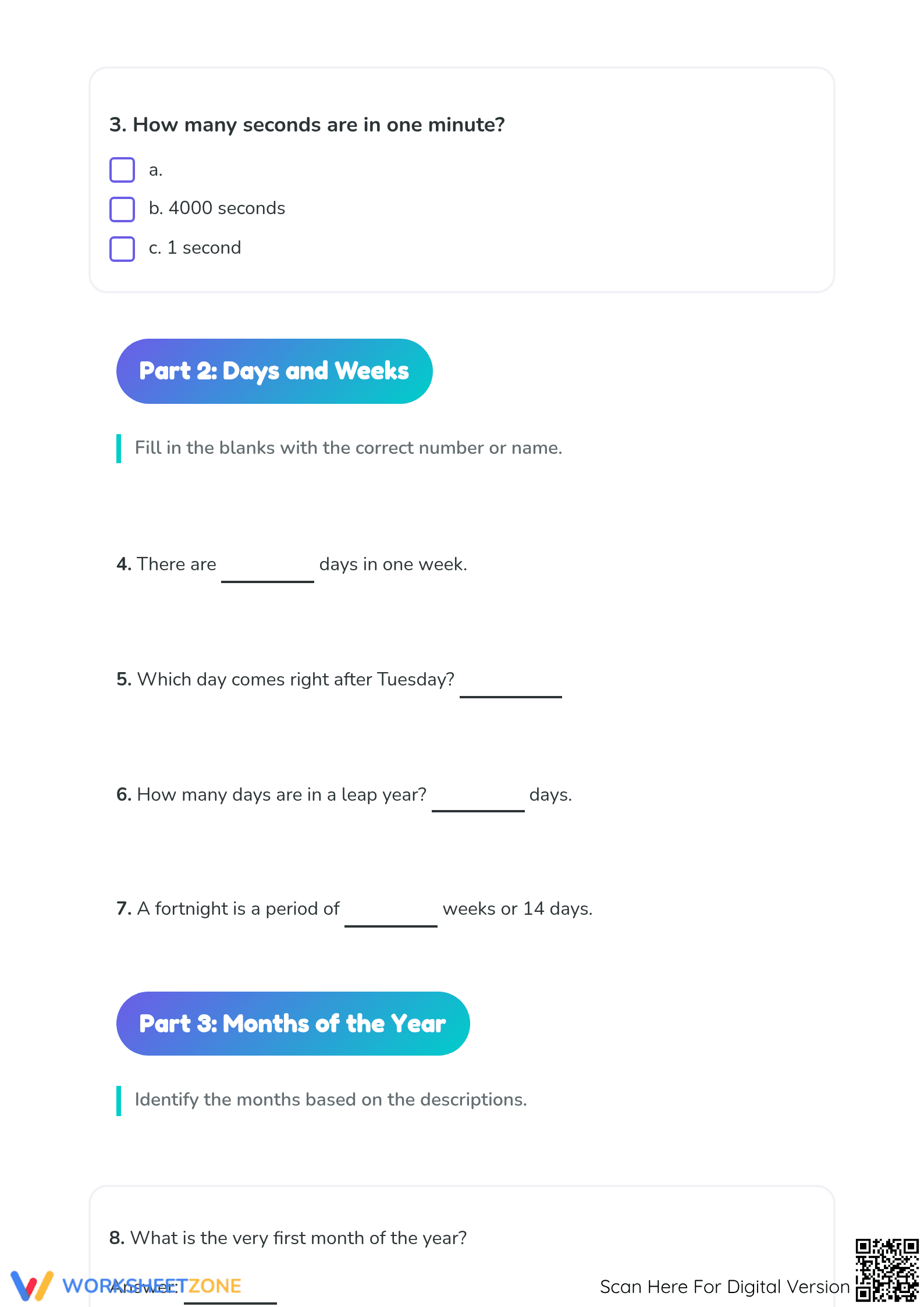
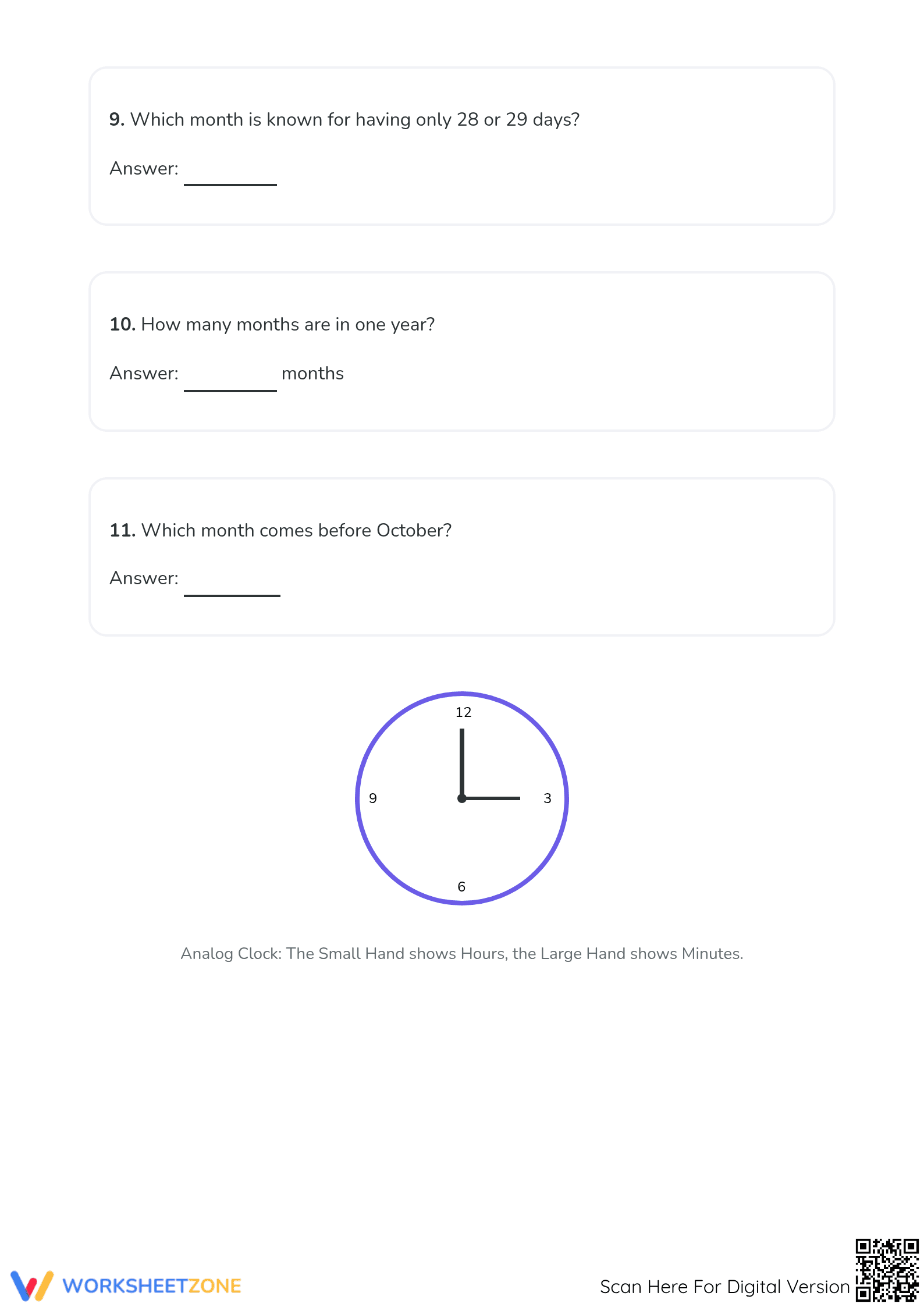
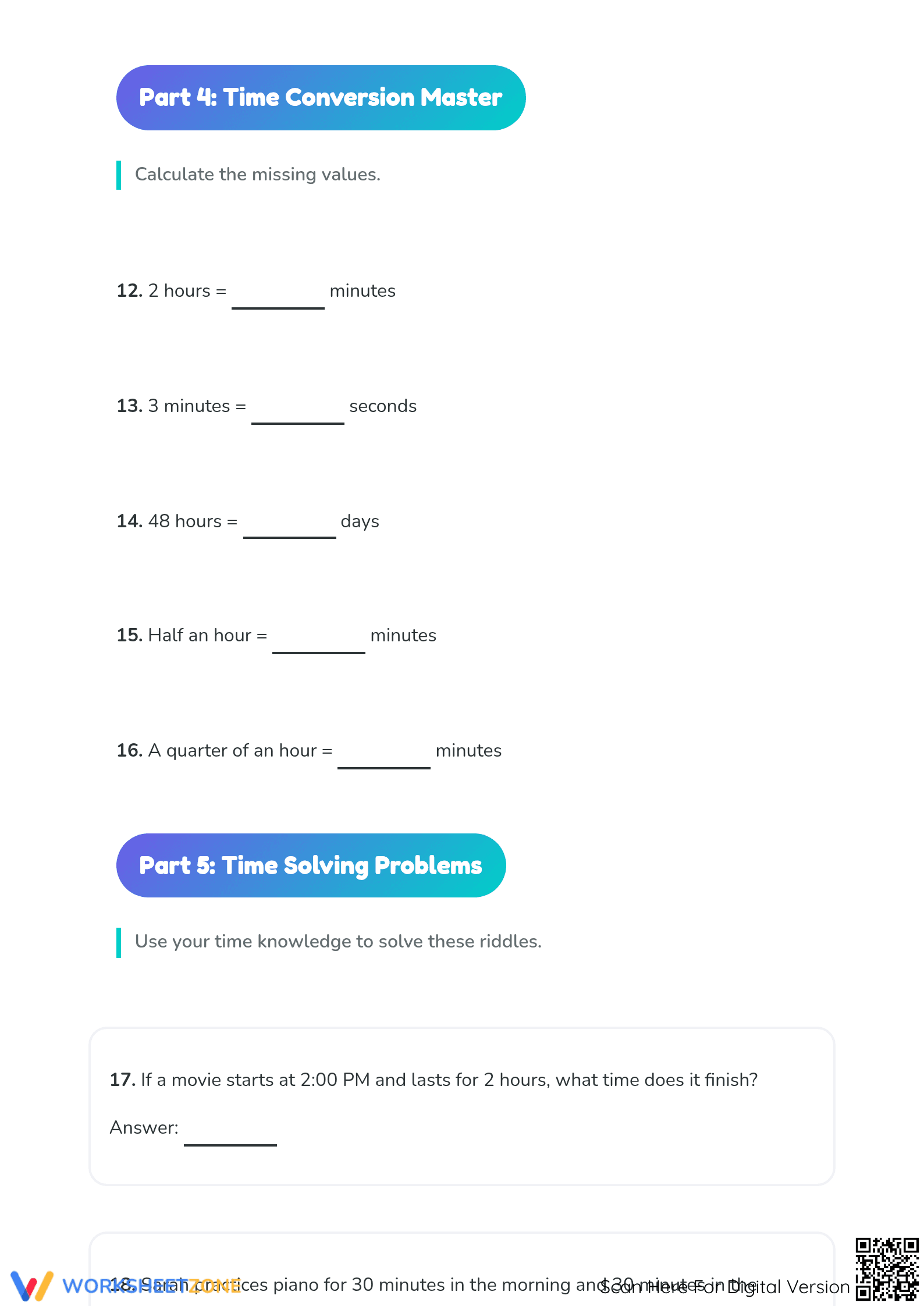
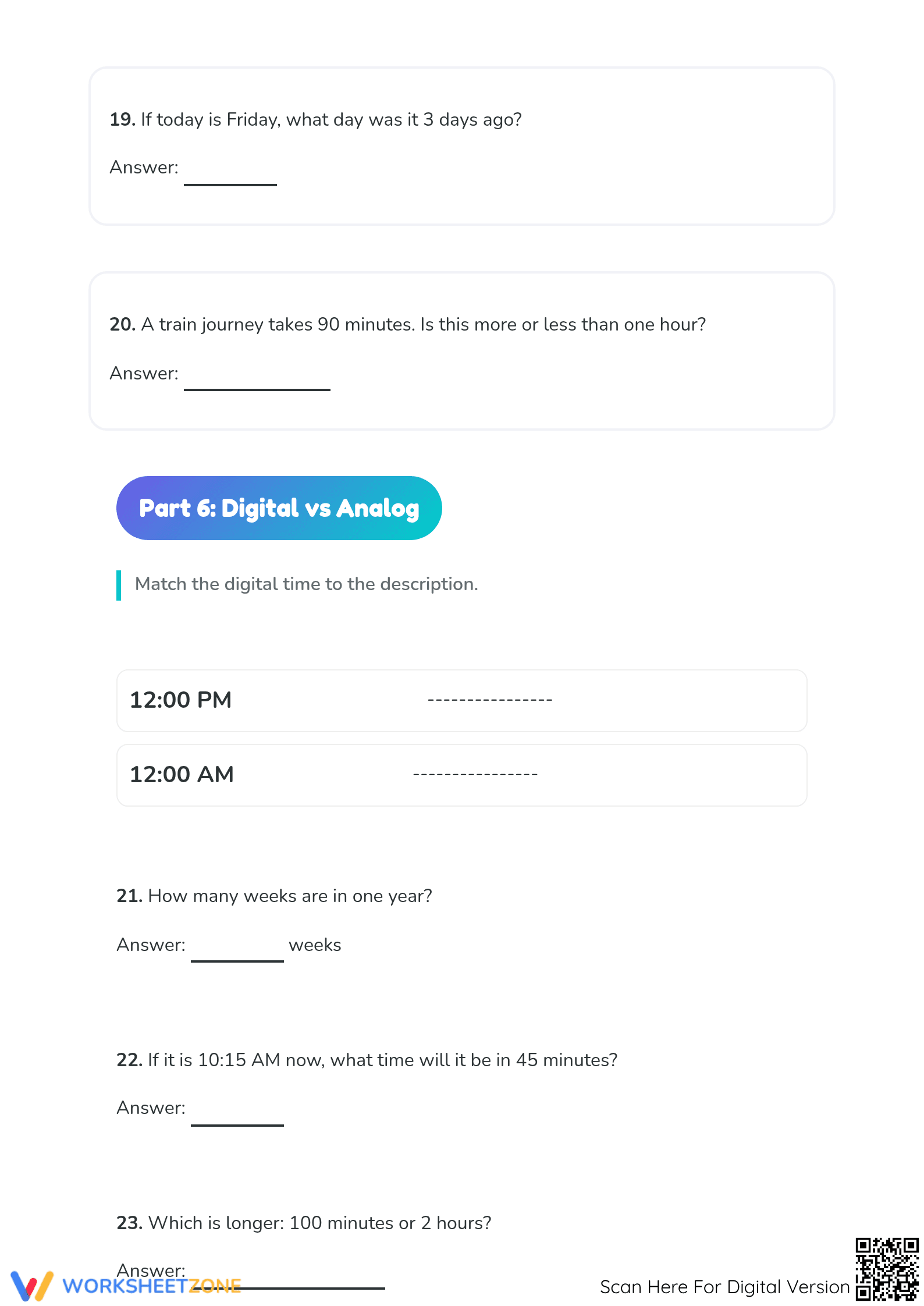
This comprehensive Grade 2 math worksheet helps students master units of time through 23 structured problems. Students identify basic units, convert between minutes and hours, and solve real-world time riddles. By completing these exercises, learners gain the foundational measurement skills necessary for scheduling, sequencing, and understanding the temporal world around them.
At a Glance
- Grade: 2 · Subject: Math
- Standard:
CCSS.MATH.CONTENT.2.MD.C.7— Tell and write time from analog and digital clocks and understand time units- Skill Focus: Time units, conversions, and calendaring
- Format: 5 pages · 23 problems · Answer key included · PDF
- Best For: Weekly measurement review and mastery checks
- Time: 30–45 minutes
What's Inside
This 5-page PDF packet contains six distinct parts that build complexity as the student progresses. It starts with multiple-choice questions on basic units like seconds, minutes, and hours. The middle sections cover days of the week, months of the year, and leap year facts. Finally, students tackle conversion master tasks and five multi-step word problems involving elapsed time and schedule planning.
Skill Progression
- Guided practice: Part 1 and 2 utilize 7 scaffolded questions where students choose correct units and fill in basic numerical facts about days and hours.
- Supported practice: Parts 3 and 4 move toward independent recall of calendar sequences and basic unit conversions (e.g., hours to minutes) with clear labels.
- Independent practice: The final sections challenge students with 7 rigorous riddles and matching exercises that require applying time knowledge to novel scenarios.
This gradual-release structure ensures students build confidence before attempting complex word problems.
Standards Alignment
This resource is primarily aligned with CCSS.MATH.CONTENT.2.MD.C.7, focusing on telling and writing time and understanding the relationships between time increments. Additionally, it supports Grade 3 measurement standards by introducing unit conversions and time interval calculations. Both standard codes can be copied directly into lesson plans, IEP goals, or district curriculum mapping tools.
How to Use It
Assign this packet as a summative assessment after a unit on measurement to gauge student understanding of time relationships. Alternatively, use Part 5 (Time Solving Problems) as a morning warm-up activity during "Measurement Month" to reinforce mental math and logical reasoning. Teachers should observe students during the conversion phase to identify common misconceptions regarding 60-minute cycles versus base-ten patterns.
Who It's For
This worksheet is designed for Grade 2 and Grade 3 students but works effectively for Grade 1 enrichment or as an intervention for older learners. It pairs naturally with an analog classroom clock or a student-held interactive calendar to provide visual support for the conversion and sequence questions.
Research from the RAND AIRS 2024 report indicates that mastery of time measurement in early elementary grades is a significant predictor of future success in complex proportional reasoning. This Grade 2 worksheet focuses on the critical shift from simple identification to functional application, which is essential for developing executive function and self-regulation skills. By engaging with 23 diverse tasks, students internalize the 60-second and 60-minute cycles that often conflict with base-ten number systems. The inclusion of calendar units like "fortnights" and "leap years" broadens the mathematical vocabulary, while the word problems require students to apply logic to temporal intervals. Systematic practice with units of time, as seen in this resource, provides the cognitive scaffolding necessary for later success in physics and advanced mathematics. Educators can use these structured exercises to ensure that students meet rigorous standards while developing practical life skills.


