


























Views
Plays

Renaissance History Quiz | Grade 6-8 Essential Worksheet
Paste this activity's link or code into your existing LMS (Google Classroom, Canvas, Teams, Schoology, Moodle, etc.).
Students can open and work on the activity right away, with no student login required.
You'll still be able to track student progress and results from your teacher account.
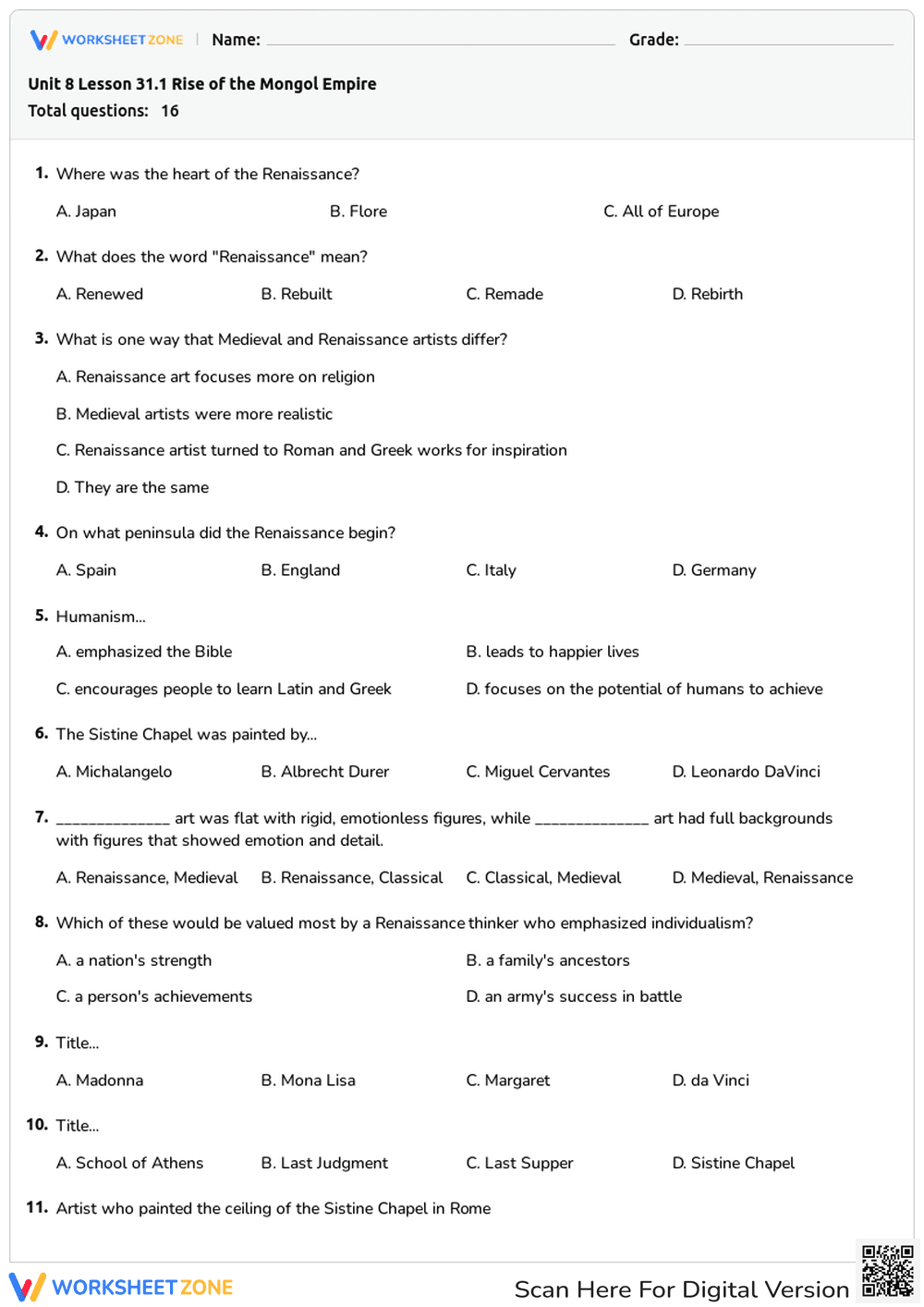
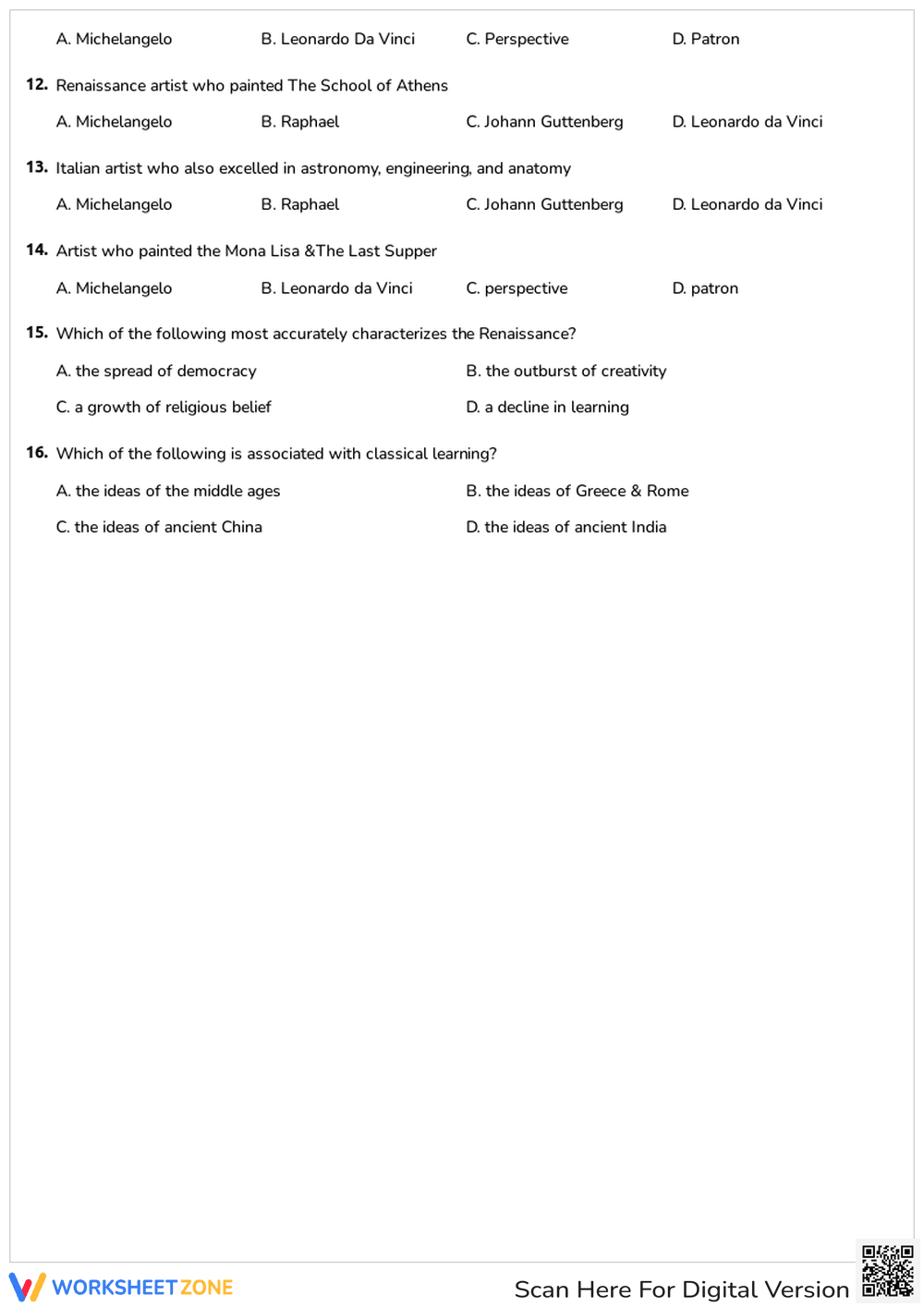
This Grade 6-8 history worksheet provides a comprehensive assessment of student knowledge regarding the European Renaissance. By engaging with 16 targeted multiple-choice questions, learners demonstrate their understanding of humanism, classical learning, and the shift from Medieval to Renaissance art. This resource ensures students can identify key figures and geographical origins of this transformative historical period.
At a Glance
- Grade: 6-8 · Subject: History
- Standard:
RH.6-8.4— Determine the meaning of domain-specific words and phrases in historical contexts- Skill Focus: Renaissance Art, Figures, and Philosophy
- Format: 2 pages · 16 problems · Answer key included · PDF
- Best For: End-of-lesson formative assessment or quick quiz
- Time: 15–20 minutes
Inside this two-page PDF, you will find a structured 16-question quiz designed for clarity and ease of use. The tasks cover a wide range of topics, including the definition of the Renaissance, the significance of the Italian peninsula, and the specific contributions of artists like Raphael and Michelangelo. The multiple-choice format allows for rapid grading, and the clear layout ensures that students can focus on the historical content without visual distraction.
Teachers can implement this resource with a total prep time of under 2 minutes. First, print the two-page PDF for your class roster. Second, distribute the worksheet as a silent starter or a formal exit ticket to gauge daily learning. Finally, review the 16 multiple-choice questions using the provided answer key for immediate feedback. This streamlined workflow makes it an ideal candidate for emergency sub plans or high-frequency check-ins during a busy history unit.
This resource is primarily aligned with CCSS.ELA-LITERACY.RH.6-8.4, which focuses on determining the meaning of symbols, key terms, and other domain-specific words and phrases as they are used in the context of history or social studies. By requiring students to distinguish between Humanism and Individualism, the worksheet supports deep vocabulary acquisition. Both standard codes can be copied directly into lesson plans, IEP goals, or district curriculum mapping tools.
Use this worksheet as a summative assessment at the conclusion of a unit on European history or as a pre-test to determine baseline knowledge. During the activity, observe if students struggle with the distinction between Medieval and Renaissance artistic styles, as this often indicates a need for further visual analysis practice. Most students will complete the 16 questions within a 15-to-20-minute window.
This worksheet is designed for middle school students in Grades 6, 7, and 8 who are studying World History or Geography. It is particularly effective for general education classrooms and can be easily adapted for English Language Learners by pairing it with an anchor chart of Renaissance artists. It serves as a natural companion to primary source readings or a direct instruction lecture on the cultural rebirth of Europe.
According to Fisher & Frey (2014), structured checks for understanding are vital for middle school social studies students to bridge the gap between historical facts and conceptual mastery. This worksheet targets CCSS.ELA-LITERACY.RH.6-8.4 by requiring students to identify and apply domain-specific vocabulary such as Humanism, Individualism, and Renaissance within a historical context. By evaluating 16 distinct items ranging from artistic differences to geographical origins, the resource provides a comprehensive snapshot of student comprehension. Research indicates that frequent, low-stakes assessments improve long-term retention of complex historical periods. This specific tool allows educators to pinpoint misconceptions regarding the transition from Medieval to Renaissance thought patterns. The inclusion of key figures like Michelangelo and Leonardo da Vinci ensures that students connect abstract cultural shifts to concrete historical actors, fulfilling the requirements for evidence-based historical inquiry in the 6-8 grade band.


