


























Views
Downloads
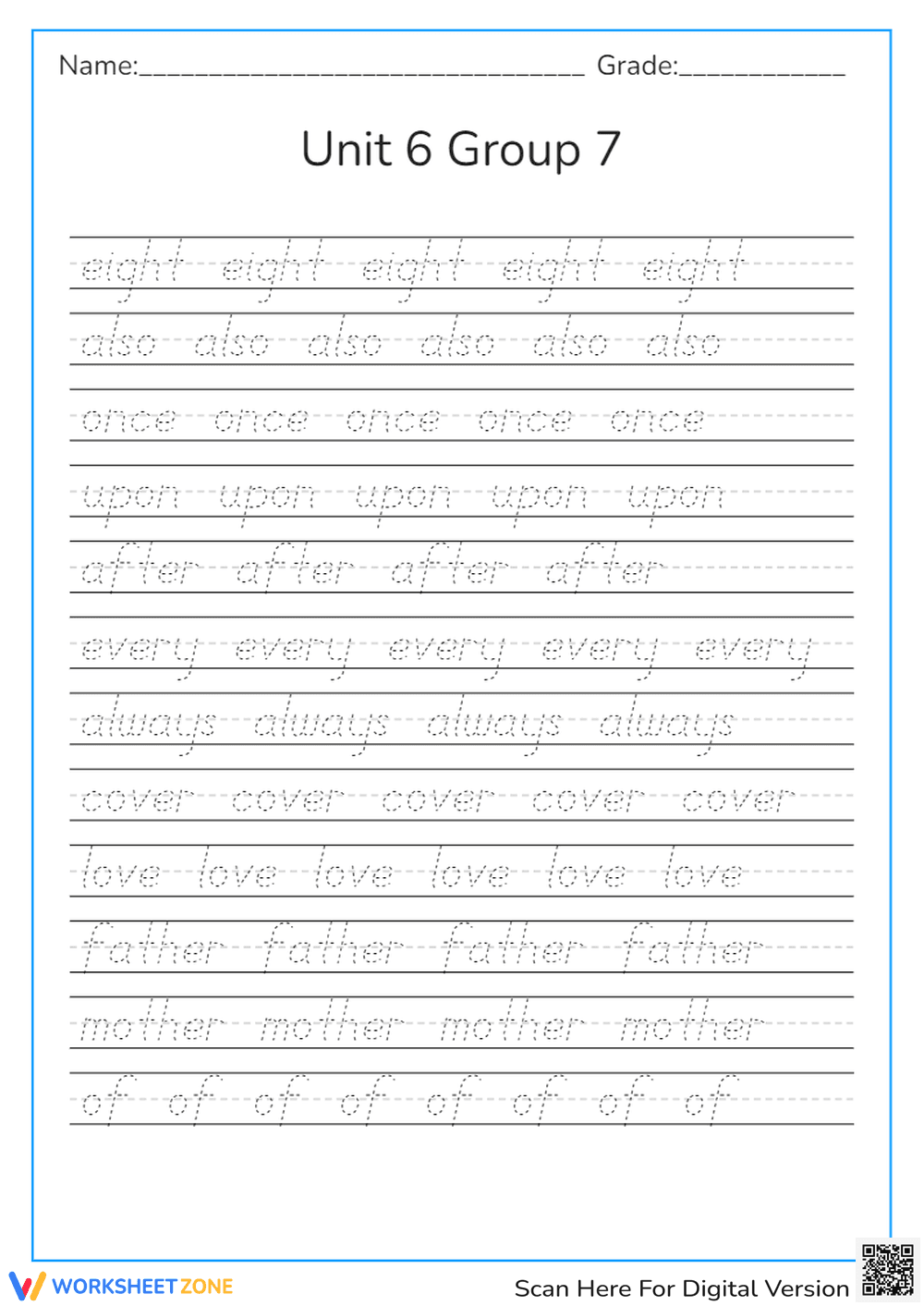

Cursive Handwriting Practice | Grade 2 Essential Worksheet
Paste this activity's link or code into your existing LMS (Google Classroom, Canvas, Teams, Schoology, Moodle, etc.).
Students can open and work on the activity right away, with no student login required.
You'll still be able to track student progress and results from your teacher account.
This Grade 2 cursive handwriting worksheet provides students with structured tracing practice to master fluid letter connections and spelling. By focusing on high-frequency vocabulary, learners develop the muscle memory required for legible, efficient penmanship. It is an ideal resource for reinforcing foundational writing conventions in a clear, distraction-free format.
At a Glance
- Grade: 2 · Subject: Handwriting
- Standard:
CCSS.ELA-LITERACY.L.2.1— Demonstrate command of standard English conventions when writing- Skill Focus: Cursive word tracing
- Format: 1 page · 12 tasks · No-prep · PDF
- Best For: Morning work or independent centers
- Time: 10–15 minutes
This single-page PDF features 12 distinct rows of high-frequency words, including "eight," "always," and "mother." Each row provides a dotted-line model for students to trace multiple times, ensuring repetitive practice of specific letter joins. The layout includes clear horizontal guidelines to help students maintain consistent letter height and slant throughout the exercise.
The zero-prep workflow for this resource is designed for maximum efficiency: 1. Print the single-page PDF for your class in under 30 seconds. 2. Distribute the sheets during your writing block or as a transition activity with no setup required. 3. Review student work for proper grip and stroke direction as they complete the 12 rows. Total teacher preparation time is less than 2 minutes, making this an excellent option for emergency sub plans or daily warm-ups.
This resource aligns with `CCSS.ELA-LITERACY.L.2.1`, which requires students to demonstrate command of the conventions of standard English when writing. While cursive is a specific motor skill, it supports the broader goal of legible communication and spelling accuracy. Both standard codes can be copied directly into lesson plans, IEP goals, or district curriculum mapping tools.
Use this worksheet during the independent practice phase of a handwriting lesson. After demonstrating the specific loops and joins on the board, have students complete the tracing tasks to solidify the movement. It also serves as an effective formative assessment tool; observe students as they write to identify common struggles with specific letter combinations like "ou" or "th." Expected completion time is 15 minutes.
This worksheet is designed for second-grade students transitioning from manuscript to cursive. It is also suitable for older students requiring remedial penmanship support or English Language Learners practicing high-frequency spelling. Pair this with a cursive alphabet anchor chart to provide a visual reference for students as they work through the word list.
Handwriting instruction remains a vital component of literacy development, as noted in the RAND AIRS 2024 report on foundational skills. This worksheet targets CCSS.ELA-LITERACY.L.2.1 by providing 12 rows of repetitive tracing practice for high-frequency words. Research from Fisher & Frey (2014) emphasizes that the gradual release of responsibility begins with high-quality modeled practice, which this tracing format provides. By engaging in 10 to 15 minutes of focused cursive work, students improve their fine motor control and orthographic mapping. This resource is designed to be a standalone tool for classroom teachers or homeschool educators looking for evidence-based penmanship materials. The inclusion of words like "father" and "mother" ensures that students are practicing vocabulary they will frequently encounter in their own narrative and informational writing, bridging the gap between motor skills and functional literacy.


