


























Views
Downloads


Essential Vocabulary Worksheet | Grade 2 ELA Aligned
Paste this activity's link or code into your existing LMS (Google Classroom, Canvas, Teams, Schoology, Moodle, etc.).
Students can open and work on the activity right away, with no student login required.
You'll still be able to track student progress and results from your teacher account.
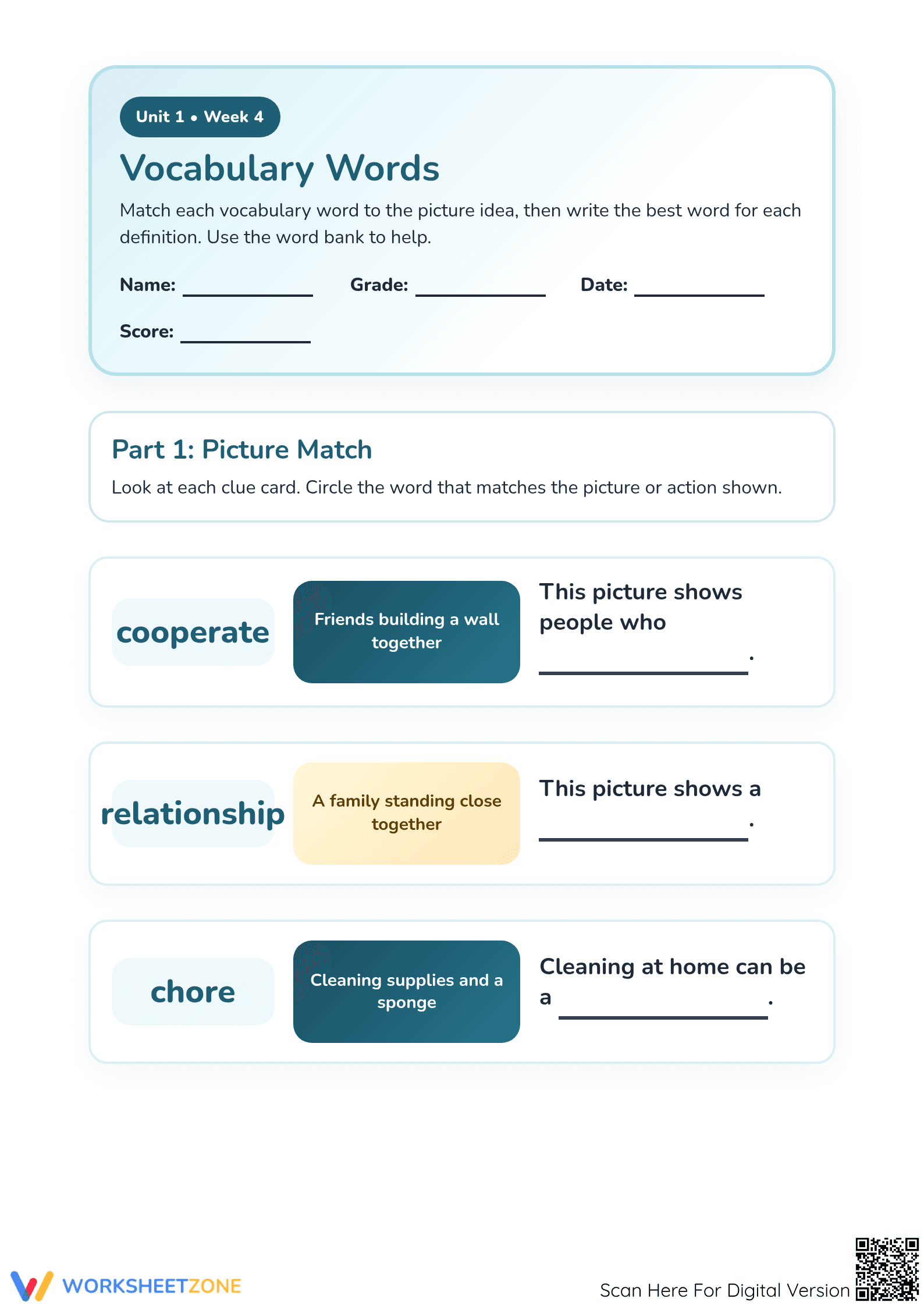
This Grade 2 vocabulary worksheet provides a complete solution for teaching Tier 2 academic words. Students interact with high-frequency terms through visual context and formal definitions to ensure deep comprehension. By matching words like "cooperate" and "relationship" to specific scenarios, learners build the linguistic foundations necessary for advanced reading and writing.
At a Glance
- Grade: 2 · Subject: ELA
- Standard:
CCSS.ELA-LITERACY.L.2.6— Use accurately grade-appropriate general academic and domain-specific words and phrases- Skill Focus: Vocabulary Recognition & Contextual Definition
- Format: 3 pages · 10 problems · Answer key included · PDF
- Best For: Small group vocabulary reinforcement and review
- Time: 15–20 minutes
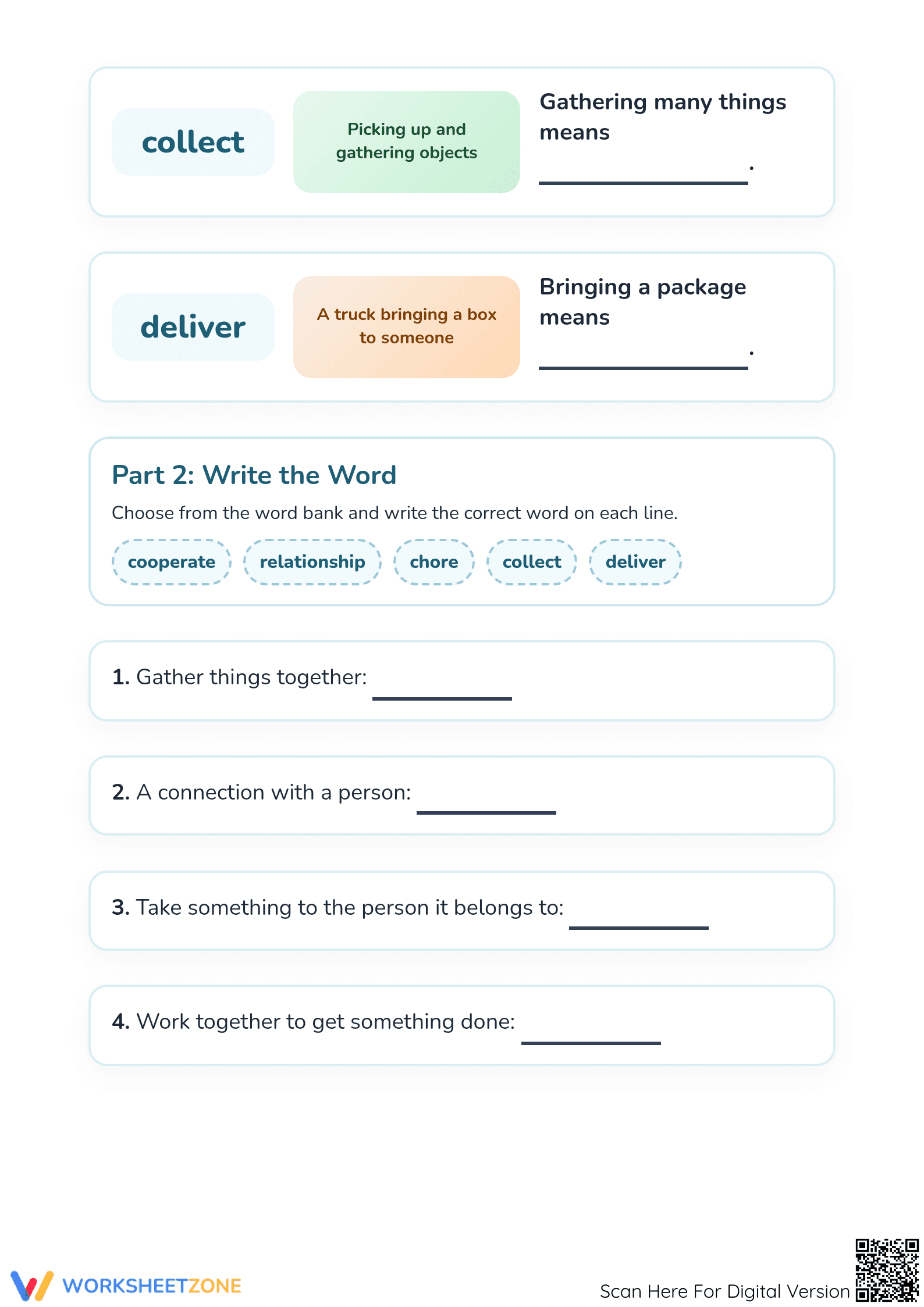
This comprehensive packet contains three pages of structured vocabulary practice. It includes two distinct parts: a visual "Picture Match" section that uses clue cards to provide context, and a "Write the Word" section featuring a clear word bank for definition matching. A complete answer key is provided for immediate feedback and grading efficiency.
- Guided Practice: 5 visual matching tasks where students identify the correct word based on illustrated clue cards and sentence starters.
- Supported Practice: 5 formal definition matching problems utilizing a word bank to narrow choices and reduce cognitive load.
- Independent Practice: Final review questions requiring students to synthesize word meanings without visual aids.
This structure follows a gradual-release model, moving from high visual support to more abstract linguistic application.
This resource is aligned to CCSS.ELA-LITERACY.L.2.6. Students demonstrate mastery by acquiring and using conversational, general academic, and domain-specific words and phrases. This includes using adjectives and adverbs to describe and being able to match definitions to their correct usage. Both standard codes can be copied directly into lesson plans, IEP goals, or district curriculum mapping tools.
Use this as a post-lesson check after introducing the Unit 1, Week 4 vocabulary list. It works exceptionally well during literacy centers or as a formative assessment to gauge which students are confusing similar concepts like "collect" and "deliver." Instructors should observe whether students rely on the pictures or the word bank first, as this reveals their current level of word-meaning internalization.
Designed primarily for Grade 2 students, this worksheet is also suitable for Grade 3 learners needing a vocabulary refresher or Grade 1 students ready for extension. It is a natural pairing for any grade-level reading passage that discusses community, teamwork, or household responsibilities, providing the necessary scaffolding for ELL students to succeed.
According to the NAEP framework and research by Fisher & Frey (2014), the acquisition of Tier 2 vocabulary is a primary predictor of long-term reading comprehension success. This worksheet targets specific academic terms—such as "relationship" and "cooperate"—that appear across multiple domains, ensuring students move beyond simple word recognition to functional application. By integrating visual clue cards with formal definition matching, the resource provides the dual-coding support recommended for diverse learners. This Grade 2 ELA resource ensures that standard CCSS.ELA-LITERACY.L.2.6 is addressed through structured, repetitive practice that builds the mental models required for academic discourse. This curriculum-aligned tool is designed for easy integration into existing daily routines, requiring zero teacher preparation while maintaining high instructional standards for all students in the classroom setting.


