


























Views
Plays

Grade 6 Nonfiction Review: Essential Reading Skills
Paste this activity's link or code into your existing LMS (Google Classroom, Canvas, Teams, Schoology, Moodle, etc.).
Students can open and work on the activity right away, with no student login required.
You'll still be able to track student progress and results from your teacher account.
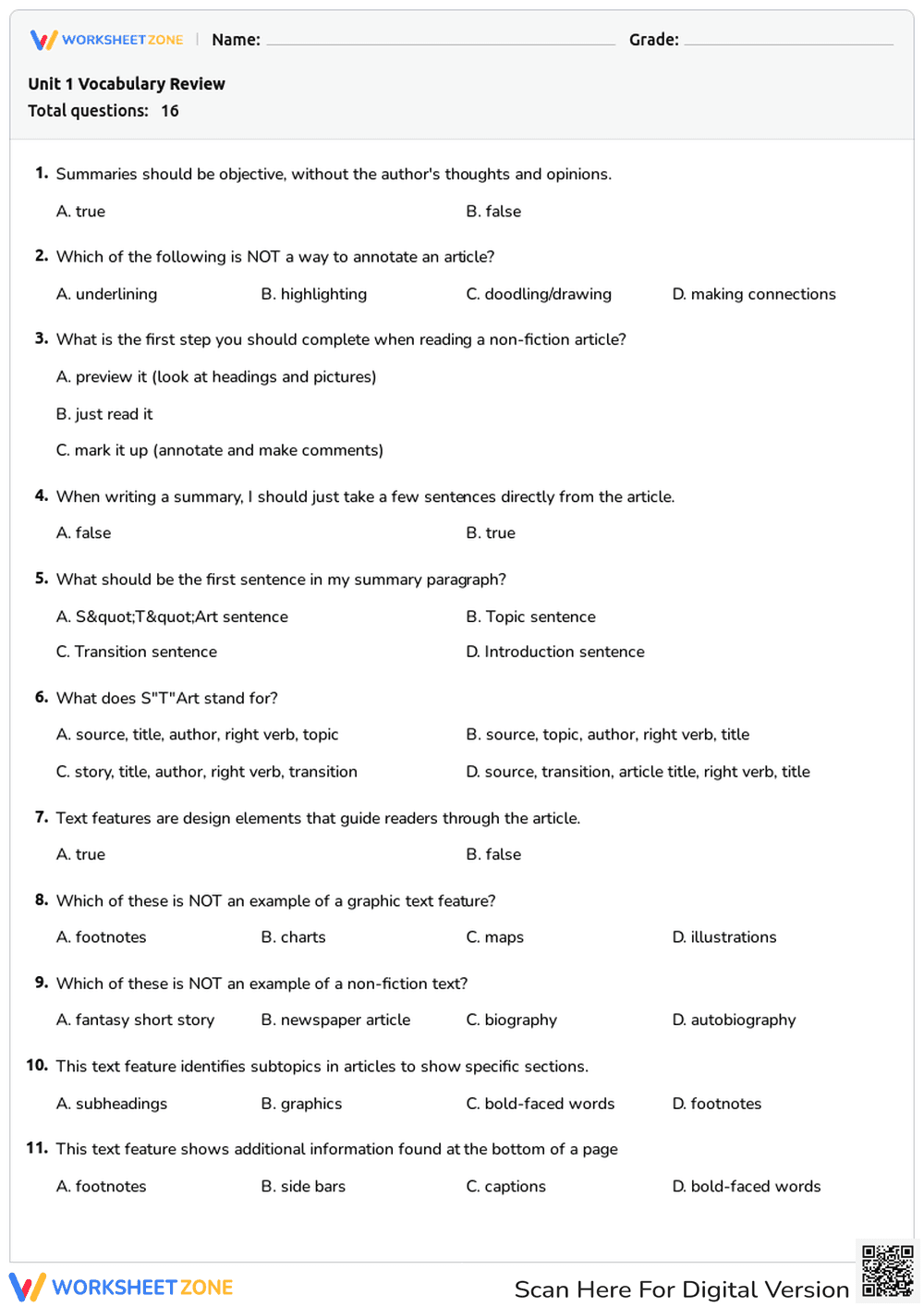
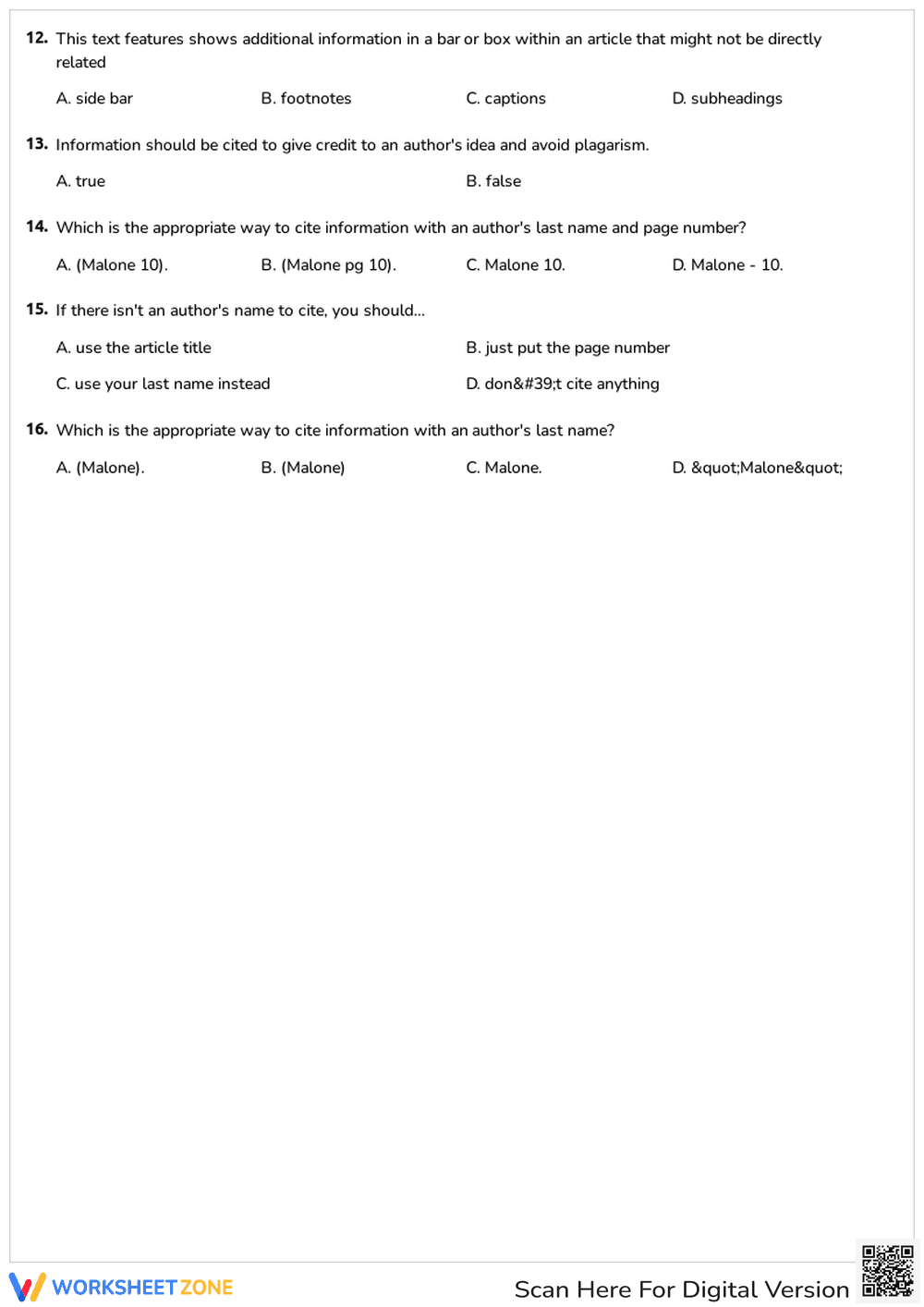
This Grade 6 nonfiction review worksheet provides a comprehensive assessment of essential reading strategies, including objective summarizing, text feature identification, and proper citation techniques. Students demonstrate their understanding of informational text structures to improve comprehension and academic writing accuracy. It is designed to bridge the gap between reading and evidence-based writing.
At a Glance
- Grade: 6 · Subject: ELA Reading
- Standard:
CCSS.ELA-LITERACY.RI.6.2— Determine central ideas and provide an objective summary of the text- Skill Focus: Nonfiction Text Analysis
- Format: 2 pages · 16 problems · Answer key included · PDF
- Best For: Unit 1 review or formative assessment
- Time: 20–30 minutes
This two-page assessment features 16 multiple-choice questions covering three critical domains of nonfiction literacy. It includes specific checks for the "S.T.Art" summary method, identification of graphic and informational text features like sidebars and footnotes, and foundational MLA-style citation rules for avoiding plagiarism. The layout is clean and distraction-free for focused student work.
Zero-Prep Workflow:
- Print: Select the two-page PDF and print enough copies for your class in under 1 minute.
- Distribute: Hand out the review as a quiet starter or a formal Unit 1 quiz with zero teacher setup.
- Review: Use the included answer key to grade or facilitate a peer-review session in 5 minutes.
Total teacher prep time is under 2 minutes, making this an ideal sub plan or last-minute assessment.
The primary focus is `CCSS.ELA-LITERACY.RI.6.2`, which requires students to provide a summary of the text distinct from personal opinions or judgments. Additionally, it supports `CCSS.ELA-LITERACY.RI.6.5` by testing the function of specific text features in contributing to the whole. Both standard codes can be copied directly into lesson plans, IEP goals, or district curriculum mapping tools.
Use this worksheet as a summative assessment at the conclusion of an introductory nonfiction unit to gauge student mastery of structural elements. Alternatively, assign it as a diagnostic tool before starting a research project to identify which students need additional support with citations. Completion typically takes 20 to 30 minutes depending on student reading speed.
This resource is designed for Grade 6 students but is highly effective for Grade 5 enrichment or Grade 7 intervention. It pairs naturally with an anchor chart on text features or a direct instruction lesson on the S.T.Art summarizing technique. It is particularly useful for students who struggle with distinguishing between facts and opinions in informational writing.
According to the RAND AIRS 2024 report, structured practice in identifying text features and summarizing informational content significantly correlates with higher scores in middle school literacy assessments. This worksheet targets CCSS.ELA-LITERACY.RI.6.2 by requiring students to distinguish between objective summaries and subjective opinions, a key milestone in the transition to complex academic reading. By evaluating 16 distinct points of knowledge—from the S.T.Art summary framework to MLA citation basics—educators can pinpoint specific gaps in student understanding of nonfiction mechanics. Research from Fisher & Frey (2014) emphasizes that explicit instruction in text features like subheadings and sidebars allows students to navigate informational texts with greater efficiency. This assessment provides the necessary data to drive differentiated instruction and ensure all learners meet grade-level expectations for informational text analysis and academic integrity.


