




























0
Views
0
Downloads

0.0
0
Save
0 Likes
Share
Understanding Relative Frequency Tables in Data Analysis
0 Views
0 Downloads

Paste this activity's link or code into your existing LMS (Google Classroom, Canvas, Teams, Schoology, Moodle, etc.).
Students can open and work on the activity right away, with no student login required.
You'll still be able to track student progress and results from your teacher account.
Information
Description
What It Is:
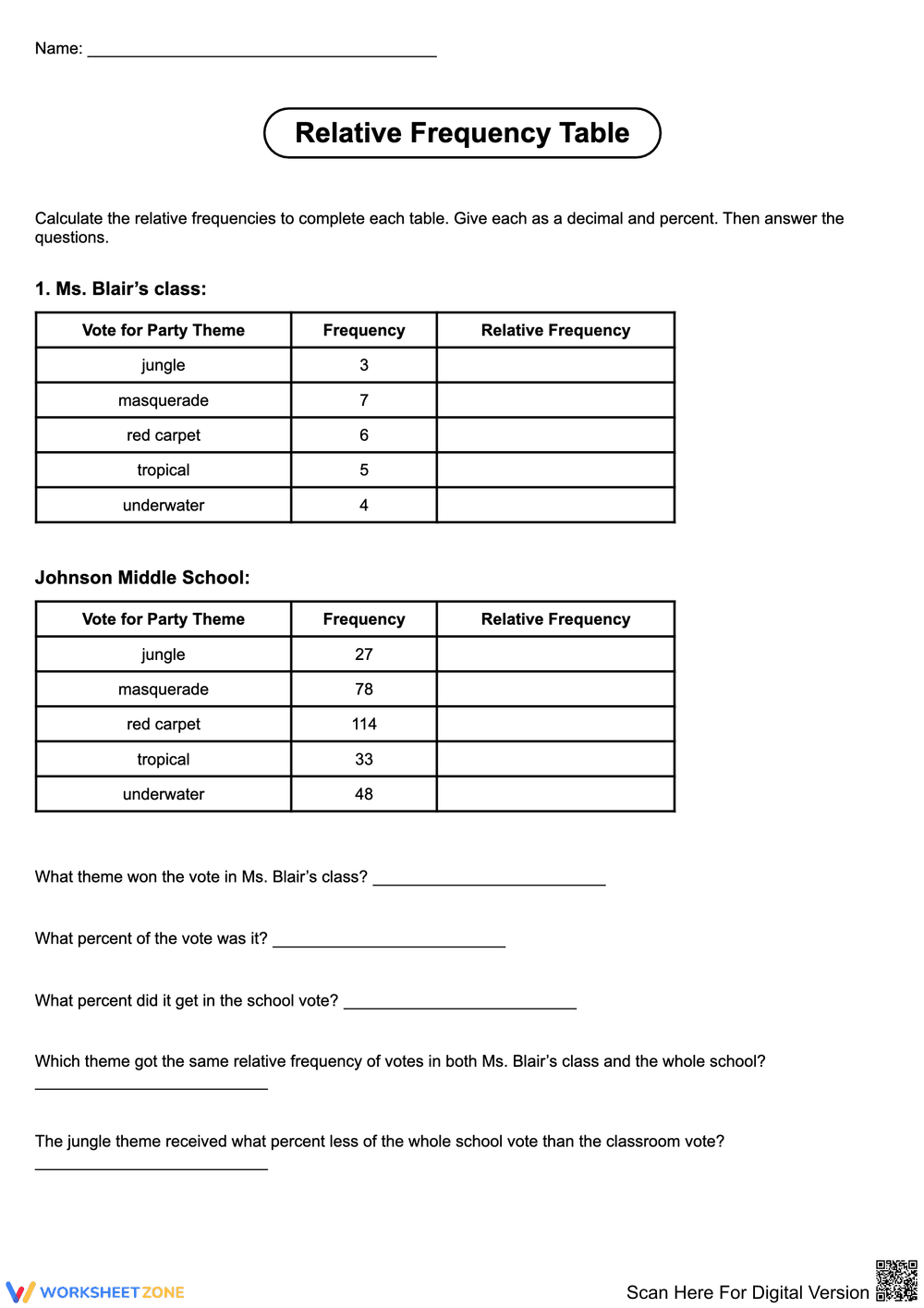
This worksheet focuses on calculating relative frequencies from given data sets, illustrated with fun party theme voting examples. Students will complete tables and answer related questions.
Why Use It:
This activity enhances students' understanding of data interpretation, critical thinking, and statistical analysis. It promotes practical application of math skills in real-life scenarios.
How to Use It:
• Introduce the concept of relative frequency using real-life examples.
• Guide students through the calculations for frequency and percent.
• Discuss the interpretation of results as a class.
Grade Suitability:
Best for Grade 7 - Grade 9.
• Younger kids focus area: Basic understanding of frequency.
• Older students focus area: Data analysis and interpretation.
Target Users:
This worksheet is for teachers to use in the classroom and parents helping with home learning.
This worksheet focuses on calculating relative frequencies from given data sets, illustrated with fun party theme voting examples. Students will complete tables and answer related questions.
Why Use It:
This activity enhances students' understanding of data interpretation, critical thinking, and statistical analysis. It promotes practical application of math skills in real-life scenarios.
How to Use It:
• Introduce the concept of relative frequency using real-life examples.
• Guide students through the calculations for frequency and percent.
• Discuss the interpretation of results as a class.
Grade Suitability:
Best for Grade 7 - Grade 9.
• Younger kids focus area: Basic understanding of frequency.
• Older students focus area: Data analysis and interpretation.
Target Users:
This worksheet is for teachers to use in the classroom and parents helping with home learning.


