


























Views
Downloads

Printable Plant Growth Worksheet | Kindergarten Science
Paste this activity's link or code into your existing LMS (Google Classroom, Canvas, Teams, Schoology, Moodle, etc.).
Students can open and work on the activity right away, with no student login required.
You'll still be able to track student progress and results from your teacher account.
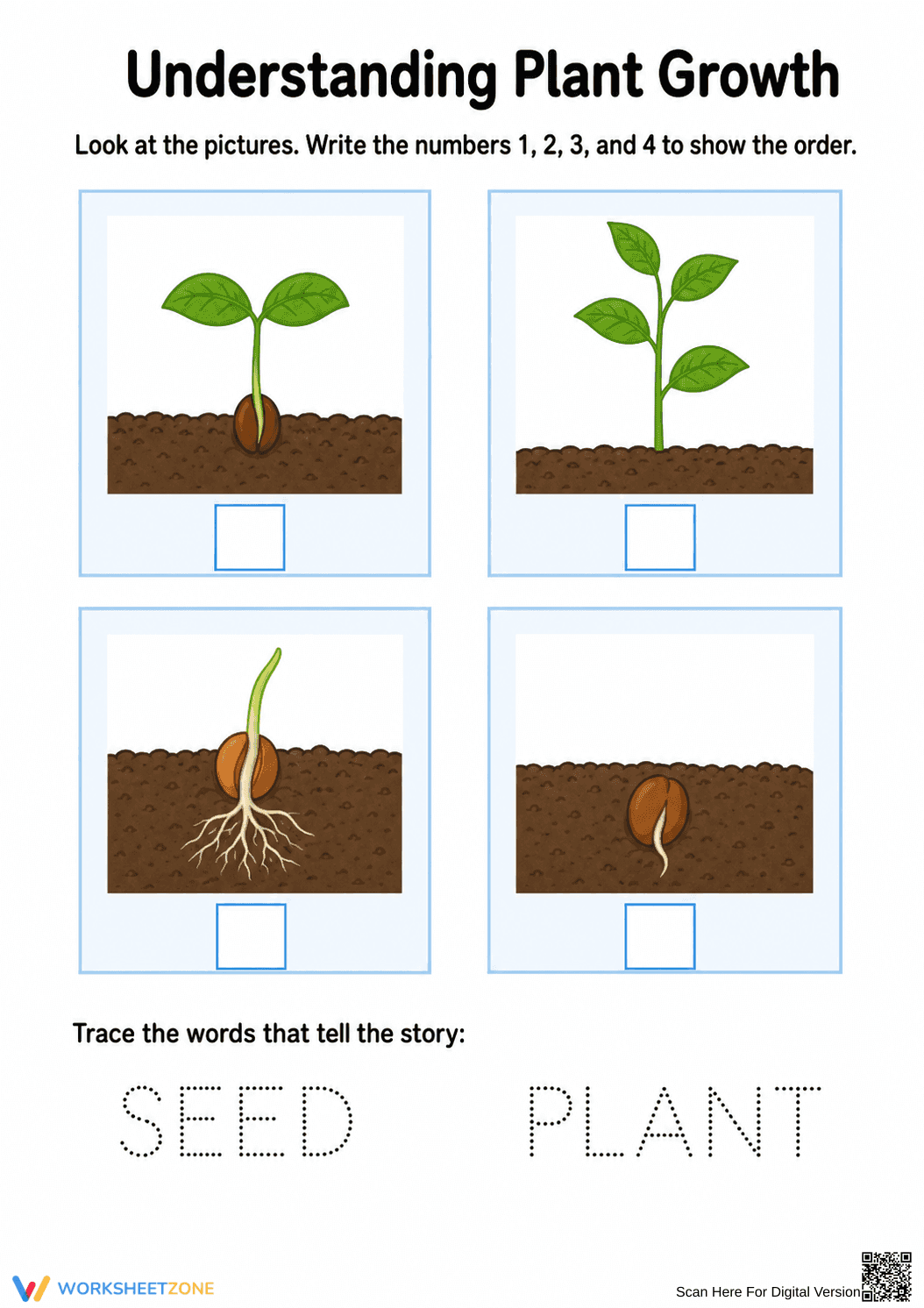
This science worksheet helps early learners understand the biological process of seed germination and the fundamental requirements for plant survival. By engaging with visual sequencing and identification tasks, students build a foundational knowledge of life science. The activities are designed to transform abstract biological concepts into concrete, observable patterns for young minds.
At a Glance
At a Glance
- Grade: Kindergarten · Subject: Science
- Standard:
K-LS1-1— Use observations to describe patterns of what plants need to survive- Skill Focus: Seed germination stages and plant needs
- Format: 2 pages · 13 tasks · Answer key included · PDF
- Best For: Introduction to plant life cycles and survival needs
- Time: 15–20 minutes
What's Inside
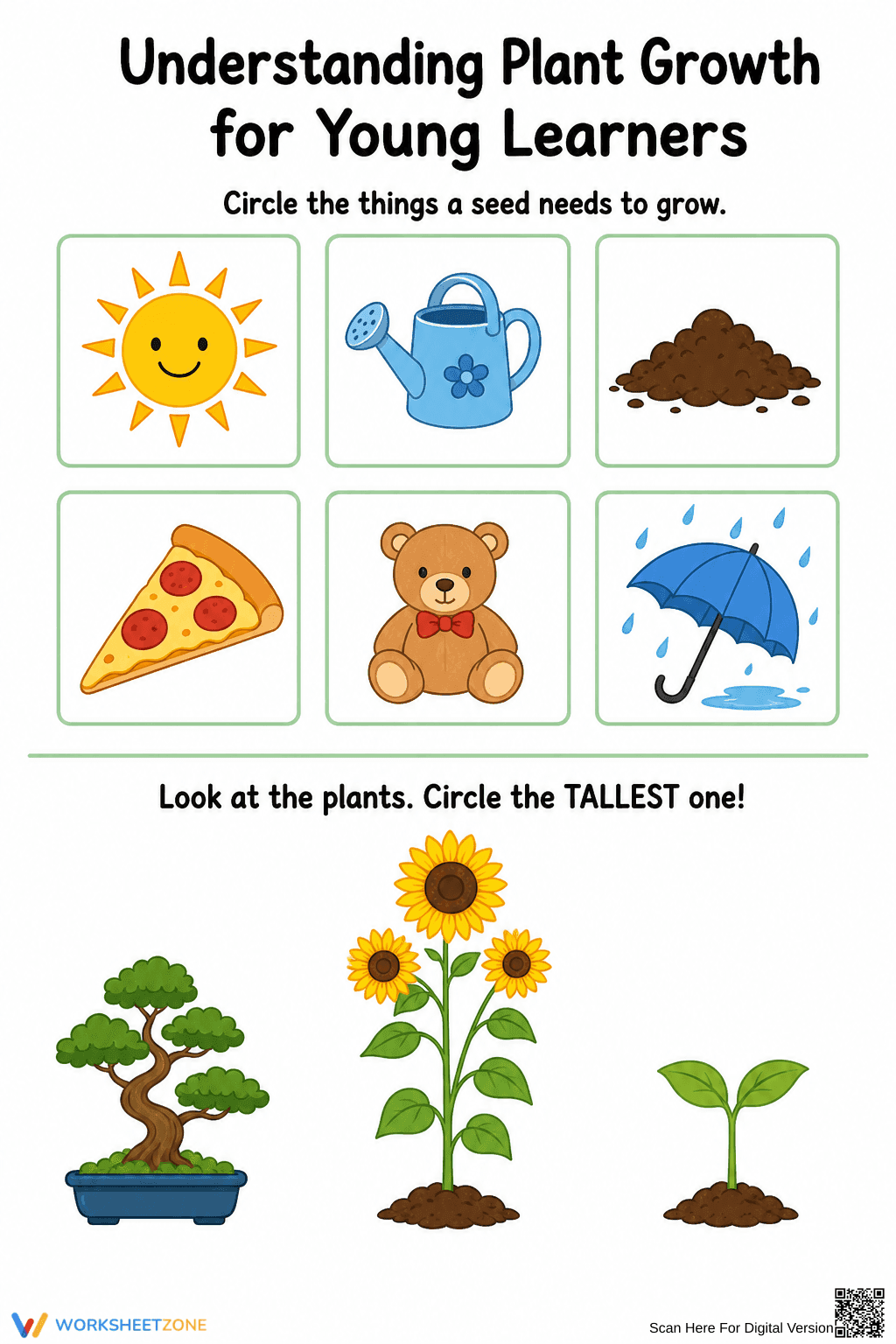
This 2-page PDF resource features a structured layout optimized for early childhood learners. Page one focuses on chronological sequencing, where students number four distinct stages of a sprouting seed. It also includes large-font tracing exercises for the words SEED and PLANT to support literacy. Page two provides a visual sorting task where students circle essential growth factors like sunlight and water, followed by a comparative measurement task to identify the tallest plant.
Zero-Prep Workflow
This resource is designed for immediate classroom implementation with a total teacher preparation time of under 2 minutes. First, print the 2-page PDF for your class (30 seconds). Second, distribute the sheets during your science block or as a morning work assignment (30 seconds). Finally, review the sequencing and survival needs as a whole group to provide immediate feedback (1 minute).
Standards Alignment
The primary focus is `K-LS1-1`, which requires students to use observations to describe patterns of what plants and animals need to survive. This resource also supports `CCSS.ELA-LITERACY.L.K.1.A` through the tracing of key vocabulary words like seed and plant. Both standard codes can be copied directly into lesson plans, IEP goals, or district curriculum mapping tools.
How to Use It
Use this worksheet as a formative assessment after a read-aloud about gardening or plant life. During the activity, observe if students can correctly identify the sun and water icons as needs versus the pizza or teddy bear distractors. This provides a quick check for understanding regarding living versus non-living requirements. Expected completion time ranges from 15 to 20 minutes depending on the student's fine motor skills.
Who It's For
This resource is tailored for Preschool, Kindergarten, and Grade 1 students. It is particularly effective for English Language Learners (ELLs) due to the heavy reliance on visual cues and tracing support. Pair this worksheet with a hands-on bean-planting activity or a Parts of a Plant anchor chart to reinforce the vocabulary introduced in the tracing section.
According to the RAND AIRS 2024 report on early childhood science education, visual sequencing and the identification of survival patterns are critical precursors to complex systems thinking in later grades. This worksheet addresses the K-LS1-1 standard by requiring students to observe and categorize the specific inputs—such as water and light—necessary for biological growth. By integrating literacy through tracing and math through size comparison, the resource provides a multi-disciplinary approach to the stages of seed germination. Research from Fisher & Frey (2014) suggests that such scaffolded visual tasks help bridge the gap between observation and scientific explanation for learners aged 4 to 6. This evidence-based design ensures that students are not just memorizing facts but are actively analyzing the life cycle of a plant through structured, age-appropriate inquiry.


