


























Views
Downloads

Counting 1-10 Worksheet | Printable Kindergarten Math
Paste this activity's link or code into your existing LMS (Google Classroom, Canvas, Teams, Schoology, Moodle, etc.).
Students can open and work on the activity right away, with no student login required.
You'll still be able to track student progress and results from your teacher account.
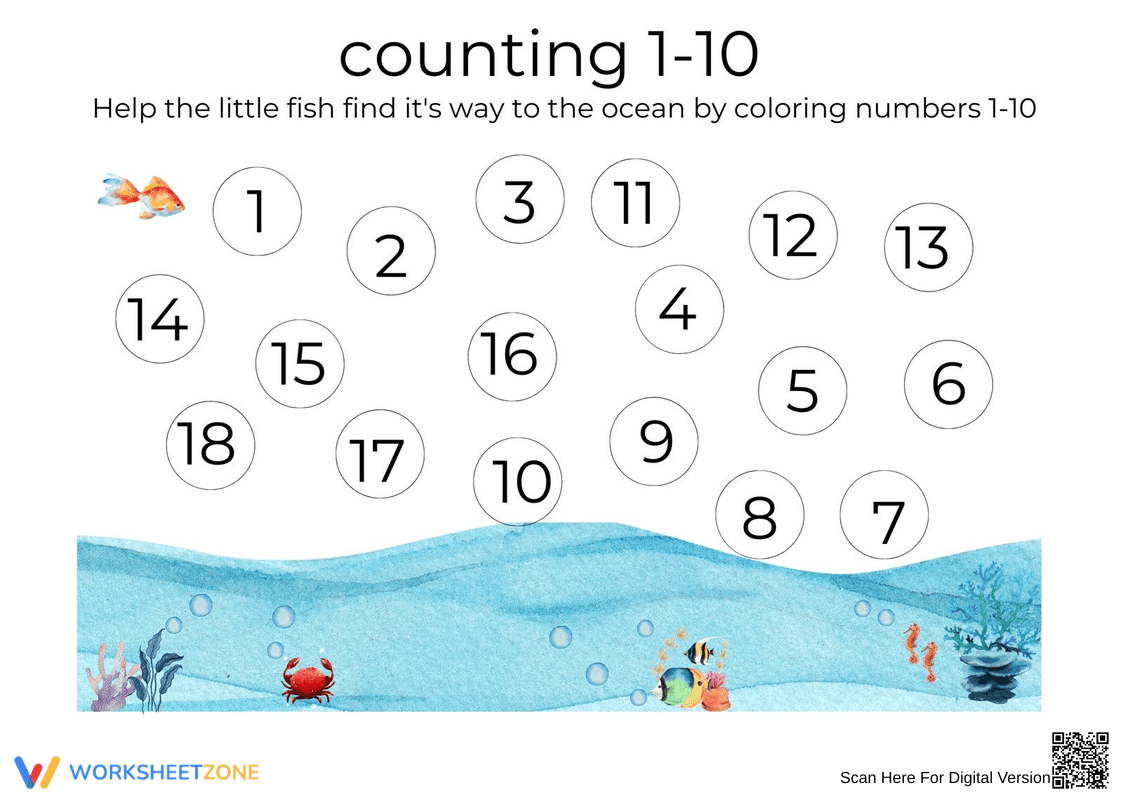
This engaging Kindergarten counting worksheet helps students master number recognition and sequencing from 1 to 10. By coloring a path for a little fish to reach the ocean, young learners practice identifying numbers in order while developing fine motor skills. It provides a fun, thematic approach to foundational math concepts.
At a Glance
- Grade: K · Subject: Math
- Standard:
CCSS.MATH.CONTENT.K.CC.A.1— Count forward in sequence by ones- Skill Focus: Number recognition 1-10
- Format: 1 page · 10 problems · No answer key · PDF
- Best For: Independent practice centers
- Time: 10–15 minutes
Inside this single-page resource, educators will find an under-the-sea maze featuring scattered number bubbles from 1 to 18. Students visually scan the page, locate numbers 1 through 10 in sequential order, and color them to create a continuous path. The clear font and engaging graphics make the task accessible and motivating for early learners.
This resource is designed for a completely zero-prep workflow:
- Print (30 seconds): Simply download the PDF and print a class set. No special materials or cutting required.
- Distribute (1 minute): Hand out the sheets along with crayons or markers. The instructions are simple enough for students to grasp immediately.
- Review (30 seconds): A quick visual check of the colored path confirms student understanding.
Total teacher prep time is under two minutes, making this an ideal, reliable option for emergency sub plans or last-minute center activities.
This activity is aligned to CCSS.MATH.CONTENT.K.CC.A.1: Count to 100 by ones and by tens. While the standard covers up to 100, this specific worksheet targets the critical foundational sequence of 1 to 10. It also supports early number identification skills. Both standard codes can be copied directly into lesson plans, IEP goals, or district curriculum mapping tools.
Teachers can use this worksheet during morning work to transition students into the school day with a low-stress task. Alternatively, it serves as an excellent independent math center activity while the teacher conducts small group instruction. As a formative assessment tip, observe students as they work to see if they can identify the next number automatically or if they need to recount from one each time. Expected completion time ranges from 10 to 15 minutes depending on the child's fine motor coloring speed.
This resource is primarily designed for Kindergarten students, though it serves as an excellent review for first graders needing extra support or a challenge for advanced Pre-K learners. For differentiation, teachers can provide a physical number line for students who need visual support to remember the sequence. This worksheet pairs perfectly with whole-class counting songs or a direct instruction lesson using physical manipulatives like counting bears.
Developing automaticity with early number sequences is a critical predictor of future mathematical achievement. When students practice counting forward in sequence by ones, as outlined in CCSS.MATH.CONTENT.K.CC.A.1, they build the cognitive framework necessary for addition and subtraction. According to a recent EdReports 2024 analysis of early childhood math curricula, integrating visual-spatial tasks like mazes with number recognition significantly improves retention and engagement among young learners. This worksheet combines fine motor coloring with sequential number identification, ensuring that students are not merely memorizing digits but actively applying their knowledge to solve a visual puzzle. By embedding this foundational skill practice within an engaging, play-based format, educators can foster both mathematical competence and a positive attitude toward problem-solving in early childhood classrooms. Regular exposure to these targeted, standard-aligned activities ensures long-term mastery.


