


























Views
Downloads

Kindergarten Handwriting Practice | Essential Word Writing
Paste this activity's link or code into your existing LMS (Google Classroom, Canvas, Teams, Schoology, Moodle, etc.).
Students can open and work on the activity right away, with no student login required.
You'll still be able to track student progress and results from your teacher account.
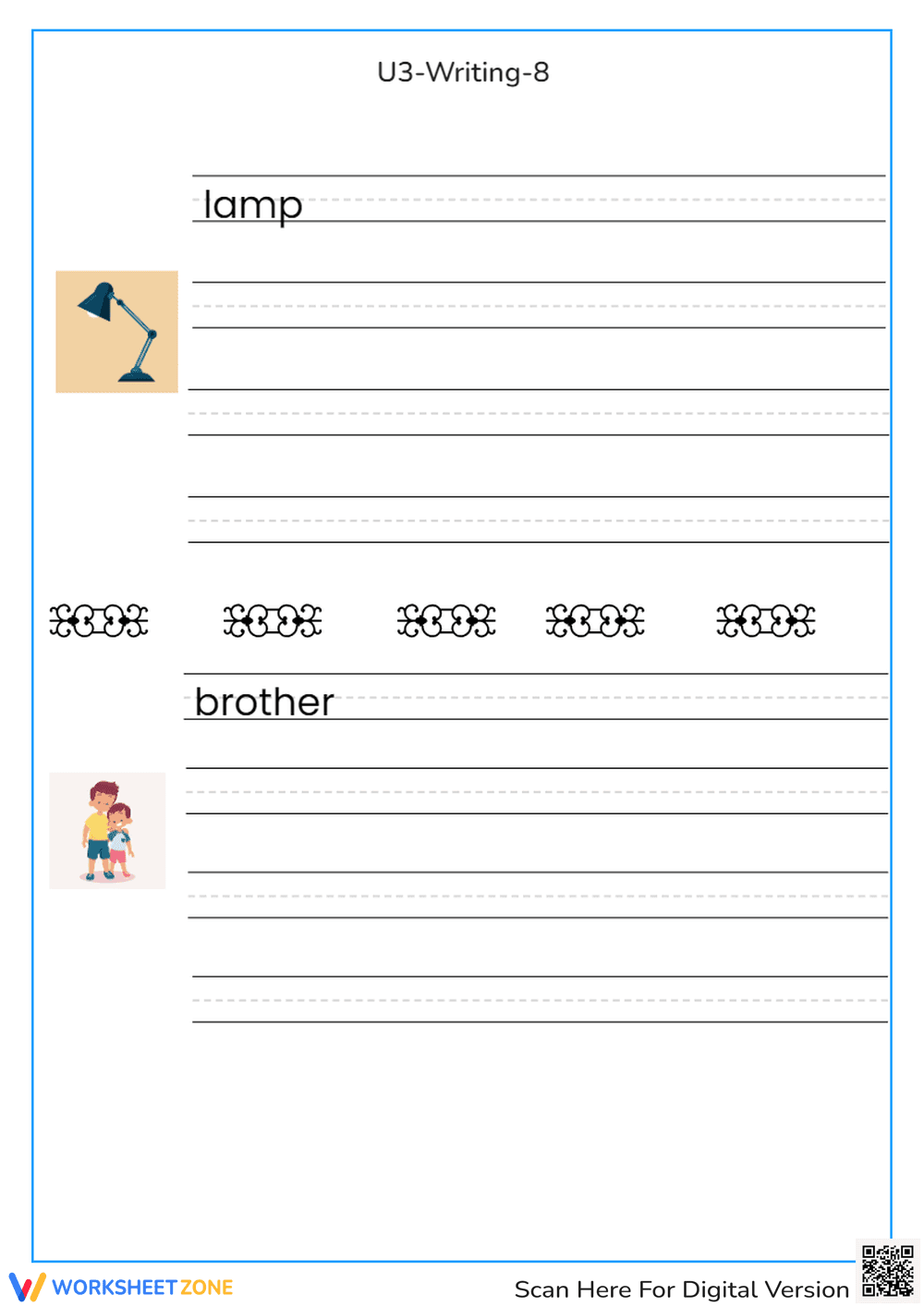
This Kindergarten handwriting worksheet provides students with structured space to practice writing common words like "lamp" and "brother." By focusing on letter formation and spacing on primary ruled lines, learners develop the fine motor control necessary for legible writing. It is a straightforward tool for early literacy development and daily morning work.
At a Glance
- Grade: Kindergarten · Subject: Handwriting
- Standard:
CCSS.ELA-LITERACY.L.K.1.A— Print many upper- and lowercase letters correctly- Skill Focus: Word copying and letter formation
- Format: 1 page · 2 words · No answer key needed · PDF
- Best For: Daily morning work or writing centers
- Time: 10–15 minutes
The worksheet features two distinct sections, each dedicated to a specific word accompanied by a visual cue. Students see the word "lamp" and "brother" printed clearly at the top of primary ruled lines. With 1 page of focused practice, the layout provides ample room for repetition, helping children internalize the physical movements required for each letter.
This resource is designed for immediate classroom implementation. Teachers can print the single-page PDF in less than 30 seconds. Distribution takes about 1 minute during transition periods. Reviewing student work is a simple visual check for letter height and baseline alignment, requiring no more than 15 seconds per student. It is an ideal sub-plan filler for early childhood classrooms.
The primary focus is `CCSS.ELA-LITERACY.L.K.1.A`, which requires students to print many upper- and lowercase letters. By copying whole words, students also touch upon supporting standards regarding the recognition that spoken words are represented in written language by specific sequences of letters. Both standard codes can be copied directly into lesson plans, IEP goals, or district curriculum mapping tools.
Use this worksheet during the independent practice phase of a handwriting lesson after demonstrating proper stroke order for the letters. It also serves as an effective formative assessment tool; observe if students are starting their letters at the top and maintaining consistent sizing. Expect completion within 10 to 15 minutes depending on student fine motor development.
This resource is tailored for Kindergarten students beginning their writing journey. It supports English Language Learners by pairing words with clear images to build vocabulary alongside motor skills. It pairs naturally with a letter formation anchor chart or a direct instruction lesson on the alphabet and basic phonics.
According to Fisher & Frey (2014), the gradual release of responsibility begins with clear modeling followed by independent practice, which this worksheet facilitates through its structured layout. The alignment with CCSS.ELA-LITERACY.L.K.1.A ensures that students are meeting national benchmarks for early writing. Research from the NAEP suggests that early mastery of handwriting is a strong predictor of later writing quality and fluency, as it reduces the cognitive load on young writers. This 1-page resource provides the necessary repetition for students to move toward automaticity in letter production. By focusing on 2 specific words with visual aids, the worksheet supports both orthographic mapping and fine motor development. Educators can use this tool to provide consistent, low-stakes practice that builds student confidence in their ability to communicate through written text effectively.


