




























Views
Downloads
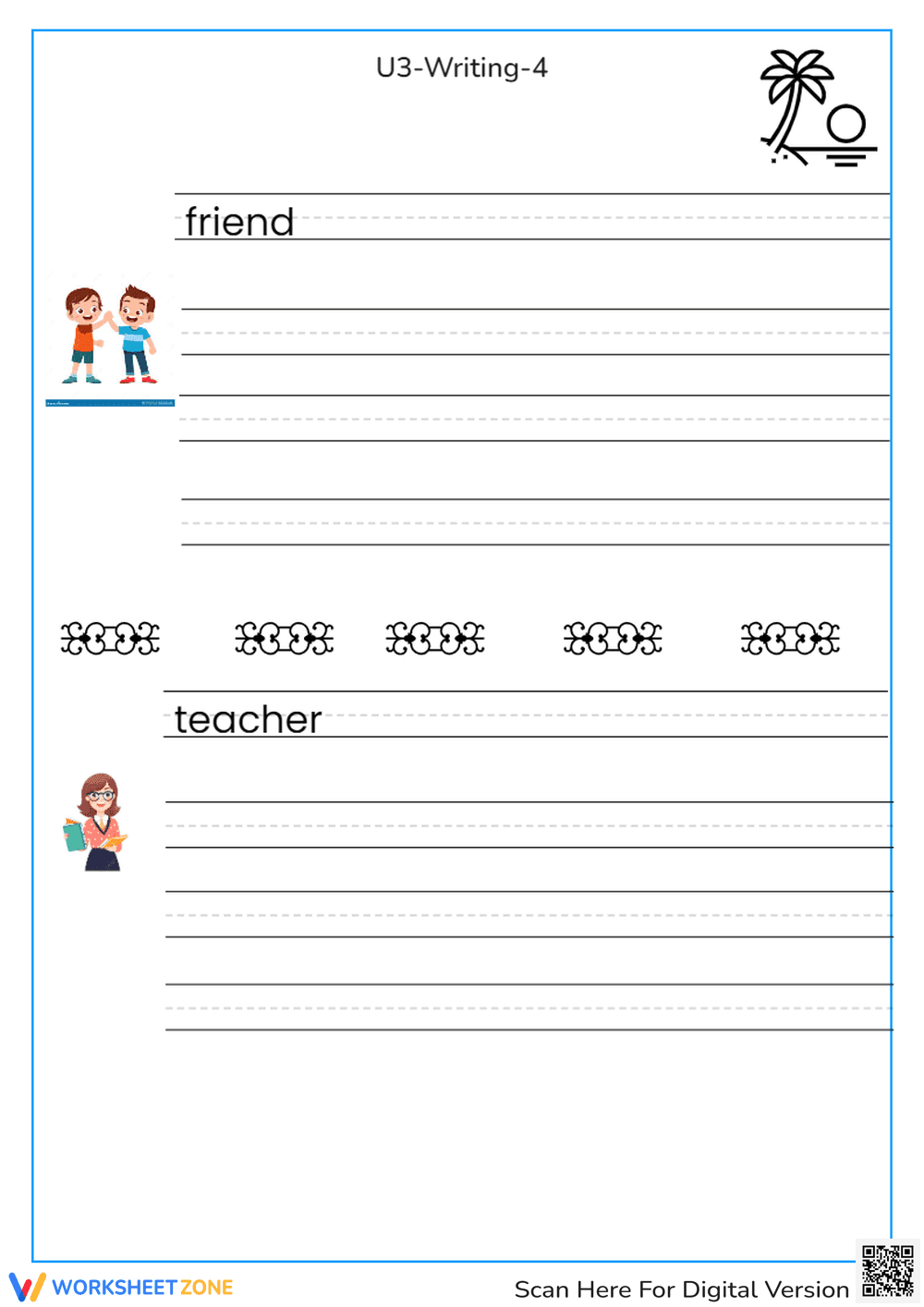

Kindergarten Handwriting Practice | Essential Word Writing

Paste this activity's link or code into your existing LMS (Google Classroom, Canvas, Teams, Schoology, Moodle, etc.).
Students can open and work on the activity right away, with no student login required.
You'll still be able to track student progress and results from your teacher account.
This Kindergarten handwriting worksheet provides structured practice for early writers to master letter formation and word spacing. By focusing on high-frequency vocabulary like "friend" and "teacher," students develop the fine motor control necessary for legible penmanship. This resource ensures young learners gain confidence in their ability to translate spoken words into written form.
At a Glance
- Grade: Kindergarten · Subject: Handwriting
- Standard:
CCSS.ELA-LITERACY.L.K.1.A— Print many upper- and lowercase letters correctly during writing tasks- Skill Focus: Word copying and letter formation
- Format: 1 page · 2 words · No answer key needed · PDF
- Best For: Morning work or literacy centers
- Time: 10–15 minutes
The worksheet features two distinct sections, each dedicated to a specific word: "friend" and "teacher." Each section includes a visual cue to support vocabulary acquisition and multiple sets of primary writing lines with a dashed midline. With 10 total lines for practice, students have ample space to move from tracing mental models to independent reproduction of the letters.
This resource is designed for immediate classroom implementation. Teachers can print the single-page PDF in less than 30 seconds. Distribution takes only a minute, and because the layout is self-explanatory, students can begin working immediately without complex instructions. Total teacher preparation time is under 2 minutes, making it an ideal choice for emergency sub plans or transition periods.
This activity aligns directly with CCSS.ELA-LITERACY.L.K.1.A, which requires students to print many upper- and lowercase letters. By practicing these specific words, students also touch upon foundational literacy skills related to word recognition and spelling. Both standard codes can be copied directly into lesson plans, IEP goals, or district curriculum mapping tools.
Use this worksheet during the independent practice phase of a handwriting lesson after demonstrating proper stroke order for the letters. It also serves as an effective formative assessment tool; observe students as they write to identify issues with pencil grip or letter reversals. Expect completion within 10 to 15 minutes depending on individual fine motor development.
This practice sheet is tailored for Kindergarten students or preschoolers ready for formal writing instruction. It is particularly helpful for English Language Learners who benefit from the visual associations provided by the illustrations. Pair this with a shared reading of a book about school or friendship to provide meaningful context for the writing task.
Handwriting remains a critical component of early literacy, as the physical act of writing letters reinforces orthographic mapping in the brain. According to Fisher & Frey (2014), guided practice with specific vocabulary words helps bridge the gap between letter recognition and fluent production. This worksheet targets CCSS.ELA-LITERACY.L.K.1.A by providing 10 lines of structured practice for the words "friend" and "teacher." Research from the NAEP suggests that early mastery of letter formation is a strong predictor of later writing success and reading fluency. By providing clear primary lines and visual cues, this resource supports the developmental needs of Kindergarten learners. Educators can use this tool to track progress in fine motor control and letter consistency over time, ensuring students meet foundational standards for print concepts and language conventions. This standalone practice page is an efficient way to integrate motor skill development into the daily literacy block.


