


























Views
Downloads

Kindergarten Handwriting Practice | Essential Printable
Paste this activity's link or code into your existing LMS (Google Classroom, Canvas, Teams, Schoology, Moodle, etc.).
Students can open and work on the activity right away, with no student login required.
You'll still be able to track student progress and results from your teacher account.
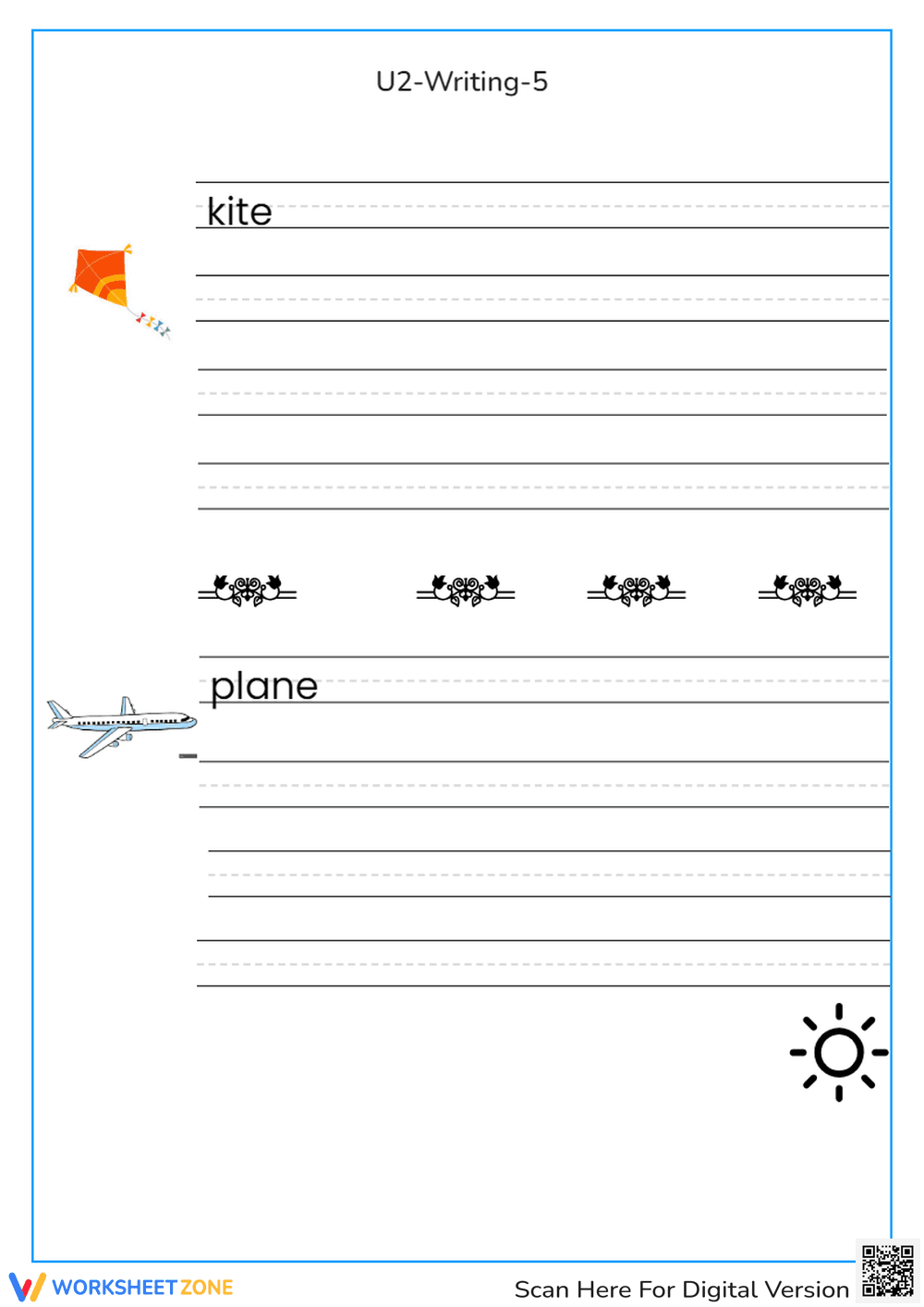
This Kindergarten handwriting worksheet helps young learners master letter formation and word spacing through repetitive practice. By focusing on high-frequency vocabulary like "kite" and "plane," students develop the muscle memory needed for legible writing. This resource provides a structured environment for early writers to refine their fine motor control on standard primary lines.
At a Glance
- Grade: Kindergarten · Subject: Handwriting
- Standard:
CCSS.ELA-LITERACY.L.K.1.A— Print many upper- and lowercase letters accurately on primary lines- Skill Focus: Letter formation and word writing
- Format: 1 page · 10 writing lines · No answer key needed · PDF
- Best For: Morning work or independent writing centers
- Time: 10–15 minutes
Inside this single-page PDF, you will find two distinct sections dedicated to the words "kite" and "plane." Each section features a clear model word followed by multiple sets of primary lines, including a dashed midline to guide lowercase letter height. The clean layout and simple illustrations provide visual cues without distracting the student from the primary task of penmanship.
The zero-prep workflow is designed for busy educators. First, print the single-page PDF (30 seconds). Second, distribute the sheets to students during your literacy block or as a transition activity (1 minute). Third, provide immediate verbal feedback as you circulate the room, checking for proper pencil grip and letter orientation. Total teacher preparation time is under two minutes.
This resource aligns with `CCSS.ELA-LITERACY.L.K.1.A`, which requires students to print many upper- and lowercase letters. By practicing full words, students also touch upon foundational literacy skills related to phonics and word recognition. This standard code can be copied directly into lesson plans, IEP goals, or district curriculum mapping tools.
Use this worksheet as a formative assessment after a direct instruction lesson on the letters 'k' or 'p'. Observe students to see if they start their letters from the top down, which is a key indicator of writing readiness. Alternatively, place this in a writing center for independent practice once students are familiar with the vocabulary words. Completion typically takes 10 to 15 minutes.
This worksheet is ideal for Kindergarten students or preschoolers ready for formal writing instruction. It serves as an excellent intervention tool for older students struggling with fine motor delays. Pair this with a tactile activity, such as writing the words in sand or shaving cream, to reinforce the letter shapes before moving to paper.
Effective handwriting instruction in early childhood is a predictor of later academic success. According to Fisher & Frey (2014), the gradual release of responsibility begins with clear modeling, which this worksheet provides through its header examples. Practicing specific words like "kite" and "plane" on primary lines helps students internalize the spatial relationships between letters, a core requirement of CCSS.ELA-LITERACY.L.K.1.A. Research from the NAEP suggests that students who develop automaticity in handwriting can devote more cognitive resources to higher-level composition tasks later in their schooling. This 1-page resource offers the repetitive, low-stakes practice necessary for building that automaticity. By focusing on 10 lines of dedicated practice, educators ensure that students are not overwhelmed while still meeting the rigorous demands of state standards. This worksheet is a practical tool for any Kindergarten classroom focusing on foundational literacy and fine motor development.


