




























Views
Downloads

Kindergarten Handwriting Practice | Essential Printable

Paste this activity's link or code into your existing LMS (Google Classroom, Canvas, Teams, Schoology, Moodle, etc.).
Students can open and work on the activity right away, with no student login required.
You'll still be able to track student progress and results from your teacher account.
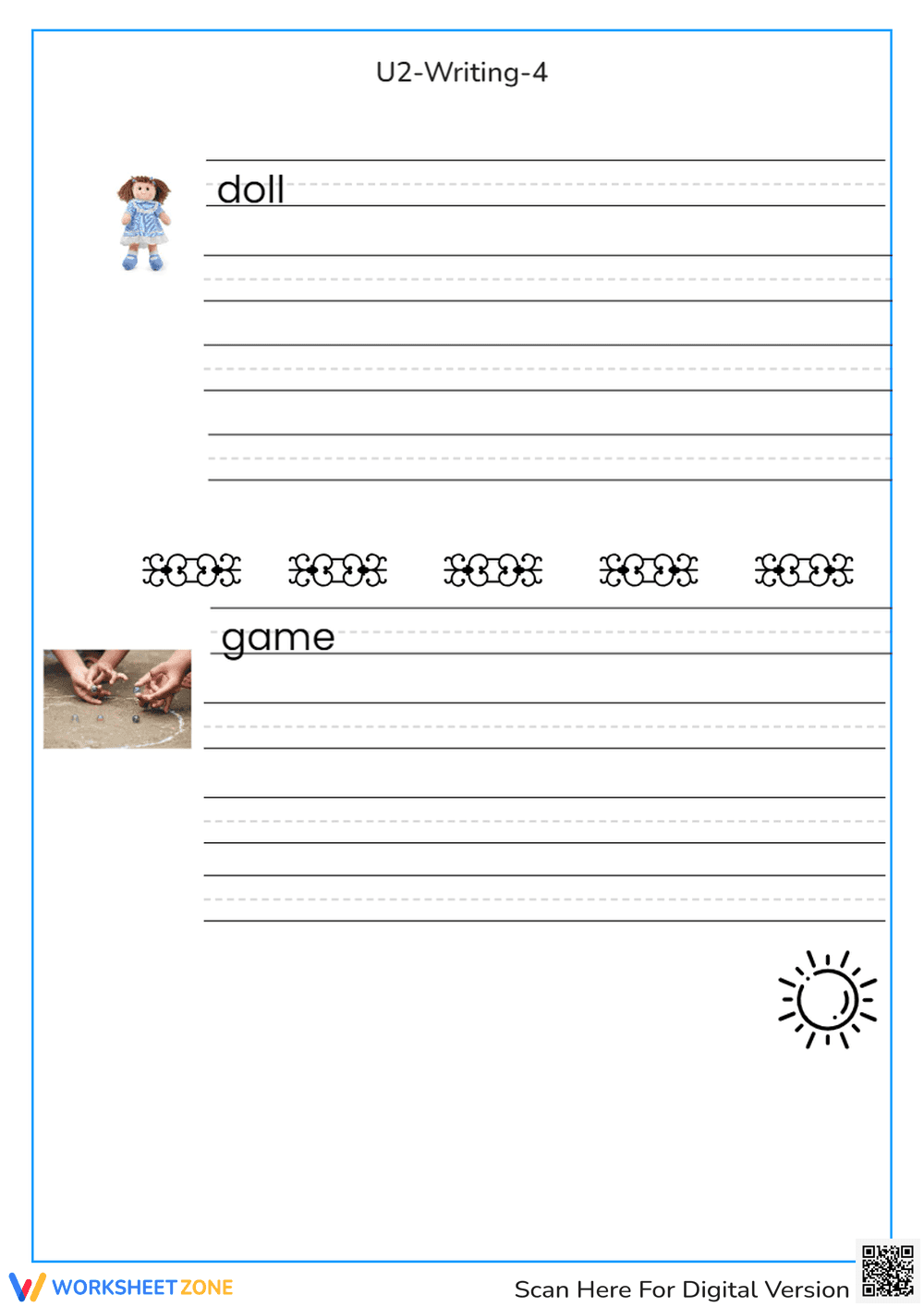
This Kindergarten handwriting worksheet helps young learners master letter formation and word spacing through focused practice on the words doll and game. By combining visual cues with primary-ruled lines, students develop the fine motor control necessary for legible writing. This resource ensures students gain confidence in their ability to translate spoken words into written form.
At a Glance
- Grade: Kindergarten · Subject: Handwriting
- Standard:
CCSS.ELA-LITERACY.L.K.1.A— Print many upper- and lowercase letters correctly during daily writing tasks- Skill Focus: Letter formation and word writing
- Format: 1 page · 2 words · Practice lines included · PDF
- Best For: Morning work or literacy centers
- Time: 10–15 minutes
Inside this resource, you will find a single-page layout featuring two distinct sections. Each section includes a high-quality image representing the target word—a doll and a game—to support vocabulary acquisition. Below each image, the word is printed in a clear font, followed by four sets of primary-ruled lines with a dashed midline to guide proper letter height and placement.
The zero-prep workflow is designed for maximum efficiency. First, print the single-page PDF in less than 30 seconds. Second, distribute the sheets to students during your writing block or as they arrive for morning work. Finally, walk the room to provide immediate feedback on pencil grip and stroke order as students complete the 8 lines of practice. This makes it an ideal choice for emergency sub plans.
This worksheet is aligned with CCSS.ELA-LITERACY.L.K.1.A, which requires students to print many upper- and lowercase letters. It also supports the development of fine motor skills essential for later writing fluency. Both standard codes can be copied directly into lesson plans, IEP goals, or district curriculum mapping tools to ensure compliance with state and national frameworks.
Use this worksheet as a formative assessment tool during the first half of the school year. Observe students as they write to identify those struggling with specific letter reversals. It also serves as an excellent quiet-time activity for students who finish their primary literacy tasks early, providing meaningful reinforcement of foundational writing skills in a 15-minute window.
This resource is ideal for Kindergarten students, English Language Learners needing visual support, and students receiving occupational therapy for fine motor delays. It pairs naturally with letter-sound anchor charts or a direct instruction lesson on the letters D and G. The simple layout prevents cognitive overload for emerging writers.
According to the RAND AIRS 2024 report, consistent and repetitive handwriting practice in early childhood is a significant predictor of later reading and writing success. This worksheet provides the structured environment necessary for students to internalize the mechanics of writing without the cognitive load of complex sentence construction. By focusing on high-frequency nouns like doll and game, the resource allows students to concentrate entirely on the physical act of printing. Research indicates that the tactile experience of forming letters on paper strengthens neural pathways associated with literacy. This specific tool addresses the need for high-quality, low-barrier practice materials that can be integrated into any classroom routine. The inclusion of primary-ruled lines ensures that students develop an early understanding of spatial awareness and letter proportions, which are critical components of the CCSS.ELA-LITERACY.L.K.1.A standard.


